
Politics
Some California incumbents lagging in fundraising: report
At vero eos et accusamus et iusto odio dignissimos ducimus qui blanditiis praesentium voluptatum deleniti atque corrupti.






Politics
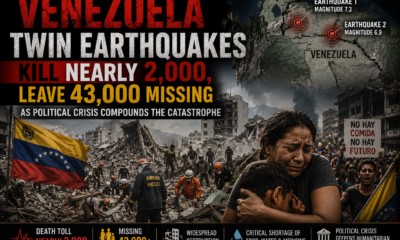
Venezuela Twin Earthquakes Kill Nearly 2,000, Leave 43,000 Missing as Political Crisis Compounds the Catastrophe
A pair of powerful earthquakes has plunged Venezuela into crisis, with massive casualties, extensive infrastructure damage, and rescue efforts unfolding amid political instability.
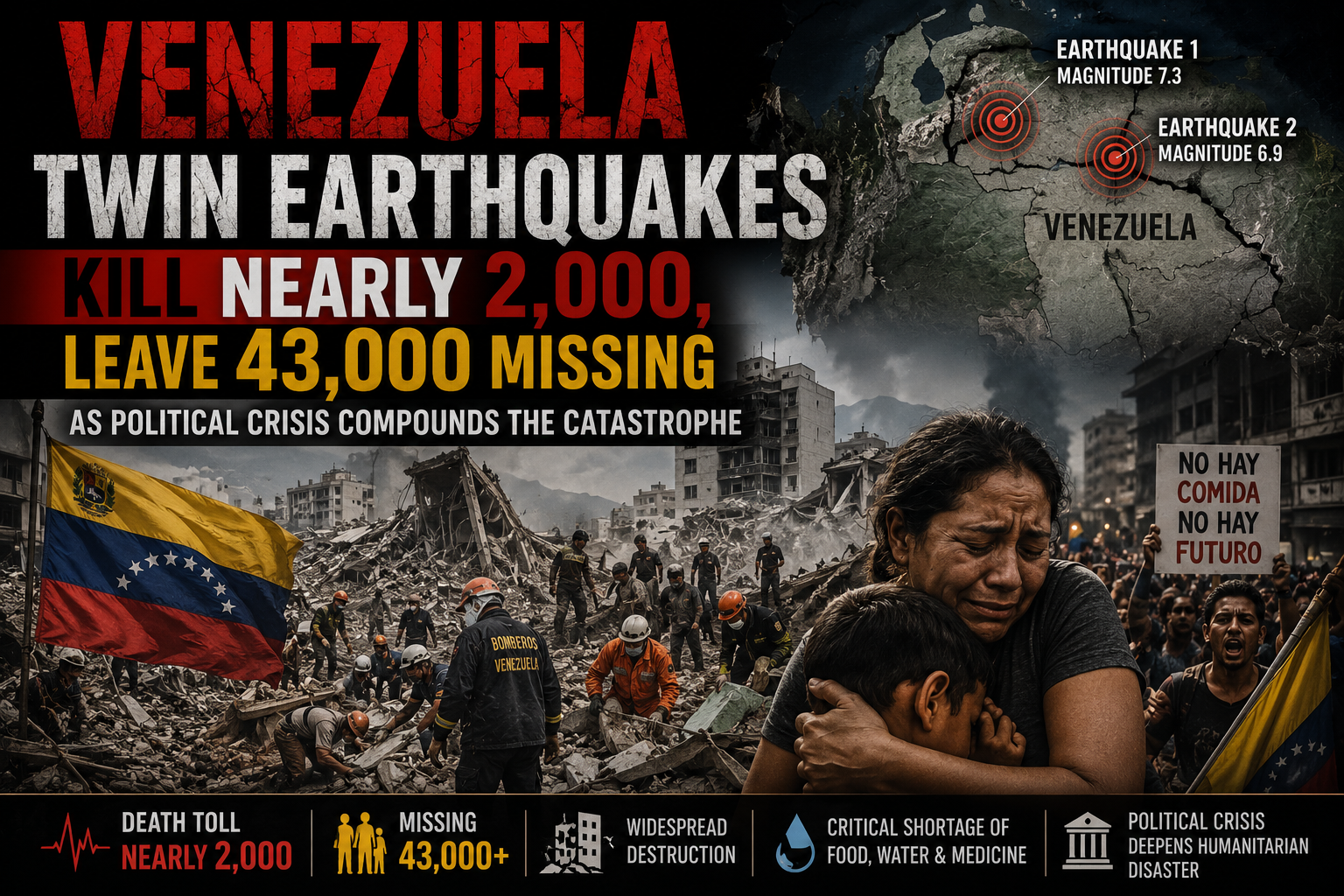
Venezuela is facing one of the worst natural disasters in its modern history after two massive earthquakes struck the country’s northern coast within 39 seconds of each other on June 24, 2026, killing nearly 2,000 people, injuring more than 10,500, and leaving over 43,200 people reported missing. The disaster has compounded an already fragile political and humanitarian situation in a country that has been in turmoil since the removal of Nicolás Maduro earlier this year.
The Earthquakes: Scale and Sequence
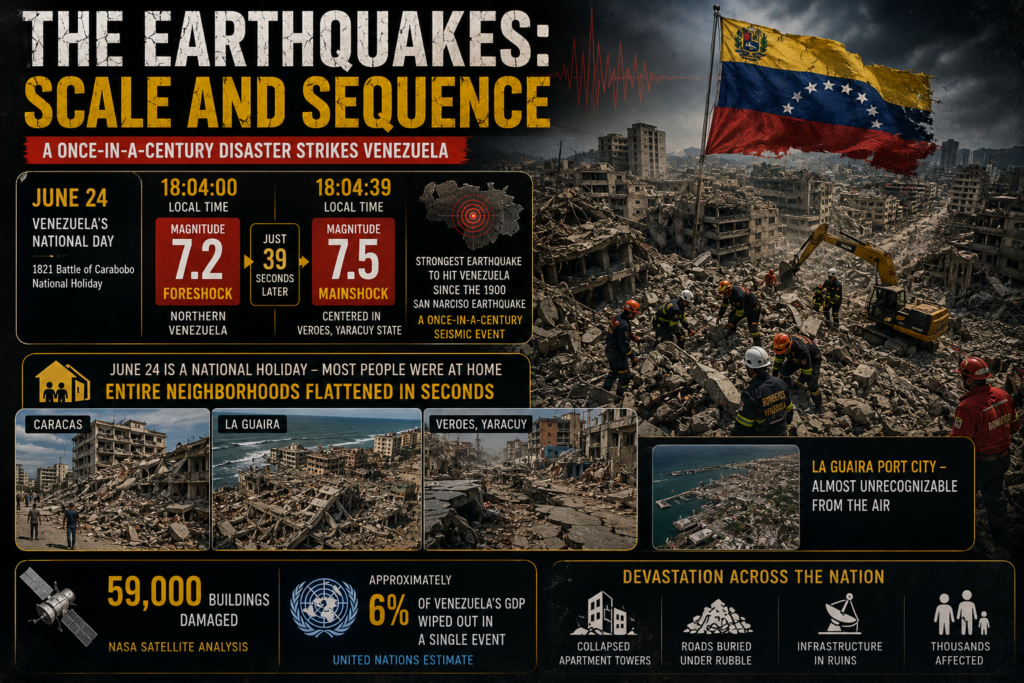
The catastrophe began at 18:04 local time on June 24 — Venezuela’s National Day, commemorating the 1821 Battle of Carabobo — when a magnitude 7.2 foreshock struck northern Venezuela. Just 39 seconds later, a magnitude 7.5 mainshock followed, centered in Veroes, a municipality in Yaracuy state. The mainshock is the strongest earthquake to hit Venezuela since the 1900 San Narciso earthquake, making it a once-in-a-century seismic event.
The timing proved particularly devastating: because June 24 is a national holiday, most Venezuelans were at home rather than at work or school when the ground began to shake — concentrating the population inside residential buildings at exactly the moment those structures collapsed. Entire neighborhoods across Caracas and the northern coastal state of La Guaira were flattened within seconds. Images from the scene showed collapsed apartment towers, roads buried under rubble, and the port city of La Guaira — a densely populated coastal area — almost unrecognizable from the air.
<cite index=”20-1″>NASA satellite analysis subsequently estimated that approximately 59,000 buildings were damaged by the twin quakes</cite>, while the United Nations estimated the disaster had wiped approximately 6% of Venezuela’s GDP in a single event.
Death Toll: Still Rising, Potentially Catastrophic
The confirmed death toll has risen sharply with each passing day. <cite index=”19-1″>Venezuela’s Health Minister Carlos Alvarado reported at least 235 dead and 4,300 injured in the immediate aftermath</cite>, but those numbers quickly climbed. <cite index=”22-1″>By Friday, National Assembly President Jorge Rodríguez reported the death toll had climbed to 920, with 3,360 injured, and hundreds of homes seriously damaged or totally destroyed.</cite>
As of the most recent official figures, <cite index=”20-1″>over 1,943 people have been confirmed killed, over 10,500 injured, and over 43,200 reported missing.</cite> However, the true scale of the disaster may be far larger. <cite index=”19-1″>The US Geological Survey’s PAGER system estimated the death toll could reach thousands and possibly exceed 10,000,</cite> while Wikipedia’s compilation of PAGER data indicates a 44% probability of 10,000 to 100,000 deaths for the mainshock alone — a sobering reminder that confirmed numbers represent only what rescue teams have been able to reach so far.
On the Ground: Overwhelmed Rescuers, Desperate Survivors
<cite index=”19-1″>Survivors described the shock as “like a horror movie,” with people wondering how they would escape collapsed apartment buildings.</cite> With emergency resources stretched thin, <cite index=”22-1″>volunteers arrived at disaster sites carrying their own shovels, hammers, and basic tools to assist rescue efforts.</cite> One volunteer, Sebastian Arias, described moving between neighborhoods where buildings had collapsed, noting that some sites were overcrowded with helpers while others appeared to lack equipment entirely.
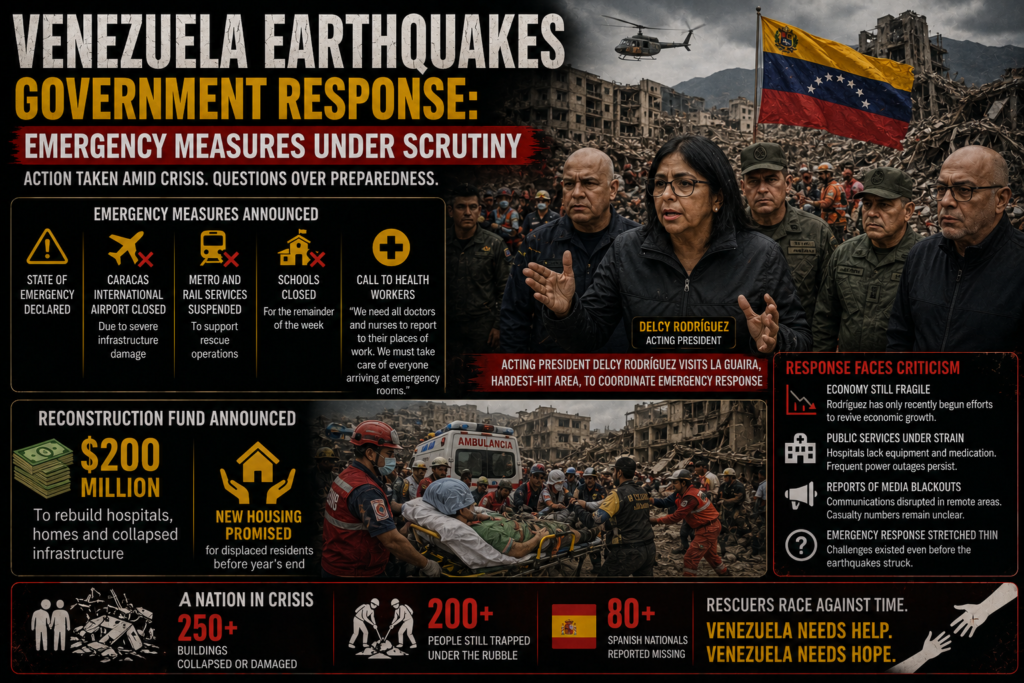
<cite index=”19-1″>At least 200 people remained trapped under the rubble of some 250 collapsed or damaged buildings</cite> days after the initial strikes, with rescuers racing against time. Among the missing internationally: <cite index=”21-1″>at least 80 Spanish nationals were reported missing by Spain’s Ministry of Foreign Affairs.</cite>
The Government Response: Emergency Measures Under Scrutiny
<cite index=”21-1″>Acting President Delcy Rodríguez visited La Guaira — the hardest-hit area — and led a meeting with officials including Interior Minister Diosdado Cabello, National Assembly President Jorge Rodríguez, and military commanders to coordinate the emergency response.</cite>
<cite index=”19-1″>Rodríguez declared a state of emergency, announced the closure of Caracas’ international airport due to severe infrastructure damage, and suspended metro and rail services to support rescue operations.</cite> Schools were shut for the remainder of the week. <cite index=”22-1″>She also urged all doctors and nurses to report for duty as hospitals struggled with rapidly rising casualties, saying: “We need all doctors and nurses to report to their places of work. We must take care of everyone who is arriving at emergency rooms.”</cite>
A $200 million reconstruction fund was established to cover damage to hospitals, houses, and collapsed infrastructure, and Rodríguez subsequently promised new housing for displaced residents before year’s end.
However, the government’s response has faced significant criticism. <cite index=”22-1″>Rodríguez has only recently begun efforts to revive economic growth, with public services already buckling under strain, hospitals short of equipment and medication, and frequent power outages — all of which left the emergency response stretched thin even before the earthquakes struck.</cite> Reports also suggested possible media blackouts in some areas, with casualty numbers from more remote regions remaining scarce due to disrupted communications.
International Response: US Leads Aid Push
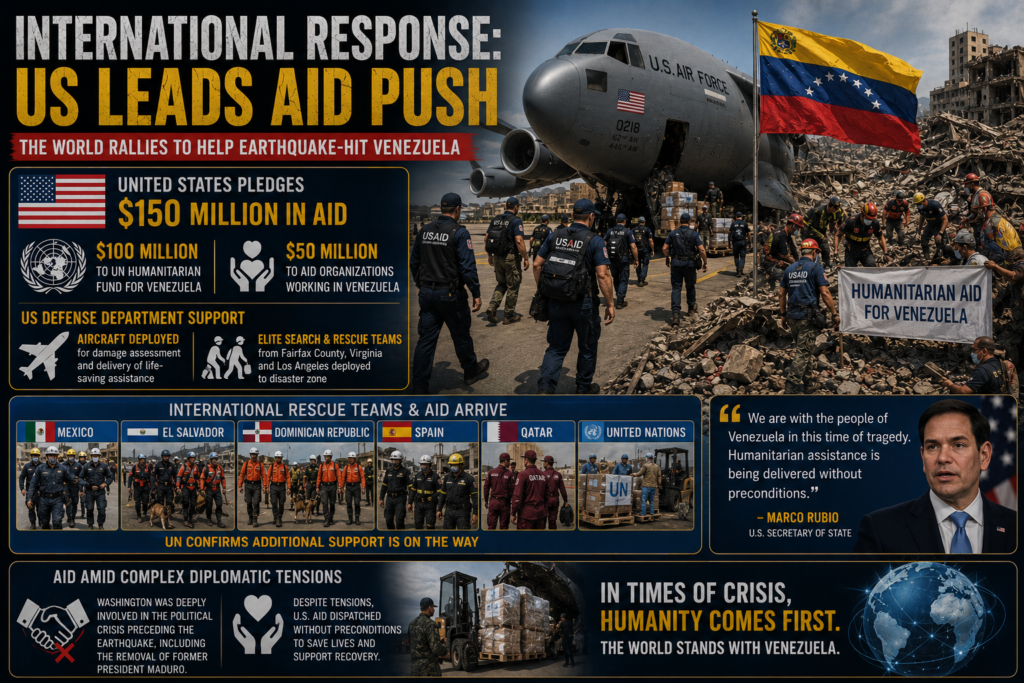
<cite index=”21-1″>The United States pledged $150 million in aid — a $100 million contribution to a UN humanitarian fund for Venezuela and $50 million to aid organizations already working in the country.</cite> The US Defense Department also committed aircraft for damage assessment and the delivery of life-saving assistance, with Secretary of State Marco Rubio confirming the deployment of elite search and rescue teams from Fairfax County, Virginia, and Los Angeles.
<cite index=”20-1″>By June 26, rescue convoys from Mexico, El Salvador, and the Dominican Republic had arrived in Venezuela.</cite> Rescue specialists from Spain and Qatar also traveled to the disaster zone, while the United Nations confirmed it was on its way with additional support.
The US aid pledge is notable given the fraught diplomatic backdrop: Washington had been deeply involved in the political crisis preceding the earthquake, including the removal of former President Maduro. Despite the tensions, US aid was dispatched without preconditions, though observers noted that every decision the acting government makes is now filtered through the lens of its contested legitimacy.
The Impossible Political Context
The earthquake has struck at the worst possible moment politically. <cite index=”21-1″>The disaster comes at a dire time for Venezuela, which was already in a deep political and financial crisis</cite> before the first tremor was felt. Delcy Rodríguez has been serving as acting president following the US capture and removal of Nicolás Maduro earlier in 2026 — a move that left her government’s authority deeply contested both domestically and internationally.
Every government action in the disaster response — the deployment of military personnel, the allocation of reconstruction funds, the management of international aid, and even the access granted to foreign rescue teams — is being observed through a lens of deep political suspicion by a population that has endured years of authoritarian governance, economic collapse, and a humanitarian crisis that predates the earthquake by nearly a decade.
<cite index=”19-1″>National Assembly President Jorge Rodríguez called for unity in a televised address, urging citizens to “set aside any form of diatribe, stance or opinion that divides us, and become a single force, a single voice, a single person and a sea of helping hands.”</cite> Whether that call for solidarity can cut through Venezuela’s deeply polarized political landscape — at the precise moment the country faces its worst natural disaster in more than a century — remains the defining question of the weeks ahead.
Politics
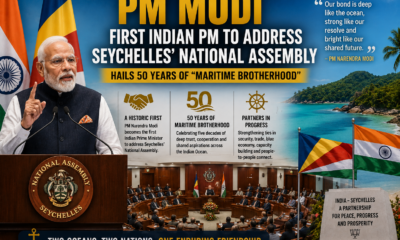
PM Modi Becomes First Indian PM to Address Seychelles’ National Assembly, Hails 50 Years of “Maritime Brotherhood”
Narendra Modi’s historic address to Seychelles’ National Assembly underscored the growing strategic partnership between India and Seychelles while marking 50 years of diplomatic and maritime cooperation.
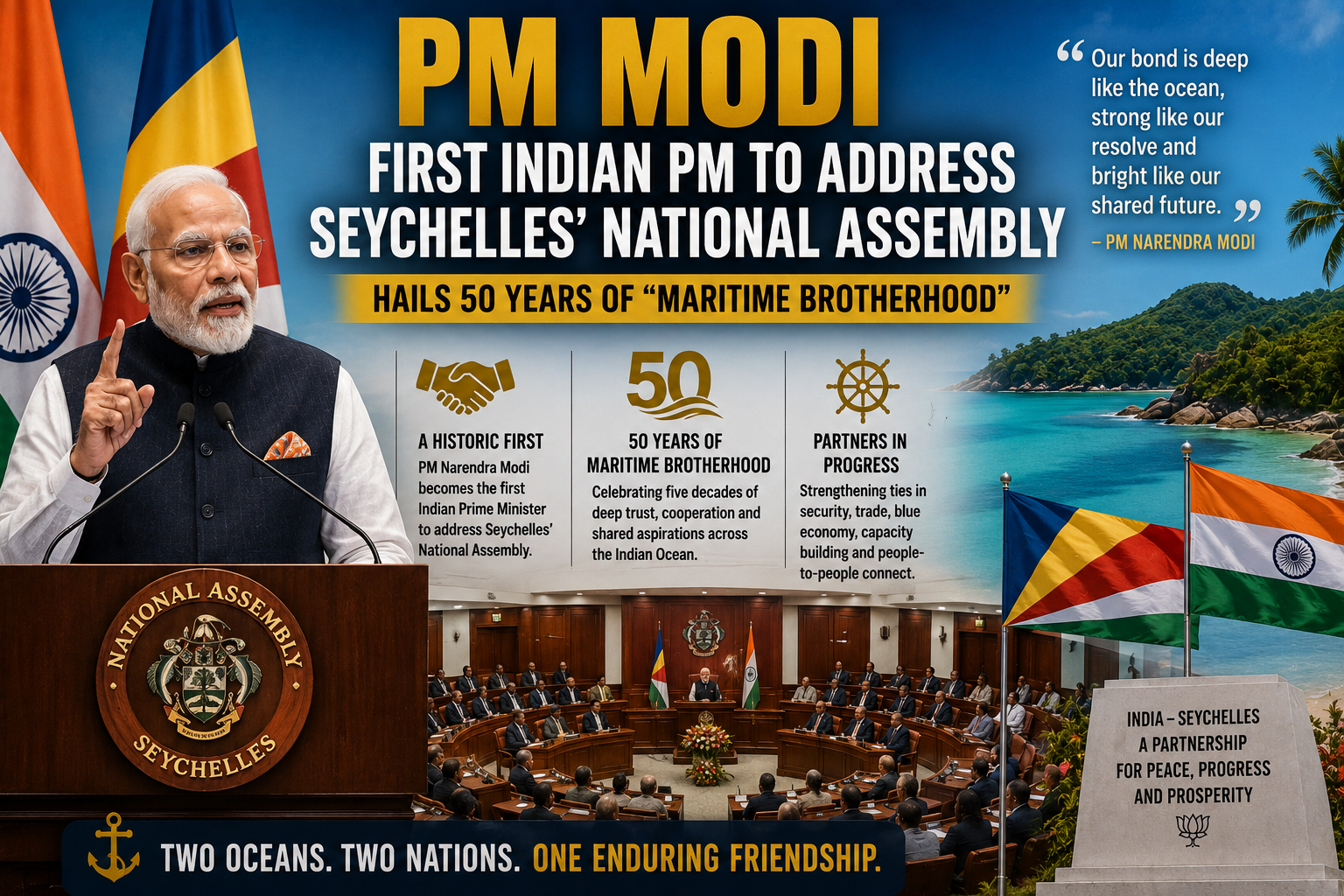
Prime Minister Narendra Modi has become the first Indian Prime Minister in history to formally address the National Assembly of Seychelles, marking a historic high point in a three-day state visit to the island nation that coincided with the Golden Jubilee celebrations of its independence.
The Visit: Three Days, One Historic Address
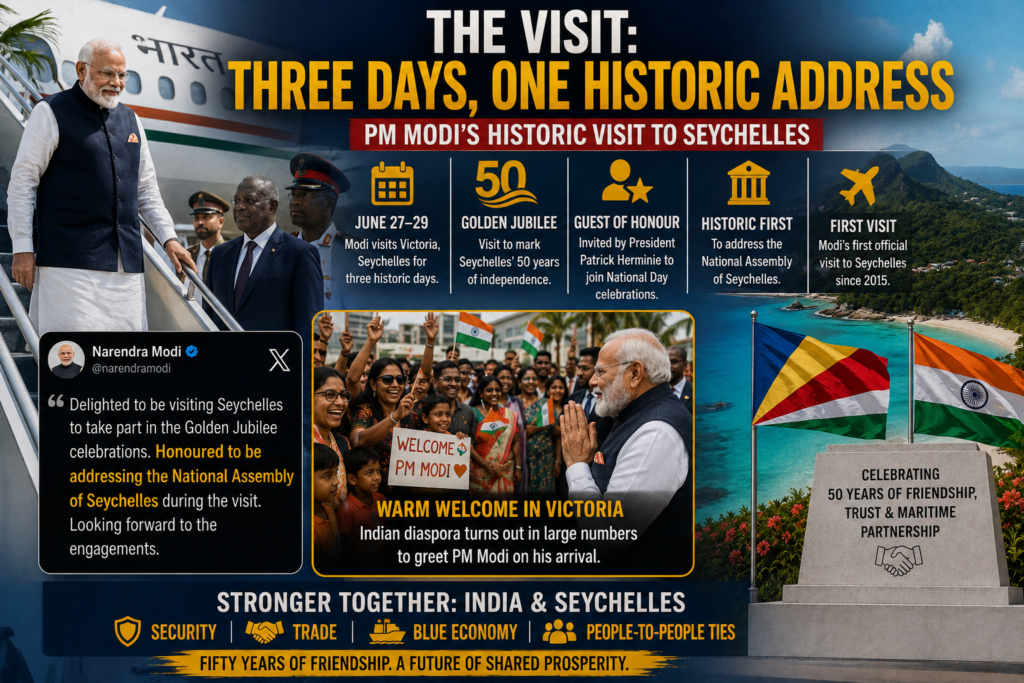
Modi traveled to Victoria, Seychelles from June 27 to June 29 at the invitation of President Patrick Herminie, primarily to participate in Seychelles’ Golden Jubilee National Day celebrations as the Guest of Honour — commemorating 50 years since Seychelles gained independence from the United Kingdom in 1976. The trip marked Modi’s first official visit to the archipelago since 2015.
Ahead of his departure, Modi shared his excitement on social media platform X, writing that the timing was especially special because of the Golden Jubilee milestone, and that he was “honoured to be addressing the National Assembly of Seychelles during the visit.” Upon landing in Victoria, he received a warm welcome, with members of the Indian diaspora gathering enthusiastically to greet him ahead of a packed schedule of bilateral engagements.
Inside the Historic National Assembly Address
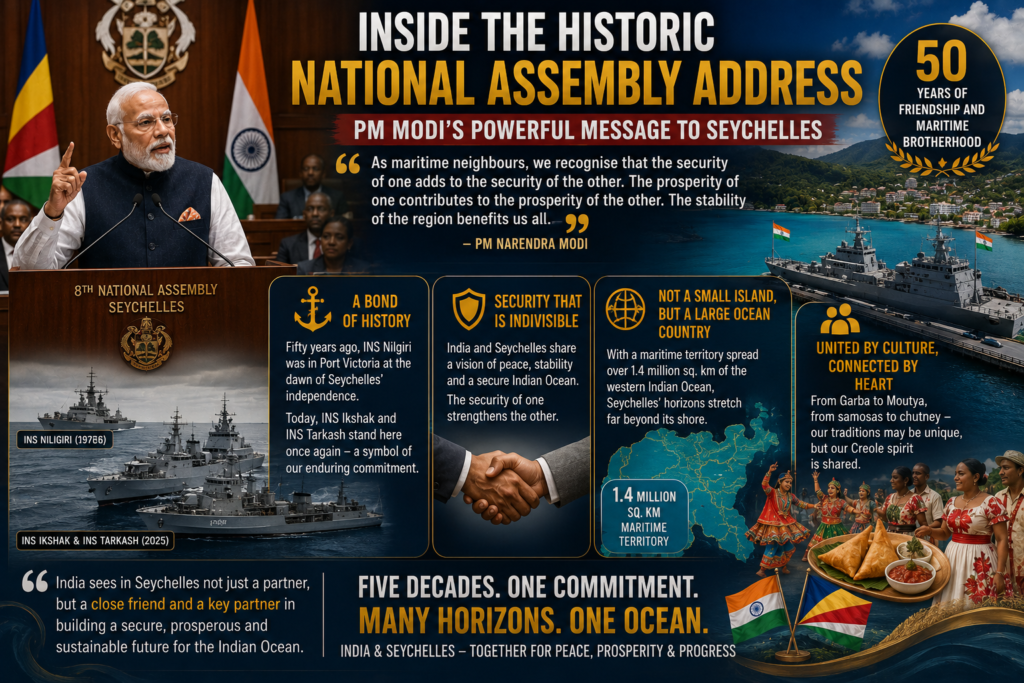
Addressing Seychelles’ 8th National Assembly, Modi centered his speech on the deep historical and security ties binding the two nations, describing regional security as fundamentally “indivisible.” He told lawmakers: “As maritime neighbours, we recognise that the security of one adds to the security of the other. The prosperity of one contributes to the prosperity of the other. The stability of the region benefits us all.”
Modi drew a powerful historical parallel to underscore the longevity of India’s commitment to Seychelles’ sovereignty, recalling that the Indian Naval Ship INS Nilgiri had been present in Port Victoria fifty years ago, at the dawn of Seychelles’ independence, as a mark of friendship and solidarity. He noted that on this Golden Jubilee occasion, two more Indian Navy vessels — INS Ikshak and INS Tarkash — were once again docked at Port Victoria, symbolizing that India’s commitment had endured across five decades.
The Prime Minister also pushed back against any tendency to view Seychelles purely through the lens of its small physical size, telling the Assembly that while people looking at a map might see only “a group of islands in the Indian Ocean,” India sees “a nation whose horizons stretch far beyond its shore.” Pointing to the country’s maritime territory, which spans approximately 1.4 million square kilometres of the western Indian Ocean, Modi described Seychelles as “not a small island State but a large ocean country.”
In a notable cultural touch reflecting the deep people-to-people ties between the two nations, Modi’s remarks also referenced shared cultural threads — invoking Indian traditions like Garba alongside Seychellois Creole traditions like Moutya, and comparing favorite foods like samosas with local chutney — to highlight what he described as a shared “Creole spirit” connecting the two Indian Ocean democracies.
The Strategic Backdrop: Vision MAHASAGAR
The visit holds significance well beyond ceremony. Modi described Seychelles as a “valued maritime neighbour and a key partner” in India’s Vision MAHASAGAR initiative, as well as in advancing the interests of the Global South. Seychelles’ position in the western Indian Ocean makes it a key partner in India’s broader strategic outlook for maritime security, capacity building, and hydrography across the region — cooperation Modi characterized not merely as policy, but as a reflection of shared commitment to a safer and more secure Indian Ocean Region.
That defence and maritime partnership was visibly underscored during the celebrations themselves, with a contingent of Indian Armed Forces personnel and two Indian Navy ships participating directly in the Golden Jubilee National Day events alongside Seychelles’ own forces.
Golden Jubilee Context: 50 Years of Bilateral Ties
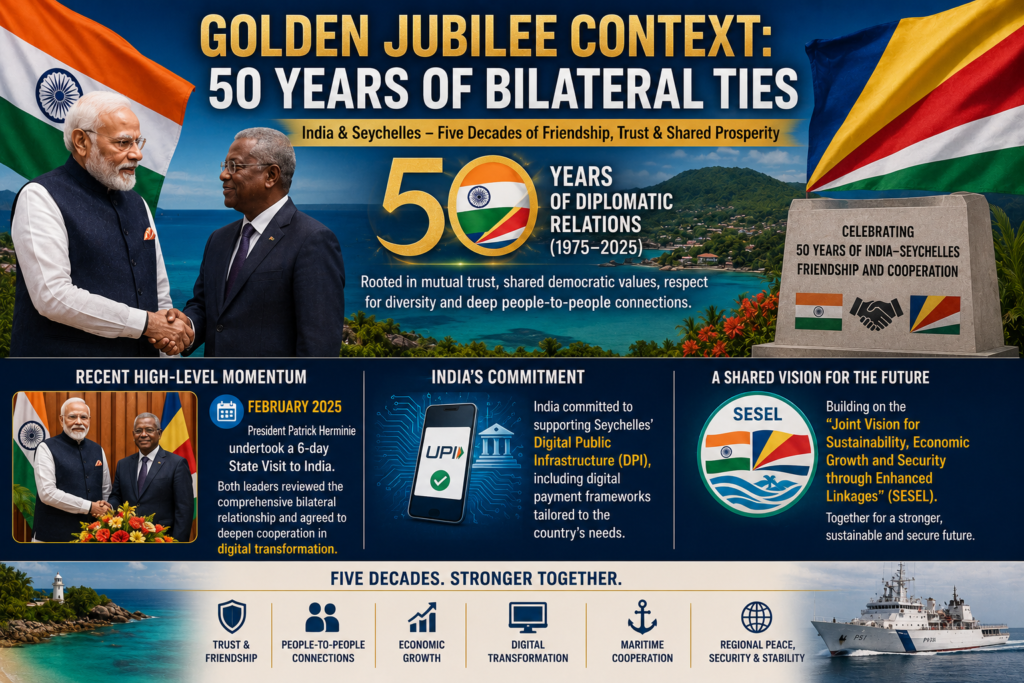
This year’s visit carries special weight because it coincides with the 50th anniversary of the establishment of diplomatic relations between India and Seychelles — a relationship officials describe as rooted in mutual trust, shared democratic values, respect for diversity, and deep people-to-people connections.
The visit also builds on recent high-level diplomatic momentum: it follows a six-day state visit to India by President Herminie back in February, during which the two leaders reviewed their comprehensive bilateral relationship and agreed to deepen cooperation specifically in digital transformation. India committed during that visit to supporting the development of Digital Public Infrastructure (DPI) in Seychelles, including digital payment frameworks tailored to the country’s needs — part of a broader bilateral framework the two countries have adopted called the “Joint Vision for Sustainability, Economic Growth and Security through Enhanced Linkages” (SESEL).
Why This Visit Matters
Beyond the historic “first” of an Indian PM addressing Seychelles’ National Assembly, the visit reinforces India’s broader Indian Ocean strategy at a moment when maritime security and influence across the region remain a key geopolitical priority. By pairing a high-profile diplomatic milestone with tangible defence cooperation — Navy ship deployments, joint participation in national celebrations, and continued digital infrastructure partnerships — the visit signals India’s intent to deepen, rather than simply commemorate, its 50-year relationship with one of the Indian Ocean’s most strategically positioned island nations.
Politics
Trisha’s Delayed Birthday Post for Tamil Nadu CM Vijay Sparks Viral Political and Social Media Storm
Trisha’s belated birthday post for Chief Minister Vijay has ignited a wave of online reactions, with fans and political observers debating the timing and significance of the message.
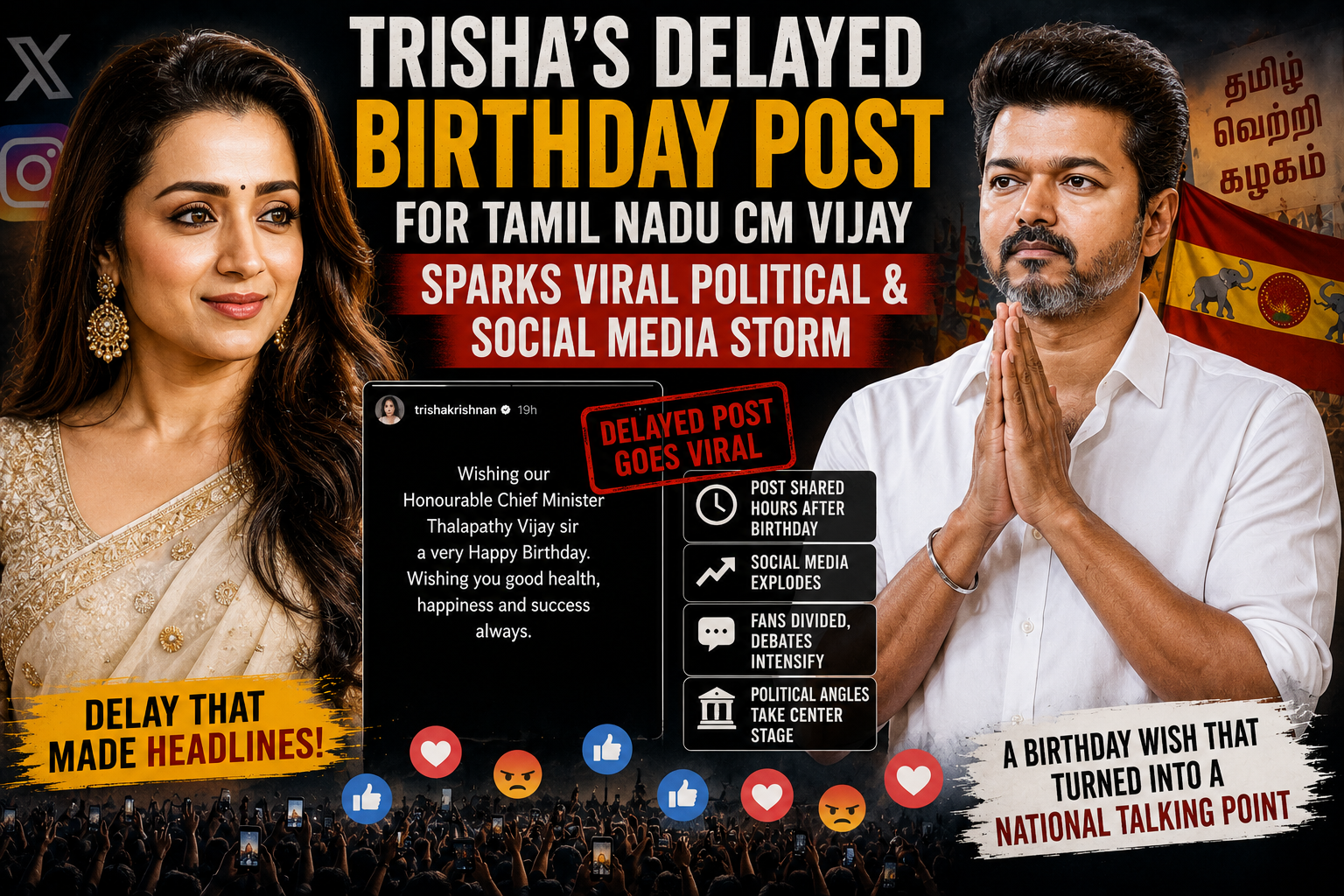
A birthday greeting is rarely political news — unless it involves a sitting Chief Minister and one of Tamil cinema’s biggest stars. That’s exactly what happened this week, as a delayed birthday post from actor Trisha Krishnan for Tamil Nadu Chief Minister Vijay (Joseph Vijay, popularly known as Thalapathy Vijay) spiraled into one of the most talked-about social media storms in recent Tamil Nadu political discourse.
How It Started: A Birthday With No Wish — At First
Vijay turned 52 on June 22, and as expected for a sitting Chief Minister, the day brought a flood of greetings from fans, fellow celebrities, and political leaders across Tamil Nadu. But one notable name was missing from the early wishes: Trisha Krishnan, despite having posted birthday greetings for Vijay in previous years.
The silence didn’t go unnoticed. Fans quickly began comparing her conspicuous absence to her past social media activity, and speculation accelerated further after reports circulated that Trisha had unfollowed Vijay’s official Instagram account, fueling fresh rumors that the two had had a falling-out. The timing added extra weight to the chatter: Vijay had just delivered what many described as a powerful, widely praised speech against the opposition DMK in the Assembly that same day — a political high point that, according to some reports, briefly became overshadowed once the Trisha speculation took hold online.

The Midnight Post That Reignited Everything
Just after midnight on June 23, Trisha finally shared a photograph that appeared to be from a private birthday celebration, captioned: “To the person who makes it all worth it.” The post’s 00:00 timestamp gave it the feel of a deliberately timed, intimate birthday tribute.
Rather than settling the speculation, the post intensified it. Several social media users questioned the photograph’s authenticity, with some alleging it was AI-generated and others claiming it was an older image being recirculated. Within hours, the internet was flooded with memes, AI-edited versions of the photo, and fan-made content speculating about the nature of the relationship between the two — turning what began as a birthday tribute into a much larger, more contentious online conversation.
A Long History of Public Speculation
This isn’t the first time Trisha and Vijay’s association has drawn public attention. The two have a long professional history in Tamil cinema, but speculation about a personal relationship gained renewed momentum in 2023, when Trisha shared a photo with Vijay from the commencement event of his film Leo — marking their first major public appearance together in nearly 15 years since their last on-screen collaboration in Kuruvi.
The two were also seen traveling together to Goa in December 2024 for actor Keerthy Suresh’s wedding, an appearance that drew significant attention from fans and online observers at the time. Trisha was also present at Vijay’s swearing-in ceremony as Chief Minister at Jawaharlal Nehru Indoor Stadium on May 10, 2026, attending with her mother among the gathered guests.

Where the Story Turns Political
The speculation crossed firmly into political territory earlier this year, when Tamil Nadu BJP chief Nainar Nagendran made remarks involving Trisha while commenting publicly on Vijay’s political career. Trisha responded through legal channels, formally objecting to what she described as inappropriate remarks.
The controversy deepened further after reports emerged that Vijay’s wife, Sangeetha Sornalingam, had filed a divorce petition, which reportedly stated that the marriage had broken down and that the couple had been separated since 2021. The petition also reportedly referred to allegations involving a frequent co-star, without publicly naming any individual. Those ongoing legal proceedings, combined with Vijay and Trisha’s continued public appearances together, have kept the speculation alive well beyond a single viral post.
No Official Word From Either Side
As of now, neither Vijay nor Trisha has publicly addressed the speculation surrounding their relationship. It’s worth noting that much of what has driven this story — the nature of their personal relationship, the reasons behind any social media activity, and the interpretation of specific posts — remains rooted in fan speculation and online interpretation rather than any confirmed statement from either party.

Why This Story Has Such Reach
The episode underscores how thoroughly Vijay’s transition from one of Tamil cinema’s most popular actors to the state’s Chief Minister has blurred the line between entertainment coverage and political commentary in Tamil Nadu. A single social media post — its timing, its caption, even its timestamp — was enough to generate days of viral debate, memes, and commentary that touched on cinema fandom, marital and family matters, and active political dynamics between the ruling TVK-led government and opposition parties, all at once.
With Vijay now navigating the demands of governing as Chief Minister while his personal life remains under intense public scrutiny, and with Trisha continuing to face public attention regardless of how she responds — or doesn’t — to it, this is a story likely to resurface with each new public appearance or social media post from either figure.


Venezuela Twin Earthquakes Kill Nearly 2,000, Leave 43,000 Missing as Political Crisis Compounds the Catastrophe

PM Modi Becomes First Indian PM to Address Seychelles’ National Assembly, Hails 50 Years of “Maritime Brotherhood”

Trisha’s Delayed Birthday Post for Tamil Nadu CM Vijay Sparks Viral Political and Social Media Storm

Generation Z Is Killing Fast Fashion in India — And Building Something Far More Beautiful in Its Place

AR Rahman reacts to “anti-national” row over Imtiaz Ali’s Main Vaapas Aaunga

