
Fashion
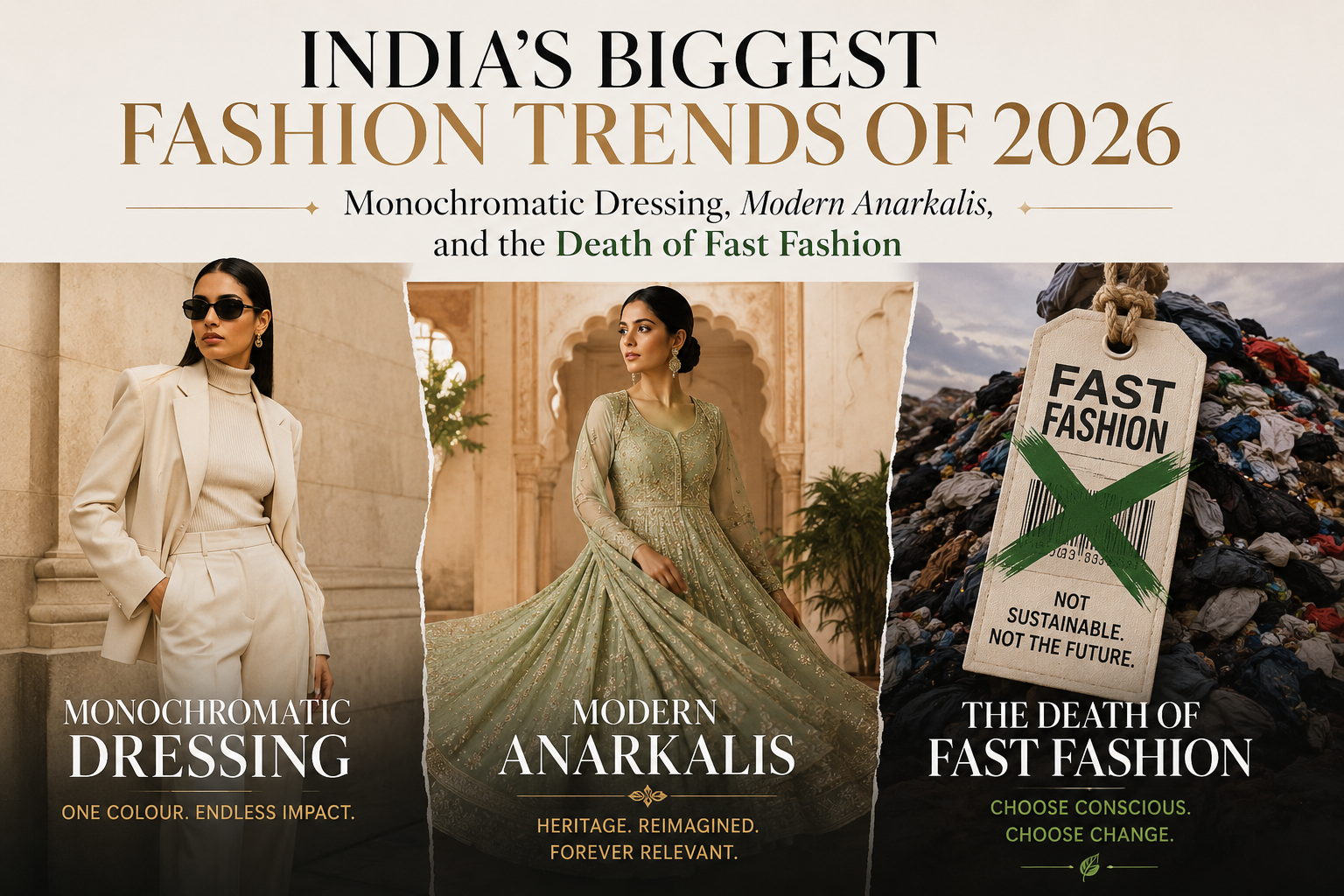
India’s Biggest Fashion Trends of 2026: Monochromatic Dressing, Modern Anarkalis, and the Death of Fast Fashion
Indian fashion in 2026 is the most exciting it has been in a decade. The lines between traditional and contemporary are dissolving, new designers are challenging the old guard, and women across India are dressing with more intention and far less obligation. Here is what is defining Indian style this year and why it matters beyond the wardrobe. GIN Fashion Desk | May 8, 2026 | Fashion · Style · Lifestyle The biggest trend of 2026 is monochromatic Indian dressing. One colour, multiple textures. A deep blue kurta paired with a slightly different blue palazzo, or a rose pink saree with a tonal pink blouse. The effect is effortlessly sophisticated — a look that appears curated without trying too hard. The principle is simple: tonal dressing creates a long, unbroken visual line that elongates the body and signals quiet confidence. It works for office, festive occasions, and everything in between. White — once considered taboo at Indian celebrations — is officially having its moment. Ivory kurta sets, champagne sarees, and off-white anarkalis with heavy gold embroidery are everywhere in 2026. At weddings, at festivals, and increasingly as bridal wear itself. The old rules about white being inauspicious have been set aside by a generation of Indian women who have decided that elegance has no colour restrictions. The anarkali, written off as “too traditional” just a few years ago, has made a triumphant return — but reimagined. Modern anarkalis in 2026 feature cleaner lines, reduced volume, and contemporary embroidery. They are being worn to cocktail parties and corporate dinners, not just weddings. Designers are offering them in silk with square necklines, in Banarasi Bandhej fabric, and even inspired by Persian tapestry patterns — making the anarkali one of the most versatile garments in the Indian woman’s wardrobe today. Perhaps the most significant philosophical shift of 2026 is the rise of made-to-order fashion. Women are choosing fewer, better-made pieces over fast fashion volume. Made-to-order is no longer reserved for brides — it is for anyone who values craftsmanship, fit, and longevity. A made-to-order garment is crafted to your measurements by actual artisans, lasts longer, and supports traditional craft. Designers report a 40 per cent increase in made-to-order requests compared to 2024. Alongside this, the rise of designer cotton — beautifully printed, detailed cotton kurta sets and dresses at accessible price points — is making the designer aesthetic available for everyday wear. Fabrics like chiffon, georgette, organza, and cotton blends dominate the 2026 palette, responding to women who want traditional looks with breathable, comfortable, and practical fabrics. Pre-draped sarees with built-in zippers and hooks continue to surge in popularity, offering the grace of a saree without the time commitment of traditional draping. The colour story of 2026 is bold and unapologetic: fuchsia paired with papaya orange, mustard paired with deep pink, magenta paired with rust. Unexpected combinations that feel electric rather than jarring. Indian fashion has never been timid about colour — and in 2026, it is celebrating that confidence louder than ever.







Fashion
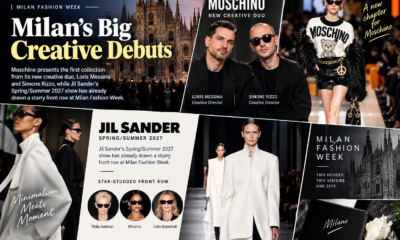
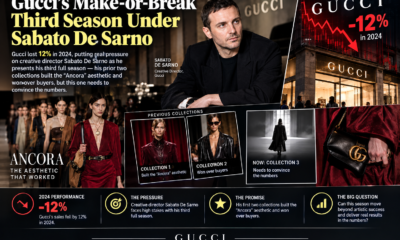
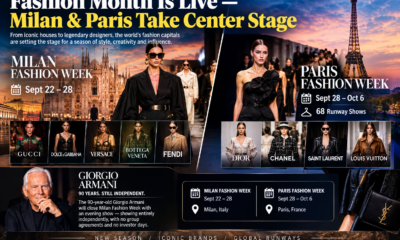
Milan’s Big Creative Debuts
Moschino’s new creative duo and Jil Sander’s Spring/Summer 2027 show are among Milan Fashion Week’s key moments, bringing fresh talent and renewed attention to the city’s fashion scene.

Quick Correction
Jil Sander’s show this season (September 23) is actually Simone Bellotti’s second collection, not a fresh debut — his debut was for Spring/Summer 2026, a year earlier. Moschino is genuinely the only true creative-director debut on this season’s Milan calendar — worth flagging since several outlets specifically note this is an unusually quiet season for brand-new appointments compared to the “15 debuts in one season” chaos of 2025.
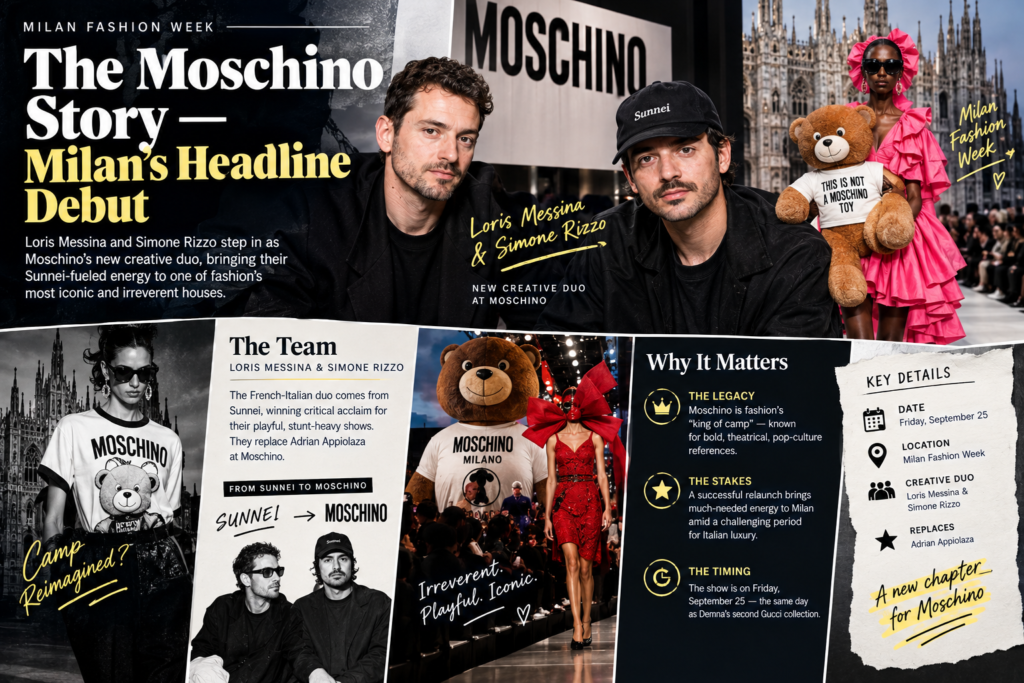
The Moschino Story — Milan’s Headline Debut
Who they are: Loris Messina (French) and Simone Rizzo (Italian) are taking over Moschino together, having built their reputation through their own urban, contemporary label Sunnei, which won them critical acclaim for stunt-heavy, playful shows. They were brought in to replace Adrian Appiolaza earlier this year.
Why it’s the week’s marquee moment: Multiple outlets are calling this one of the main events of the entire season — Moschino is described as fashion’s “king of camp” brand, historically known for irreverent, pop-culture-referencing, boldly theatrical collections (a legacy built by the late Franco Moschino and continued under Jeremy Scott for a decade). The expectation is that Messina and Rizzo will bring their Sunnei-style whimsy and stunt-driven showmanship to that legacy.
The stakes: This debut lands amid a broader industry narrative of “refocusing on craftsmanship” during a genuinely difficult period for Italian luxury — driven by a challenging international climate and the prolonged slowdown of the Chinese market, which has hit the entire sector for months. A successful, buzzy Moschino relaunch would be a meaningful shot of energy for Milan at a moment when the industry badly needs one.
Timing: The show lands on Friday, September 25 — the same day as Demna’s highly anticipated second Gucci collection — meaning it’s genuinely competing for attention with one of the week’s other biggest stories, though front-row and social buzz suggest Moschino is expected to hold its own.
The Broader “New Era” Framing
This season is being covered as part of a generational handover across Milan’s legacy houses. As one outlet put it, Milan is “entering a new era,” with a new generation of creative directors — now in their second or third collections — starting to properly define the identities of these legacy brands, rather than just introducing themselves. Adding to that narrative: Dario Vitale (previously fired from Versace after just one acclaimed collection) was just appointed creative director of Emporio Armani and Giorgio Armani accessories — though his own debut won’t be seen until early next year either, keeping the “wait for it” tension going even for him.
What Else Is Landing Around Moschino This Week
For context on the surrounding energy:
- Meryll Rogge’s second Marni collection (her debut last season was widely praised as “a stunner”)
- Maria Grazia Chiuri’s second Fendi collection
- Demna’s second Gucci collection — arguably still the single most-watched show of the week
- The Attico marking its 10th anniversary with a major evening runway slot, as founders Gilda Ambrosio and Giorgia Tordini celebrate a decade of the brand
Fashion
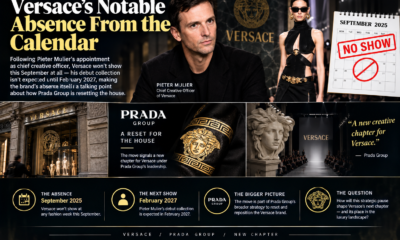
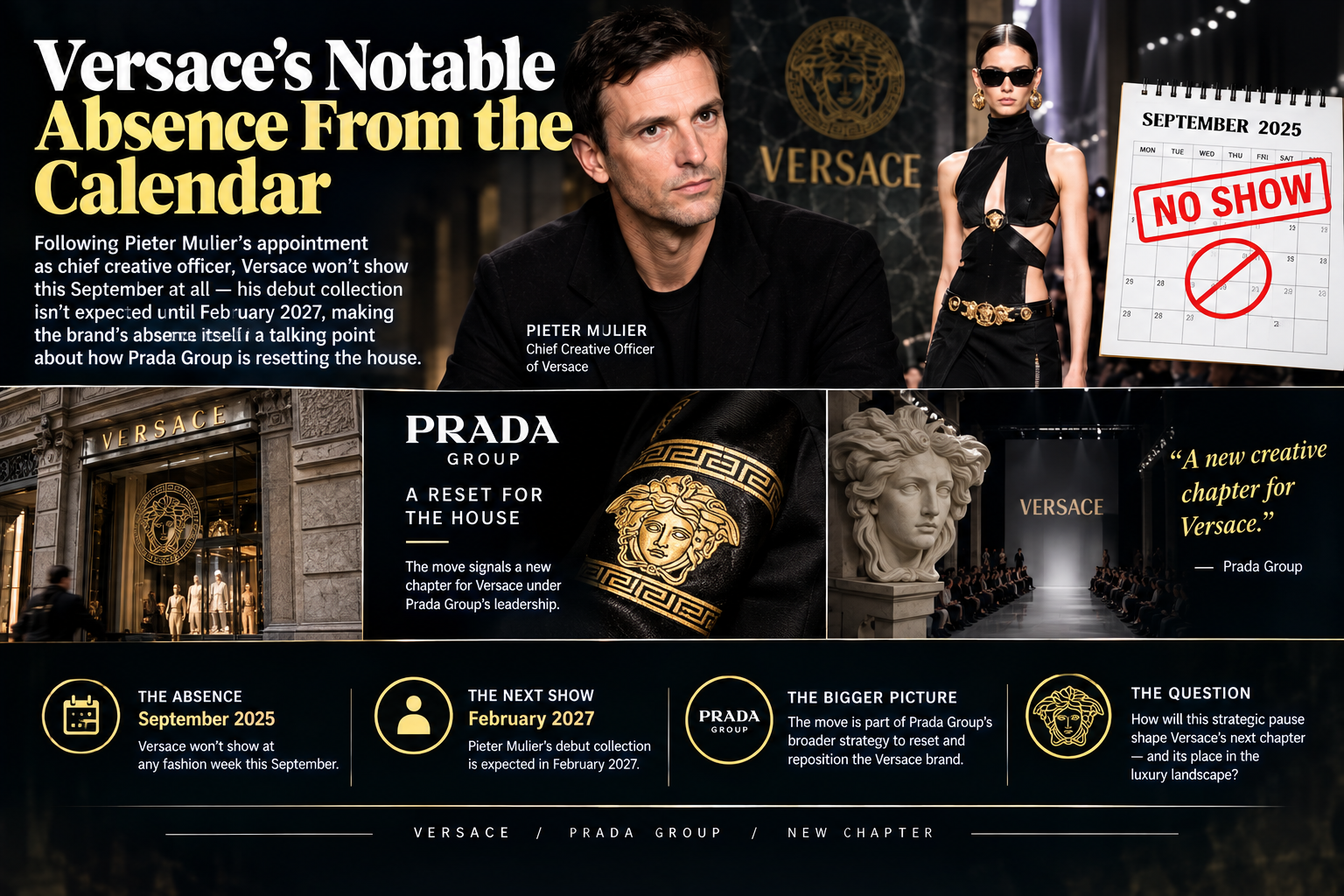
Versace’s Notable Absence From the CalendarFollowing Pieter Mulier
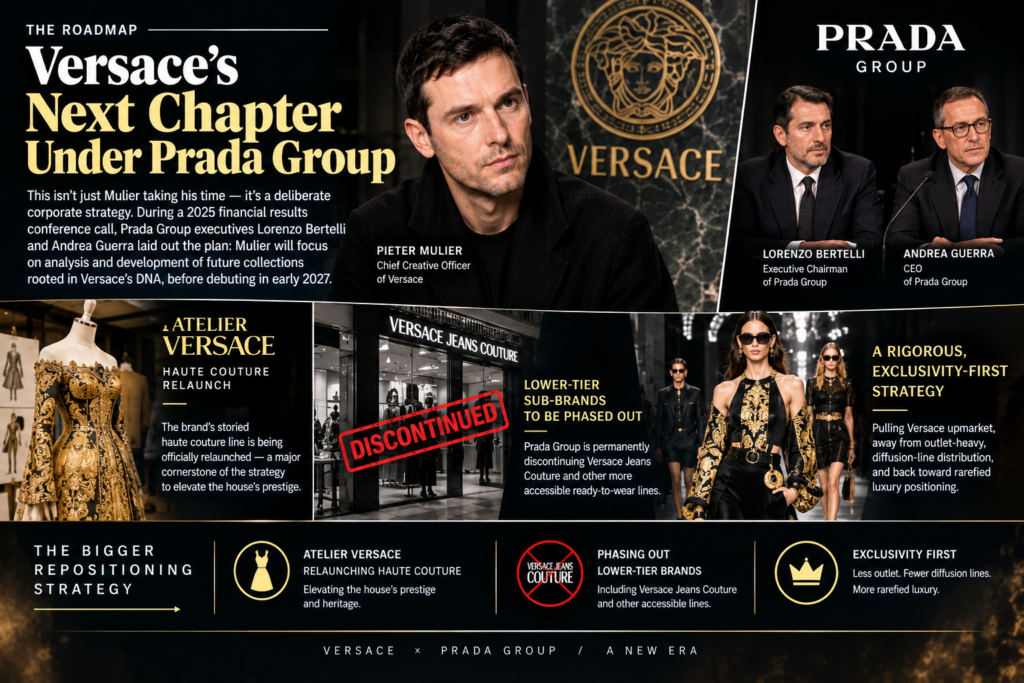
Versace’s runway absence reflects Prada Group’s broader repositioning strategy, with Pieter Mulier focusing on developing future collections while the house moves toward greater exclusivity, heritage and luxury positioning.
The Timeline of Chaos That Led Here
This is worth recapping in full, since it explains why the “absence” is so notable:
- Donatella Versace stepped down as creative director in March 2025 after 27 years, transitioning to a brand ambassador role. Dario Vitale (formerly of Miu Miu) was named her successor.
- Vitale’s sole collection was shown September 26, 2025 at the Pinacoteca Ambrosiana in Milan — and it made waves. Vanessa Friedman of The New York Times called it “one of the most buzzed about, debated and potentially influential collections of the recent runway season.”
- Despite that acclaim, Vitale was dismissed on December 12, 2025 — just one day after Prada Group officially completed its roughly €1.25 billion acquisition of Versace.
- Pieter Mulier, poached from Alaïa, was named chief creative officer, officially starting July 1, 2026.
- Vitale has since resurfaced: in September 2026 he was appointed creative director of Emporio Armani and accessories at Giorgio Armani — meaning the designer whose acclaimed Versace collection got him fired is now shaping another Italian icon’s future entirely.
Why the Debut Is Being Pushed So Far Out
This isn’t just Mulier taking his time — it’s a deliberate corporate strategy. During a conference call on 2025 financial results, Prada Group Executive Chairman Lorenzo Bertelli and CEO Andrea Guerra laid out the roadmap themselves: Mulier will spend the rest of 2026 focused exclusively on “analysis and development of future collections” deeply rooted in Versace’s original DNA, before debuting in early 2027 (some reports specify February 2027, others Fall 2027 — exact timing is still being reported slightly differently across outlets, but all agree it’s well over half a year after his official start date).
The Bigger Repositioning Strategy
Versace’s runway absence is one piece of a much larger repositioning under Prada Group ownership:
- Atelier Versace, the brand’s storied haute couture line, is being officially relaunched — a major cornerstone of the “elevate the house’s prestige” strategy.
- At the same time, Prada Group is permanently discontinuing lower-tier sub-brands, including Versace Jeans Couture and other more accessible ready-to-wear lines.
- The overall direction is a rigorous, exclusivity-first strategy — pulling Versace upmarket, away from outlet-heavy, diffusion-line distribution, and back toward rarefied luxury positioning.
Versace Isn’t Alone — A Season of Notable Absences
Versace’s empty slot sits alongside several other deliberate gaps this season, which fashion press is reading as a broader signal:
- Emporio Armani — Dario Vitale’s first collection there also won’t be seen until next year; his Spring 2027 Emporio Armani offering will be a presentation rather than a runway show.
- BOSS and N.21 are also missing from the calendar this season.
- Ferrari is showing in New York instead of Milan.
As one outlet put it, “Fashion Week calendars can tell us just as much through who isn’t showing as through who is” — changes in creative direction, brand strategy, and timing frequently determine not just what a house shows, but whether and where it shows at all.
Why This Matters for Your Coverage
This gives you a strong three-part narrative: a genuinely chaotic 18 months at one of fashion’s most storied houses (three creative directors in under two years), a big new owner (Prada Group) making a calculated bet to slow down and reposition rather than rush a new designer onstage, and a real “cameo” twist with Dario Vitale reappearing at Armani — all wrapped around the central tension of whether patience will pay off when Mulier finally does debut.
Fashion
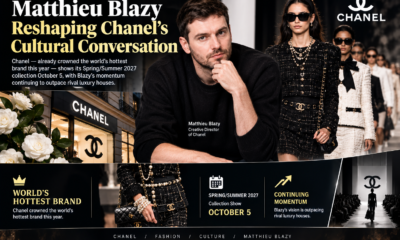
Matthieu Blazy Reshaping Chanel’s Cultural ConversationChanel.
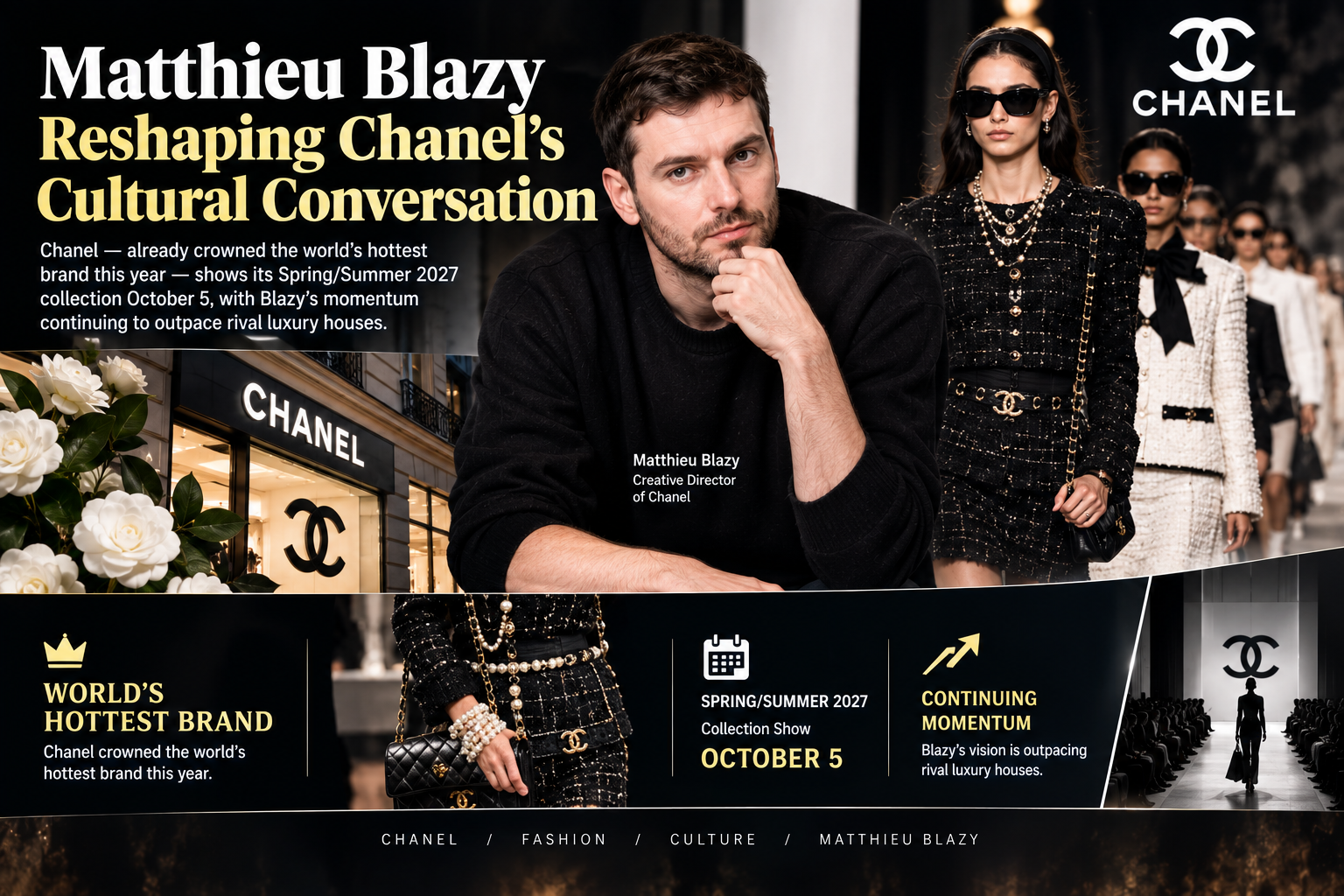
Matthieu Blazy’s Chanel debut delivered more than runway buzz, generating strong commercial demand and fueling a retail phenomenon dubbed “Blazymania.”
The Appointment
Blazy, a 40-year-old Franco-Belgian designer, was appointed Chanel’s artistic director in December 2024, replacing Virginie Viard, who had led the house since 2019 following Karl Lagerfeld’s death. This was Chanel’s first external creative hire in nearly 40 years — since Lagerfeld himself — making Blazy just the fourth head designer in the house’s entire history, after Gabrielle “Coco” Chanel, Lagerfeld, and Viard. His pedigree came from stints at Raf Simons, Maison Margiela, Céline (under Phoebe Philo), and most recently as creative director at Bottega Veneta, where from 2021-2024 he delivered 6% year-over-year revenue growth at a time when fellow Kering-owned labels like Saint Laurent and Gucci were struggling.
The Debut That Started It All
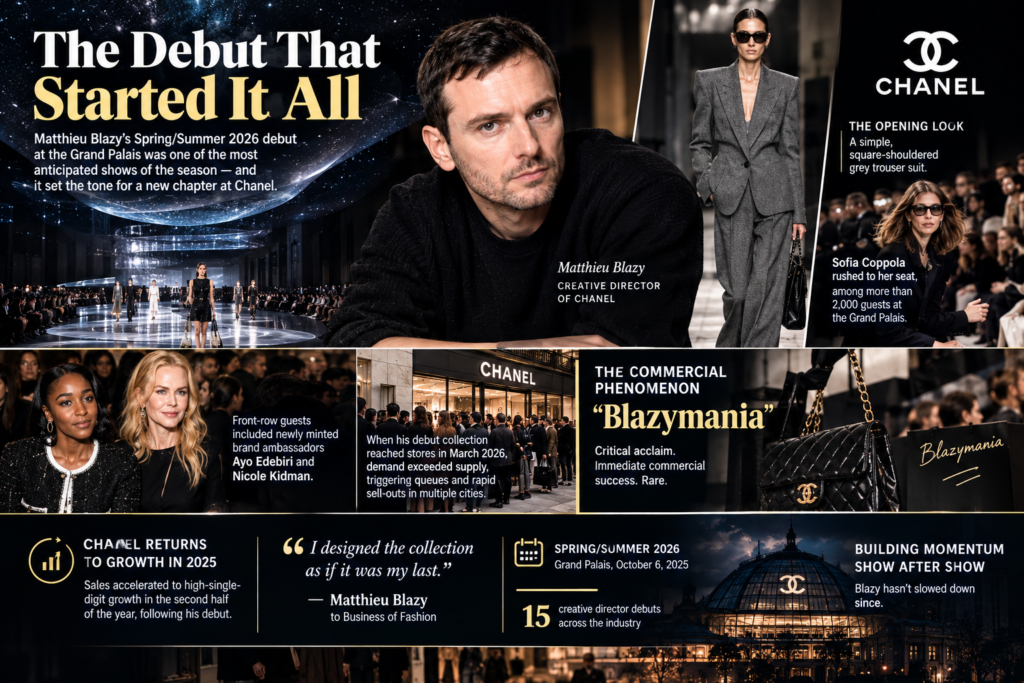
Blazy’s Spring/Summer 2026 debut on October 6, 2025 at the Grand Palais was one of the most anticipated shows of a fashion season that saw an unprecedented 15 creative director debuts across the industry. More than 2,000 people waited under a galaxy-inspired set as Sofia Coppola sprinted to her seat; the opening look was a simple, square-shouldered grey trouser suit. Blazy told Business of Fashion he’d designed the collection “as if it was his last.” He received a standing ovation, with front-row guests including newly minted brand ambassadors Ayo Edebiri and Nicole Kidman.
The Commercial Phenomenon: “Blazymania”
This is where the story becomes genuinely remarkable — most fashion debuts get critical buzz; Blazy’s got both critical acclaim AND immediate commercial success, which is rare, especially given the broader luxury slowdown in 2026. When his debut collection reached stores in March 2026, demand exceeded supply, triggering queues and rapid sell-outs in multiple cities — a retail frenzy the fashion press dubbed “Blazymania” or “Matthieu-mania.” Following his appointment and debut, Chanel returned to growth in 2025, with sales accelerating to high-single-digit growth in the second half of the year.
Building Momentum Show After Show
Blazy hasn’t slowed down since:
December 2025 — Métiers d’Art in New York: His first Métiers d’Art show took over an abandoned subway platform on the Lower East Side, featuring pinstripes, feathered gowns, and neon animal-print suits paying tribute to New York’s quirky character. Star-studded guests included A$AP Rocky, Tilda Swinton, Kristen Stewart, Solange, G-Dragon, and Jon Bon Jovi.
March 2026 — Fall/Winter Sophomore Collection: Staged beneath brightly lacquered construction cranes at the Grand Palais, referencing Coco Chanel’s own quote: “Fashion is a caterpillar and a butterfly. By day the caterpillar, by night the butterfly.” Reviewers described it as continuing to “mine a feeling of joy,” taking the Chanel woman “from dawn to dusk.”
July 2026 — Fall Couture, “Gaby and the Beanstalk”: A whimsical, fairy-tale-themed couture show inspired by a trip to Gabrielle Chanel’s personal library, where Blazy discovered a book of classic fairy tales. Front row included Teyana Taylor, Pedro Pascal, Alexa Demie, and Tilda Swinton.
Why This Story Resonates
The core narrative arc here is genuinely compelling for a general audience, not just fashion insiders: an outsider takes over one of the most guarded, tradition-bound names in luxury, immediately wins over both critics and shoppers (a combination that almost never happens together), and keeps the momentum building show after show rather than fading after a splashy debut — all while the broader luxury industry struggles. It directly explains why Chanel topped the Lyst Index as the world’s hottest brand for a third straight quarter, reinforced by moments like Dua Lipa choosing Chanel for her wedding dress.
What’s Coming October 5
His Spring/Summer 2027 show will be his fourth ready-to-wear collection in the role — the real test now shifts from “can he win people over” (clearly yes) to “can he sustain Blazymania as a durable, ongoing commercial engine for the house,” rather than an initial honeymoon effect.


Spain’s train crash and upcoming election. Spain is dealing with its second deadly train crash this year.

Hong Kong’s Tai Po fire fallout. Leader John Lee apologized

Serbia’s media shake-up. The head of public broadcaster RTS resigned after the student list won an election.

Generation Z Is Killing Fast Fashion in India — And Building Something Far More Beautiful in Its Place

AR Rahman reacts to “anti-national” row over Imtiaz Ali’s Main Vaapas Aaunga

According to Dior Couture, this taboo fashion accessory is back

-

 Entertainment14 hours ago
2026 is a big year at the box office
-

 Entertainment15 hours ago
Ramayana Part 1 arrives this week.
-

 Entertainment15 hours ago
Rajinikanth’s Jailer 2 enters the top 20.
-

 Entertainment14 hours ago
Bigg Boss 20 drama. Manoj Tiwari defended his daughter
-

 Entertainment14 hours ago
Other Diwali releases. Nayanthara’s Mookuthi Amman .