
Business
AI infrastructure spending boom
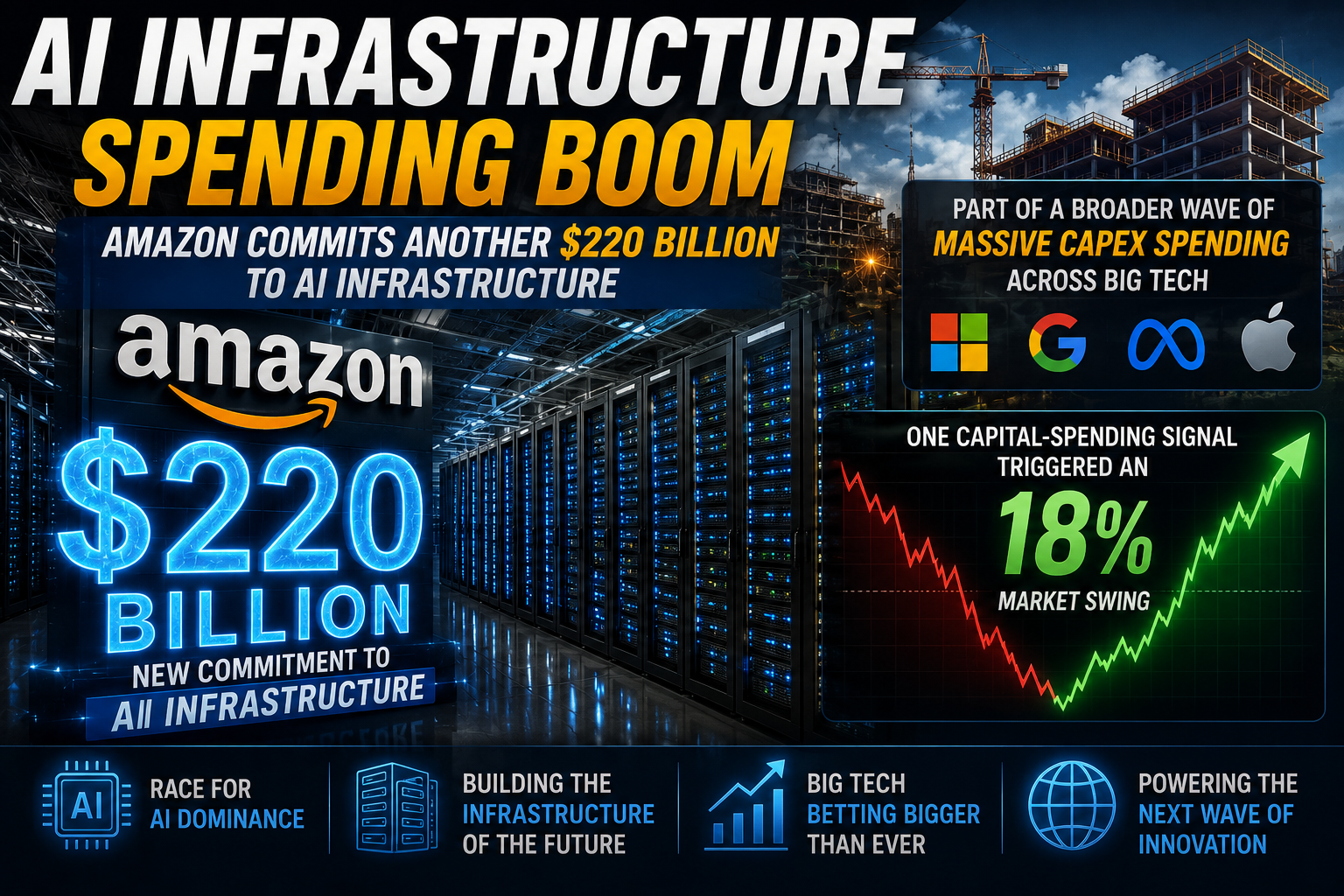
Amazon’s latest $220 billion AI infrastructure commitment underscores Big Tech’s massive spending boom and its growing impact on financial markets.

Amazon’s Big Number
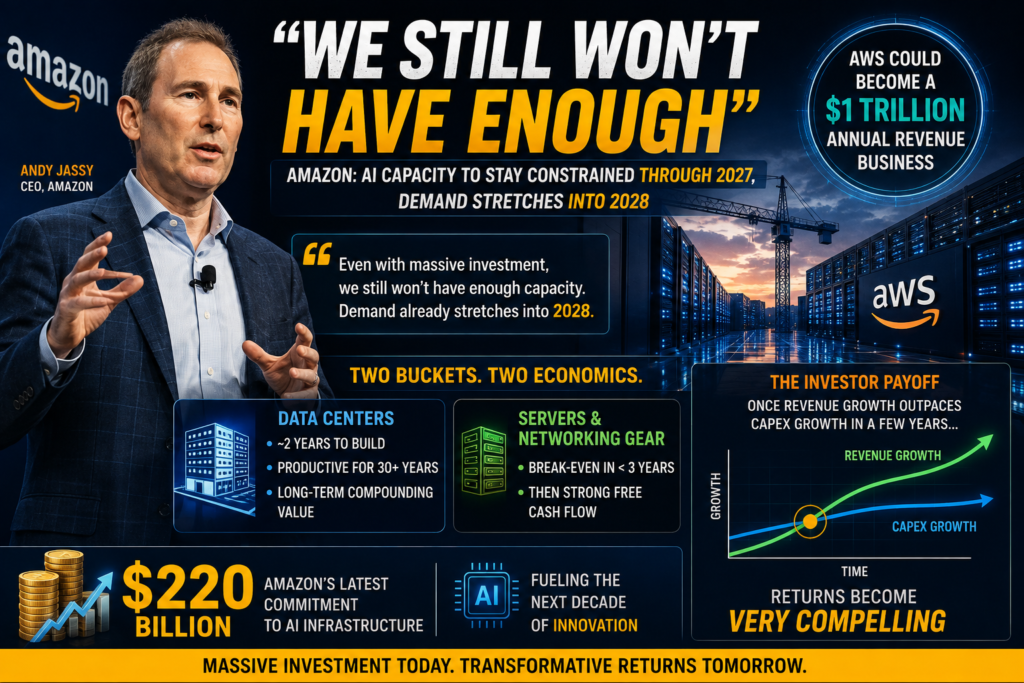
On its Q2 2026 earnings call (early August), Amazon CEO Andy Jassy raised the company’s 2026 cash capex forecast to ~$220 billion, up from the $200 billion guided back in February — a 10% jump in under six months. The increase is tied specifically to rising memory-chip costs, not an expansion of the buildout footprint itself. Jassy singled this out explicitly: the higher cost of memory pushed the number up from the prior estimate of about $200 billion.
To put the scale in context: Amazon spent about $132 billion on capex in 2025. The 2026 figure represents nearly a 67% year-over-year jump.
“We Still Won’t Have Enough”
Despite the massive spend, Jassy said Amazon expects AI capacity to stay constrained through 2027 — and noted demand already stretches into 2028. He split the reasoning into two buckets: data centers (which take ~2 years to build but stay productive 30+ years) versus servers/networking gear (break-even in under 3 years, then strong free cash flow). His pitch to investors: once revenue growth outpaces capex growth in a few years, the resulting returns are “very compelling.” He also floated that AWS could eventually become a trillion-dollar annual revenue business.
Why AWS Is Justifying It
- AWS revenue rose 36.7% year-over-year in Q2 to $42.2 billion — its fastest growth in 18 quarters, and the fifth straight quarter of acceleration.
- Operating margin expanded to 39%, up ~650 basis points year-over-year.
- Q2 capex alone was $54.2 billion, up 68% year-over-year.
- Amazon is racing to serve a $496 billion order backlog that’s grown 2.5x in a year.
It’s an Industry-Wide Arms Race
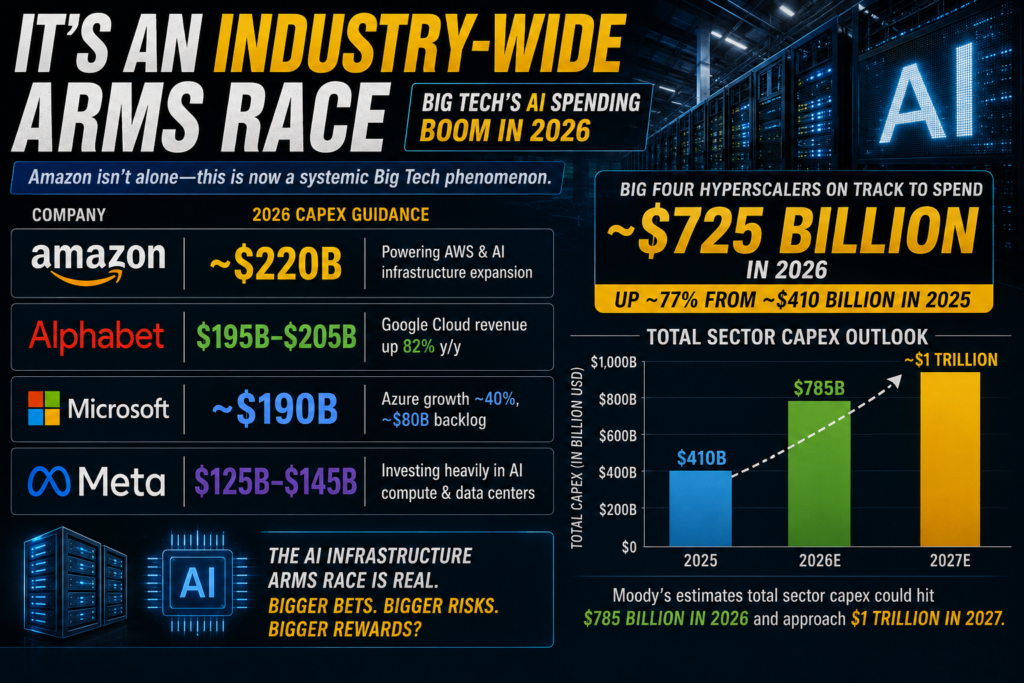
Amazon isn’t alone — this is now a systemic Big Tech phenomenon:
| Company | 2026 Capex Guidance |
|---|---|
| Amazon | ~$220B |
| Alphabet | $195B–$205B (Google Cloud revenue up 82% y/y) |
| Microsoft | ~$190B (Azure growth ~40%, ~$80B backlog) |
| Meta | $125B–$145B |
Combined, the “Big Four” hyperscalers are on track to spend roughly $725 billion in 2026 — up about 77% from ~$410 billion in 2025. Moody’s estimates total sector capex could hit $785 billion in 2026 and approach $1 trillion in 2027.
The Financing Question — and the Risk
This spending is straining even the biggest balance sheets: Alphabet, Amazon, Meta, and Oracle are expected to see forward free cash flow shrink toward zero or turn negative because of AI-driven data center spending. Hyperscalers have issued roughly $175 billion in debt this year already — far above the five-year average of about $30 billion — and bond investors are growing more cautious, with credit spreads on hyperscaler debt widening. Notably, when directly asked how Amazon plans to fund the extra $20 billion, Jassy demurred, saying only “nothing to share today.”
The comparisons being drawn are pointed: several analysts have likened this buildout to the dot-com infrastructure boom — massive spending ahead of proven returns, with a real risk that some of it proves excessive if AI demand ever cools.
The Physical/Human Cost Angle
Worth a mention for a segment: this AI buildout is tightly linked to the power grid — data centers and model training require enormous electricity and water for cooling, and power demand growing faster than supply could mean higher utility bills and strain on local infrastructure for ordinary consumers near these facilities.








Business
India: RBI policy, rupee and IT earnings
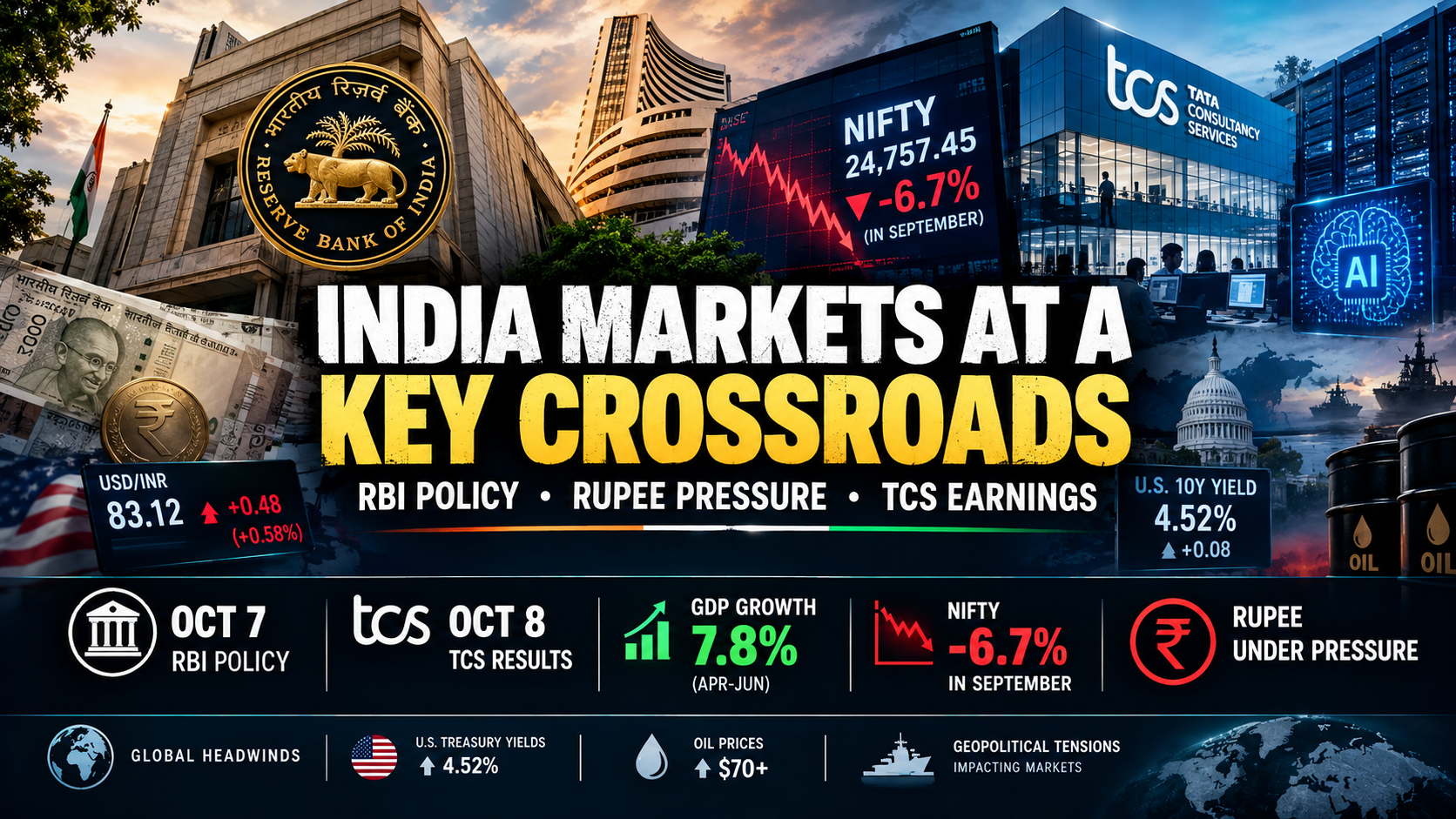
India’s markets face a crucial week as the RBI policy decision and TCS earnings approach, while rupee weakness and global pressures weigh on the Nifty.
Business
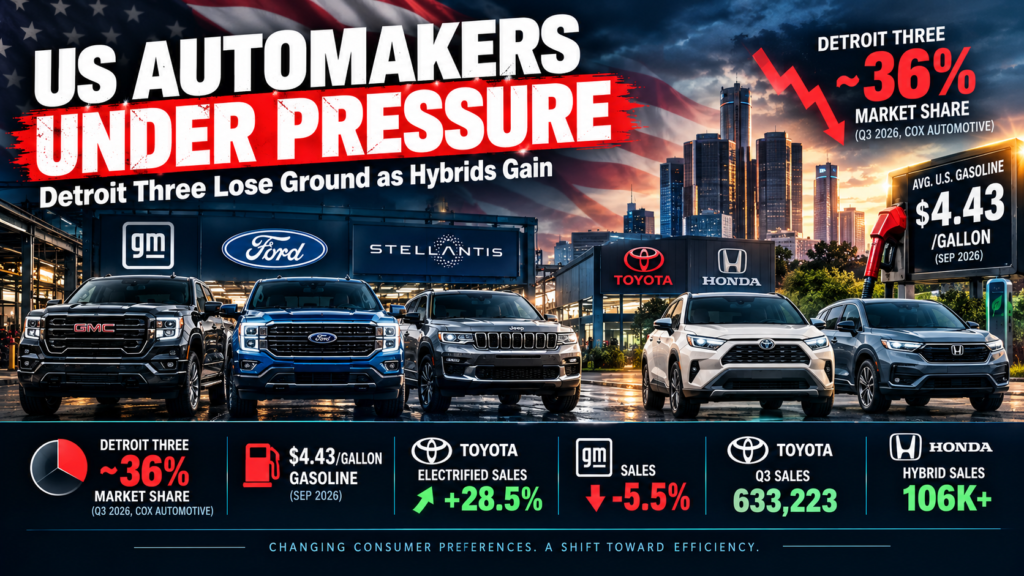
Pressure on US automakers. Reuters reports that GM, Ford and Stellantis could see their combined US market share dip to 36% for the quarter
GM, Ford and Stellantis could see their combined U.S. market share fall to around 36%, highlighting growing pressure on Detroit’s biggest automakers.

Detroit Three Slip to Record-Low US Market Share as Gas Prices Drive Buyers to Hybrids
GM, Ford and Stellantis are heading for their weakest US showing on record. Cox Automotive estimates their combined third-quarter market share at around 36%, an all-time low, while hybrid-heavy Asian brands including Toyota and Honda are expected to account for more than half of new vehicle sales.
The driver is fuel costs. The Iran war has pushed US gasoline to a national average of $4.43 a gallon in September, according to AAA, up from $3.20 a year earlier, and buyers are turning to hybrids and more efficient models.
Toyota is the clearest winner. Its electrified sales climbed 28.5% to 363,367 units, or 57.4% of its US sales, and its Corolla hybrid jumped nearly 36%. GM kept the top US sales spot, but its lead over Toyota shrank to 37,751 vehicles, and Cox has said Toyota could overtake GM in the coming years if the trend continues. GM’s quarterly sales fell 5.5% to 670,974 units. Honda posted a record hybrid quarter of more than 106,000 units, with sales up 9.3%. Stellantis sales were roughly flat at 324,277.
Ford is under particular pressure. Cox expects its sales to fall 8.8% through the first three quarters of the year, with its market share dropping nearly a full point to 12.5%. Cox also forecast that Hyundai Motor Group would outsell Ford for the first time, 511,421 vehicles to 504,172, though Ford argues that Hyundai and Kia are separate companies and that it outsold the two combined year to date.
Overall US sales for the quarter are estimated at about 4.1 million, down about 1% from a year earlier. The average new-vehicle transaction price rose 1.9% to $50,089 in August.
What to watch: Ford’s reported third-quarter sales, gasoline prices, and whether Detroit’s automakers shift more of their production toward hybrids.
Business
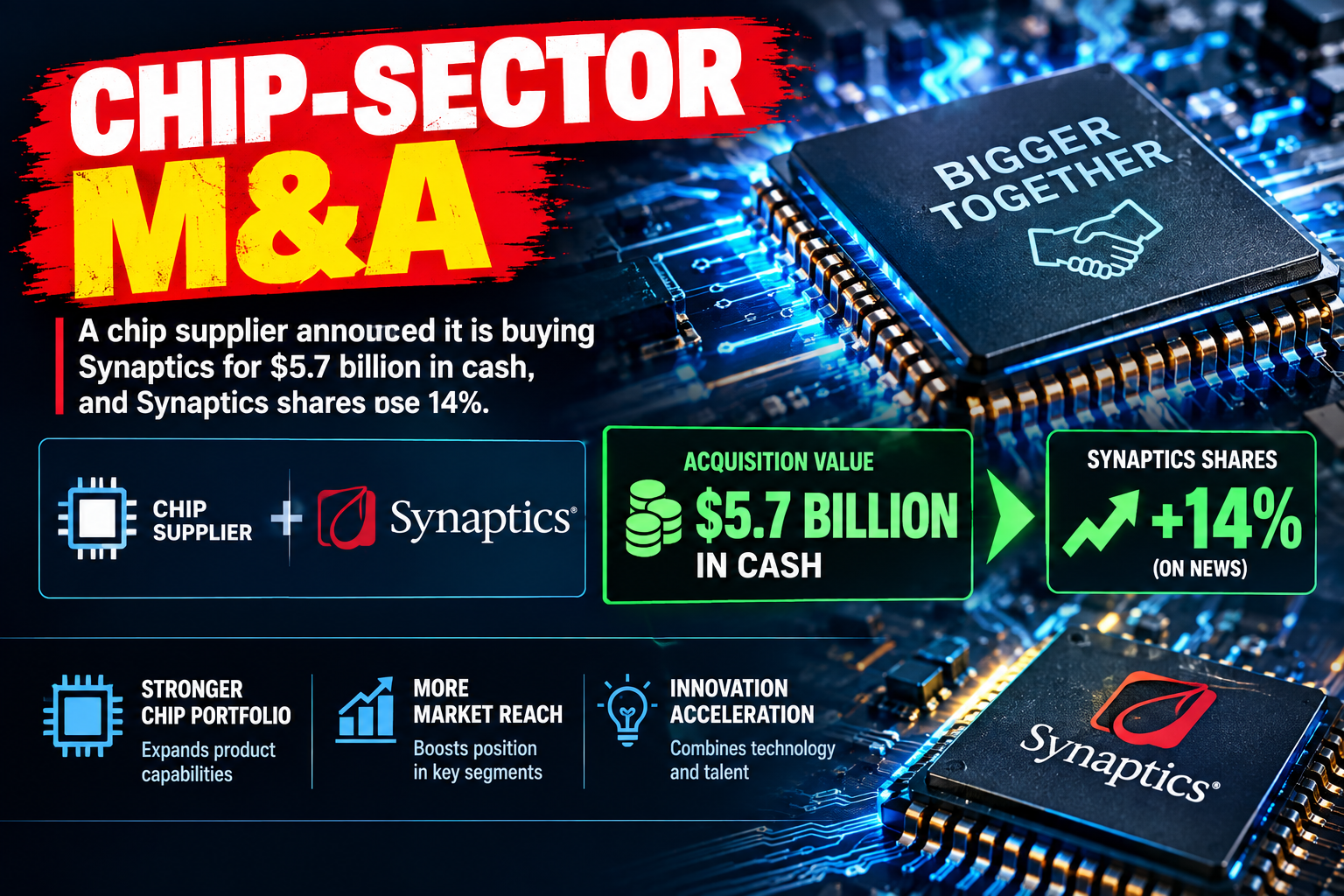
Chip-sector M&A. A chip supplier announced it is buying Synaptics for $5.7 billion in cash
Synaptics shares jumped 14% after a chip supplier announced a $5.7 billion all-cash deal to acquire the company.
onsemi Switches to $5.7 Billion All-Cash Deal for Synaptics After Rival Bid Surfaces
Shares of Synaptics jumped about 14% after chipmaker onsemi (ON Semiconductor) agreed to buy it in an all-cash deal valued at about $5.7 billion. The revised agreement, announced late Thursday, October 1, pays $123 per share in cash and replaces the all-stock deal the companies signed on June 25, which was valued at about $7 billion.
The change followed competing interest. A filing shows Synaptics had received an unsolicited, non-binding proposal from another strategic party, which likely drove the renegotiation. Synaptics’ board unanimously concluded that the amended deal remains in shareholders’ interests.
Shares of Synaptics opened more than 14% higher on Friday, moving close to the cash offer. The stock had closed at $106.15 the previous day. onsemi shares rose about 6% in premarket trading from a prior close of $80.08, with investors welcoming that the cash structure avoids issuing new shares that would have diluted existing holders.
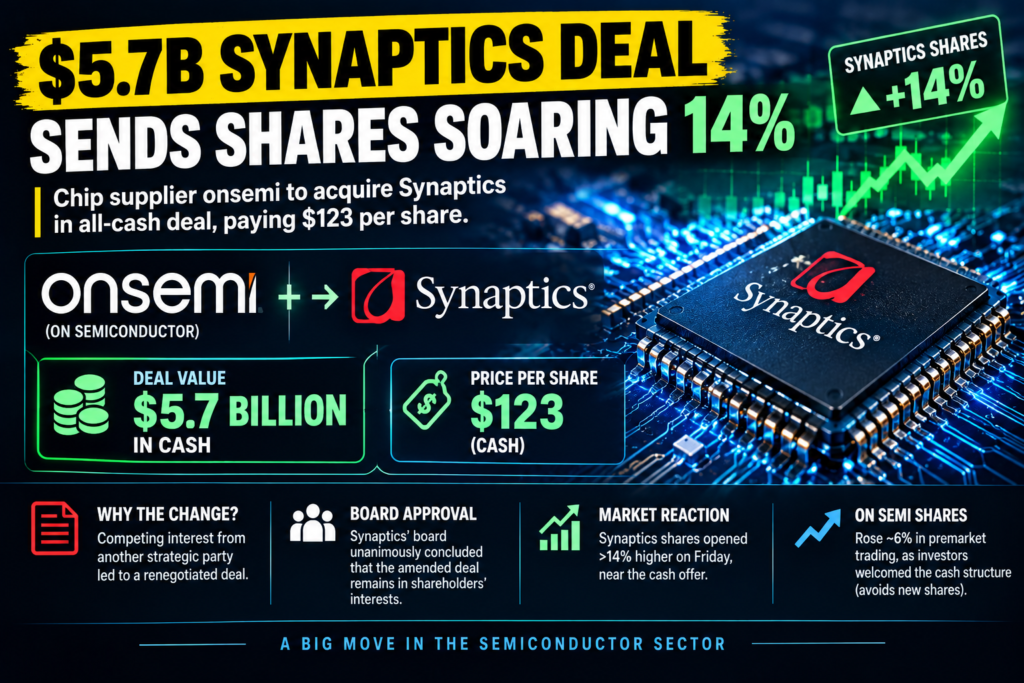
Under the original agreement, Synaptics holders were to receive 1.350 onsemi shares for each share they own. The new deal will be funded with cash on hand and about $2.45 billion in committed debt financing from Morgan Stanley. onsemi expects the acquisition to add to its non-GAAP earnings per share immediately, and has identified $200 million of annual run-rate synergies.
The deal still needs approval from Synaptics shareholders and regulators, with completion expected by mid-2027. It came amid a broader rally in semiconductor stocks.


Spain’s train crash and upcoming election. Spain is dealing with its second deadly train crash this year.

Hong Kong’s Tai Po fire fallout. Leader John Lee apologized

Serbia’s media shake-up. The head of public broadcaster RTS resigned after the student list won an election.

Generation Z Is Killing Fast Fashion in India — And Building Something Far More Beautiful in Its Place

AR Rahman reacts to “anti-national” row over Imtiaz Ali’s Main Vaapas Aaunga

According to Dior Couture, this taboo fashion accessory is back

-

 Entertainment14 hours ago
2026 is a big year at the box office
-
 Entertainment15 hours ago
Ramayana Part 1 arrives this week.
-

 Entertainment15 hours ago
Rajinikanth’s Jailer 2 enters the top 20.
-

 Entertainment15 hours ago
Bigg Boss 20 drama. Manoj Tiwari defended his daughter
-

 Entertainment14 hours ago
Other Diwali releases. Nayanthara’s Mookuthi Amman .