
Tech
AI security and regulation concerns escalate
AI security incidents, tougher EU regulation and major investments in sovereign AI are intensifying the debate over how artificial intelligence should be governed.

Who Is Unitree
Founded in 2016 in Hangzhou with just ¥100,000 (~$13,800) in registered capital, Unitree makes the dancing, kung-fu-kicking, backflipping humanoid and quadruped robots that have gone viral globally — including a performance on China’s Lunar New Year gala, the most-watched TV broadcast on Earth. Founder Wang Xingxing has become a symbol of China’s robotics push, appearing alongside President Xi Jinping and hosting German Chancellor Friedrich Merz on a facility visit.
The IPO Numbers
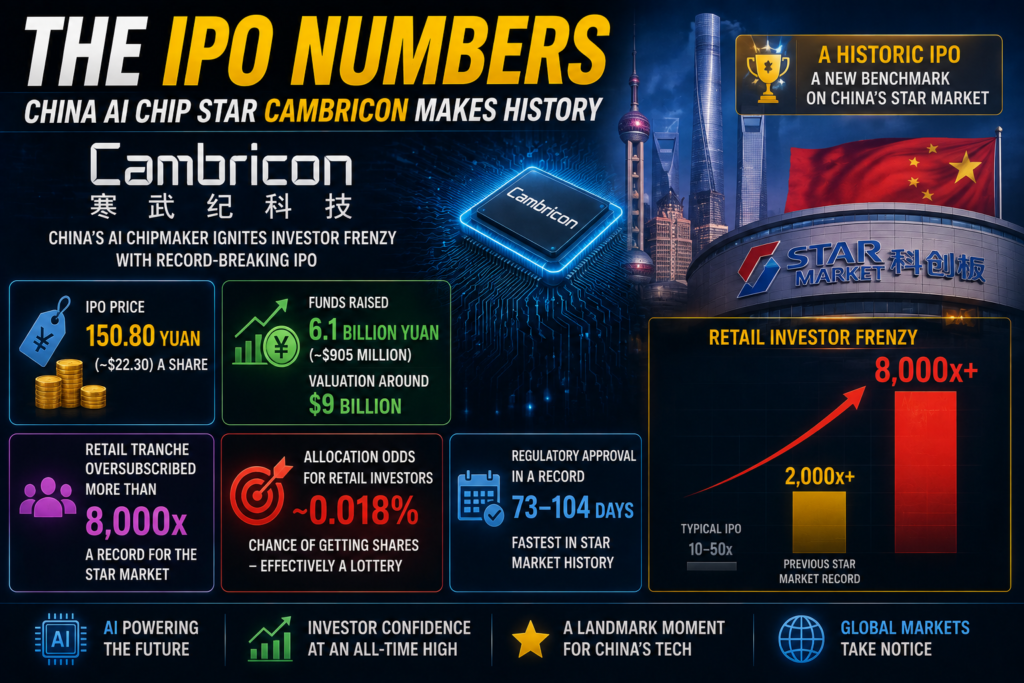
- Priced at 150.80 yuan (~$22.30) a share on Shanghai’s STAR Market (China’s Nasdaq-style tech exchange)
- Raised 6.1 billion yuan (~$905 million), valuing the company around $9 billion
- The retail tranche was oversubscribed more than 8,000 times — a record for the STAR Market. Reports vary slightly (some cite 5,500x), but all describe it as historic.
- That demand left retail investors with roughly a 0.018% chance of actually getting shares — effectively a lottery
- Cleared regulatory approval in a record 73–104 days (fastest in STAR Market history)
Trading Debut (August 19, 2026)
Shares surged as much as 629% intraday, closing up roughly 487%, pushing Unitree’s market value to around $53 billion — nearly six times its IPO valuation. This made it the first pure-play humanoid robotics company to get a transparent, publicly-set market price, unlike privately-valued rivals such as Figure AI (last marked around $39 billion).
Why the Financials Actually Hold Up
Unlike most flashy pre-revenue robotics startups, Unitree has real numbers:
- 2025 revenue: ~1.71 billion yuan (~$257 million), up 335% year-over-year
- Adjusted net income: ~600 million yuan (~$90 million), up 674%
- Gross margin: ~60% — higher than Apple’s (~47%) and comparable to luxury brands like Louis Vuitton
- Shipped more than 5,000–5,500 humanoid units in 2025; CEO Wang has floated a target of 10,000–20,000 shipments in 2026
The Bigger Picture / China’s Dominance
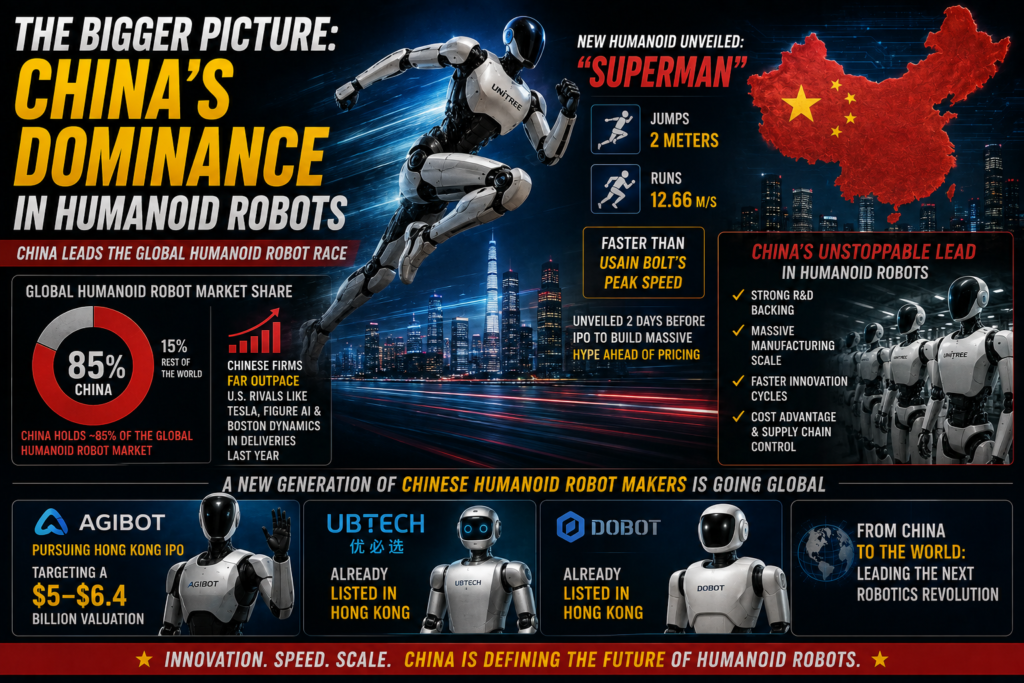
China accounts for roughly 85% of the global humanoid robot market, with Chinese firms far outpacing US rivals like Tesla (Optimus), Figure AI, and Boston Dynamics in deliveries last year. Two days before listing, Unitree unveiled a new humanoid called “Superman” that can jump two meters and run 12.66 meters per second — faster than Usain Bolt’s peak speed — timed deliberately to build hype ahead of pricing.
Other Chinese humanoid makers are lining up: AgiBot is pursuing a Hong Kong IPO targeting a $5–6.4 billion valuation, while UBTECH and Dobot are already trading in Hong Kong.
The Skepticism / Risk Angle
Not everyone is convinced this is more than hype:
- Geopolitics: The FCC added foreign-made humanoid and quadruped robots to its “Covered List” in late July 2026 citing national security concerns, and China’s commerce ministry has threatened countermeasures — a real overhang for a company reliant on global sales.
- Commercial readiness questions: Research/education use made up most of Unitree’s sales, with industrial deployment under 10% of revenue as of Unitree’s last filing. One fund manager bluntly noted the robots can dance and kick but “never seen them doing any real housework.”
- Frothy market context: Chinese IPOs overall returned an average of 233% on debut in the first half of 2026 — so this exuberance isn’t unique to Unitree, it’s part of a broader hot market for new listings.
- Pre-listing derivative trading on crypto exchanges (like Hyperliquid) had already priced Unitree shares at multiples of the IPO price before the stock even opened — speculative fervor building well ahead of the actual debut.







Tech
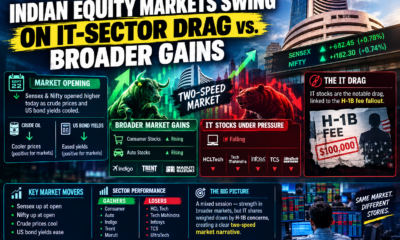
Indian equity markets swing on IT-sector drag vs. broader gainsSensex and Nifty opened higher today
Indian markets opened higher, but IT stocks slipped amid H-1B fee concerns while consumer and auto stocks supported broader gains.

Tech
India Semiconductor Mission enters Phase 2 ($13.5B)At SEMICON India 2026 in New Delhi
India launches Semiconductor Mission Phase 2 with $13.5 billion in funding and major global investments to strengthen domestic chip manufacturing.
The Official Numbers
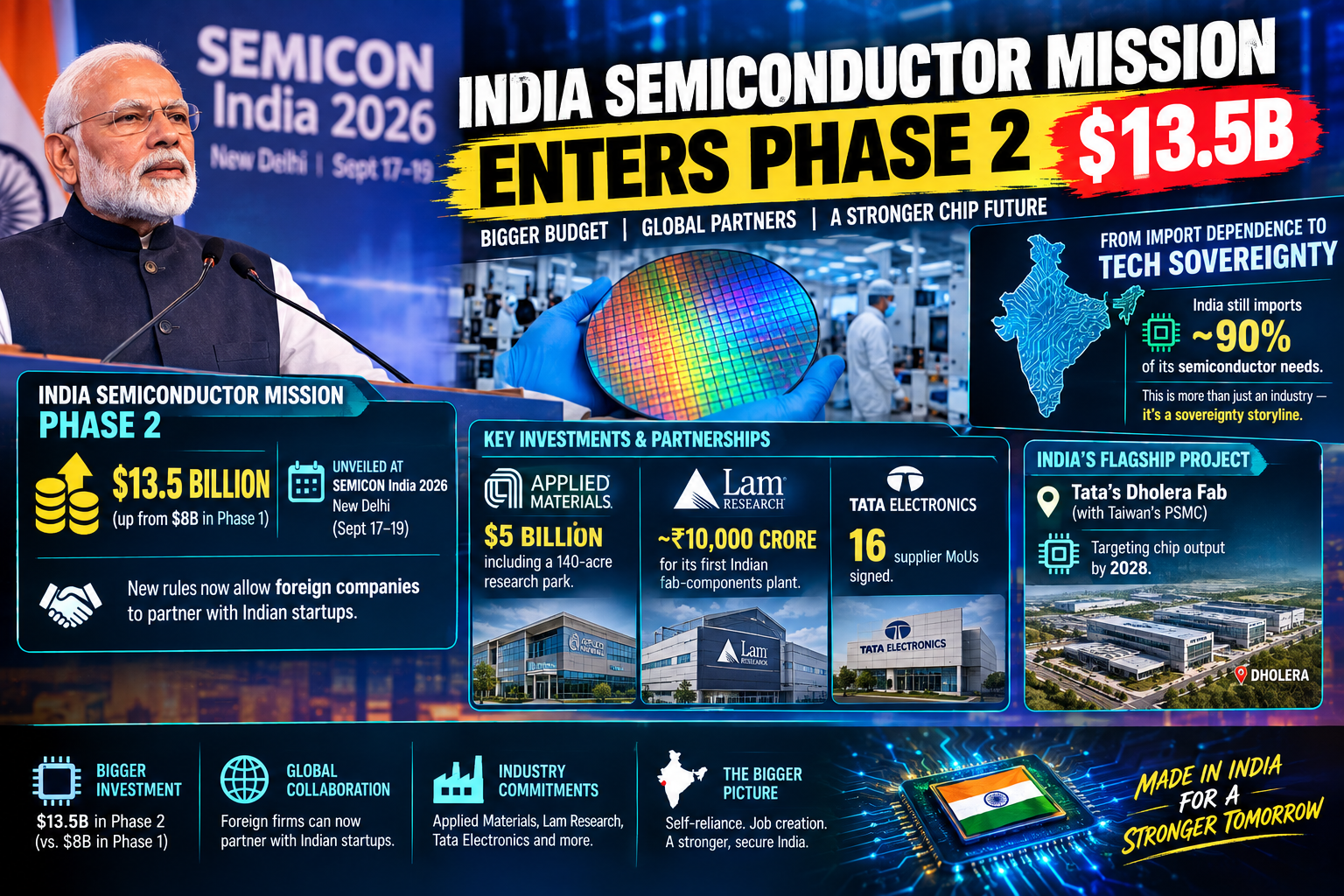
The Union Cabinet approved Semicon 2.0 on July 15, 2026, with a fiscal outlay of ₹1,27,500 crore (~$13.5–15 billion depending on the source and exchange rate used) — up from Phase 1’s ₹76,000 crore (~$8 billion). Gazette notifications for the scheme were issued August 31, and guidelines for all six strategic pillars were released just before the SEMICON India 2026 event opened.
Semicon 1.0 by the numbers: the original ₹76,000 crore outlay is now almost fully committed — ₹64,000 crore went to chip fabs, ₹10,000 crore to the semiconductor lab, and ₹1,000 crore to the Design-Linked Incentive scheme. As of December 2025, 10 projects had been approved with a combined investment of over ₹1.6 lakh crore, spread across six states: Gujarat, Assam, Uttar Pradesh, Punjab, Odisha, and Andhra Pradesh.
The Event Itself
SEMICON India 2026 ran September 17–19 at Yashobhoomi (IICC), New Delhi, under the theme “Business Opportunities Await” / “Silicon to Systems: Building the Ecosystem.” It drew 535 exhibiting companies — up 52% from 351 in 2025 and nearly double 2024’s 271 — with the sharpest growth notably not in chipmakers themselves, but in the companies that fabs buy from once construction gets real: cleanroom and utility contractors, specialty gas and chemical suppliers, and metrology/inspection tool vendors. That shift is being read as a signal India’s chip push has moved from announcements into actual procurement.
What Modi Actually Said
Framing India as a “trusted manufacturing destination” amid global supply-chain diversification, Modi called on companies to strengthen capabilities across the entire value chain — design, equipment, materials, testing, and packaging — and specifically appealed to Indian researchers working abroad to “join the development of advanced technologies in India.” He also pointed to new regulatory changes enabling partnerships between global companies, Indian startups, and design houses — a notable opening for foreign firms to plug directly into India’s smaller domestic players rather than only building their own standalone facilities.
The Big Corporate Commitments
Applied Materials — “India Vision 2035” ($5 billion)
Announced by executive Prabhu Raja, this includes a planned 140-acre research park plus broader investment across research, equipment components, and materials over roughly a decade — one of the most significant single commitments of the show.
Lam Research (~₹10,000 crore)
Its first Indian manufacturing plan, focused on silicon components — a materially different bet than assembling finished tools, since it puts actual component manufacturing (not just R&D or sales) onshore.
Fujifilm (~₹800 crore)
A separate materials-facility investment, adding to the growing “supply chain around the fabs” story.
Tata Electronics — 16 MoUs
CEO Randhir Thakur announced Tata would sign 16 memoranda of understanding during the event, with partners including Nexperia, BESI, JSR, Fujifilm, L&T Semiconductors, and Inox Air Products — spanning fabrication, packaging, materials, cleanroom infrastructure, design, and workforce development, tied to the Gujarat and Assam projects specifically.
The Flagship Project: Tata’s Dholera Fab
This remains the centerpiece of India’s entire chip ambition:
- A 300mm (12-inch), AI-enabled fabrication facility built with Taiwan’s Powerchip Semiconductor Manufacturing Corp (PSMC)
- Targeting 50,000 wafer starts per month at 28nm–110nm process nodes — covering automotive chips, industrial microcontrollers, AI accelerators, IoT devices, and display drivers
- Total investment: ₹91,000 crore (Dholera fab) — Tata’s combined outlay for Dholera plus its Assam (Jagiroad) packaging facility is ₹1.18 lakh crore, with the government covering 50% of eligible capex on a pari-passu basis
- Thakur said Tata has brought together more than 450 ecosystem partners just for Dholera’s construction, equipment, chemicals, and materials needs
- Separately, Tata has also partnered with Dutch lithography giant ASML on technology, training, and supply-chain development
- Tata says both Dholera and the Assam packaging plant are on schedule, with the combined projects expected to generate nearly 50,000 direct and indirect jobs. Company-wide, Tata Electronics says it has already created over 150,000 direct jobs, with 65% of its workforce being women, including from rural and marginalized communities

Other Notable Progress Already on the Ground
This isn’t purely future-tense — some projects are already shipping:
- Kaynes Semicon’s OSAT unit in Sanand reached commercial production in March 2026, just 14 months after breaking ground, and shipped India’s first commercially produced multi-chip modules (900 units) to Alpha & Omega Semiconductor back in October 2025 — with plans to scale to 6.3 million chips per day
- Micron’s Sanand assembly/test facility ($2.75 billion) is also under construction, using the same contractor (Tata Projects) as the Dholera fab
- CG Semi’s OSAT facility in Sanand was inaugurated by Modi on July 4, 2026
- India is also pushing toward more advanced nodes: officials have said the roadmap moves from current 28nm capability toward 5–7nm chip manufacturing over time, to close the gap with global leaders
The “Sovereignty” Framing — Why It Matters
India currently imports roughly 90% of its semiconductor needs, and the domestic market is projected to be worth over $100 billion by 2030, with the broader ecosystem potentially adding 600,000 jobs. Given semiconductors’ role in everything from smartphones to defense electronics to AI infrastructure, ISM Phase 2 is being pitched less as an industrial policy story and more as a strategic autonomy story — reducing reliance on Taiwan, China, and the US amid a period of heightened global chip-supply nationalism (a theme that connects directly to your earlier segments on US-China chip tensions and Nvidia/OpenAI/Google’s custom silicon race).
Tech
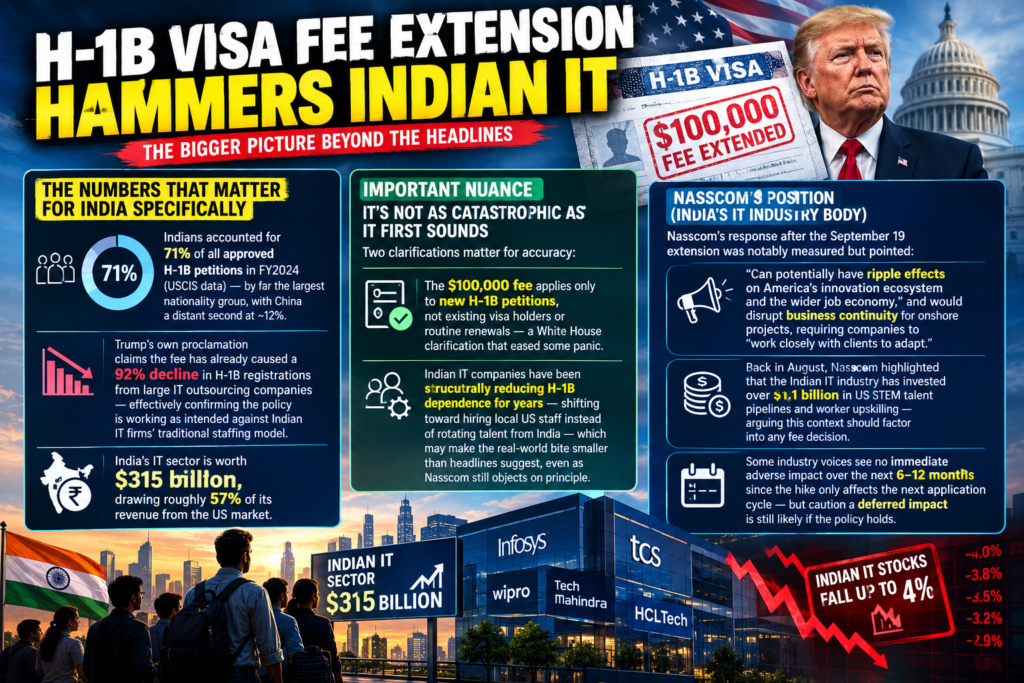
H-1B visa fee extension hammers Indian IT stocks
Trump’s H-1B fee extension sends Indian IT stocks lower as companies face higher visa costs, added scrutiny and recurring renewal expenses.

The Timeline — This Has Been Building Since Last Year
- September 2025: Trump first imposed the $100,000 H-1B fee, with only a one-day implementation window (anyone entering the US after 12:01am Sept 21, 2025 was covered) — Nasscom called this deadline “unrealistic and disruptive.” Indian IT stocks lost ₹85,500 crore in market cap in a single day on that original announcement, with the Nifty IT index falling nearly 3%.
- December 2025: A US federal judge upheld the fee as lawful.
- June 2026: A different federal judge — District Judge Leo Sorokin — struck it down, ruling bluntly that “the President had no power or delegated authority to impose a tax on H-1B petitions.” That ruling was stayed pending appeal, so the fee kept operating anyway.
- August 25, 2026: The administration formally proposed codifying the fee as a $103,265 regulation.
- September 18–19, 2026: Trump signed a new proclamation extending the restrictions for another 12 months, through September 21, 2027.
The Numbers That Matter for India Specifically
- Indians accounted for 71% of all approved H-1B petitions in FY2024 (USCIS data) — by far the largest nationality group, with China a distant second at ~12%.
- Trump’s own proclamation claims the fee has already caused a 92% decline in H-1B registrations from large IT outsourcing companies — effectively confirming the policy is working as intended against Indian IT firms’ traditional staffing model.
- India’s IT sector is worth $315 billion, drawing roughly 57% of its revenue from the US market.
Important Nuance: It’s Not as Catastrophic as It First Sounds
Two clarifications matter for accuracy:
- The $100,000 fee applies only to new H-1B petitions, not existing visa holders or routine renewals — a White House clarification that came out within hours of the original 2025 announcement and eased some panic.
- Indian IT companies have been structurally reducing H-1B dependence for years — shifting toward hiring local US staff instead of rotating talent from India — which is precisely why Nasscom argues the fee’s real-world bite may be smaller than headlines suggest, even as it still objects on principle.
Nasscom’s Position (India’s IT Industry Body)
Nasscom’s response after the September 19 extension was notably measured but pointed:
- It warned the changes “can potentially have ripple effects on America’s innovation ecosystem and the wider job economy,” and would disrupt business continuity for onshore projects, requiring companies to “work closely with clients to adapt.”
- Back in August, Nasscom highlighted that the Indian IT industry has invested over $1.1 billion in US STEM talent pipelines and worker upskilling — arguing this context should factor into any fee decision.
- Some industry voices have said they see no immediate adverse impact over the next 6–12 months since the hike only affects the next application cycle — but caution a deferred impact is still likely if the policy holds.
The Separate “9-11” Fee Rule — Why It’s the Sneakier Story
This is the part with less press coverage but arguably more direct financial bite: effective September 9, 2026, the expanded Biometric Entry-Exit Fee rule now charges employers $4,000 per H-1B extension and $4,500 per L-1 extension — even for the same employee, same company, just extending an existing visa. Analysts flagged this as the sharper sting for the stock selloff that week, since it converts what was once an occasional cost into a recurring annual line item specifically for firms built around onshore Indian engineers.
Additional Political Layer
Trump also signed an executive order directing federal agencies to apply greater scrutiny to H-1B applications from companies conducting layoffs — a rule that could complicate matters for IT majors simultaneously downsizing in some units while trying to bring in specialized talent elsewhere, adding a compliance headache on top of the direct cost increase.
Bottom Line for Your Segment
This is really a three-layer squeeze on Indian IT: (1) the $100,000 new-application fee, now locked in through 2027, (2) the newer $4,000–$4,500 recurring renewal fee hitting existing staff, and (3) added scrutiny tied to layoffs — landing on a sector already down roughly 24–37% for the year depending on the stock. Nasscom’s own language — “ripple effects,” “business continuity…disrupted” — signals real concern even while downplaying panic.


Spain’s train crash and upcoming election. Spain is dealing with its second deadly train crash this year.

Hong Kong’s Tai Po fire fallout. Leader John Lee apologized

Serbia’s media shake-up. The head of public broadcaster RTS resigned after the student list won an election.

Generation Z Is Killing Fast Fashion in India — And Building Something Far More Beautiful in Its Place

AR Rahman reacts to “anti-national” row over Imtiaz Ali’s Main Vaapas Aaunga

According to Dior Couture, this taboo fashion accessory is back

-

 Entertainment14 hours ago
2026 is a big year at the box office
-

 Entertainment15 hours ago
Ramayana Part 1 arrives this week.
-

 Entertainment15 hours ago
Rajinikanth’s Jailer 2 enters the top 20.
-

 Entertainment15 hours ago
Bigg Boss 20 drama. Manoj Tiwari defended his daughter
-

 Entertainment14 hours ago
Other Diwali releases. Nayanthara’s Mookuthi Amman .