Infastructure
World’s Highest Tunnel in Ladakh Nears Completion: India’s Answer to China’s Border Advantage


Nearing its completion deadline, India’s Shinkun La Tunnel in Ladakh is set to become the world’s highest tunnel at 15,800 feet — directly surpassing China’s Mi La tunnel at 15,590 feet and dramatically reshaping India’s all-weather military and civilian connectivity along the Line of Actual Control. GIN Infrastructure Desk | May 8, 2026 | Ladakh · National Security

The Shinkun La Tunnel project — a 4.1 km twin-tube structure being built by the Border Roads Organisation on the Nimmu-Padum-Darcha Road — was inaugurated for construction by Prime Minister Narendra Modi in July 2024 and is projected to reach completion by late 2026. At an altitude of approximately 15,800 feet, it will surpass every existing tunnel on earth in terms of elevation, knocking China’s Mi La tunnel off the top position.
The strategic imperative behind the project is unmistakable. Ladakh’s terrain has historically given China a logistical edge along the 3,488-km Line of Actual Control, particularly in winter months when high-altitude passes including the Shinkun La are snowed under and inaccessible for six months of the year. Once operational, the tunnel will provide all-weather connectivity between Himachal Pradesh and Leh — ensuring uninterrupted troop mobilisation, equipment supply, and civilian movement regardless of season or weather conditions.

“Shinkun La will not only ensure the speedy and efficient movement of our military forces and equipment — it will fundamentally alter India’s border infrastructure differential with China.” — Indian Government statement, 2024
The tunnel’s strategic value extends well beyond transport. It is designed to double as an underground storage facility for ammunition, missiles, fuel, and critical military supplies — a hardened logistics hub deep within the mountains. It will be equipped with advanced firefighting systems, mechanical ventilation, real-time communication infrastructure, and SCADA systems for remote monitoring and emergency management.

The project is part of India’s broader Ladakh infrastructure acceleration following the 2020 Galwan Valley clashes. The BRO has constructed over 6,500 km of roads, 455 bridges, and several tunnels across the LAC in the past five years — steadily closing India’s infrastructure gap with China. Shinkun La represents the crown jewel of this transformation.
At a project cost of ₹1,681 crore, the Shinkun La Tunnel is India’s most ambitious high-altitude engineering achievement — and a powerful geopolitical statement along one of the world’s most contested borders.


Infastructure
India’s Port and Logistics ExpansionWestern Carriers has secured a 15-year contract
Western Carriers’ 15-year Kolkata cargo-terminal contract highlights India’s broader expansion of port and logistics infrastructure.

The deal: Western Carriers (India) Limited (WCIL) has secured a 15-year development-and-operation contract for a General Cargo Terminal (GCT) at the GCD Yard of the Kolkata Dock System, awarded by the Syama Prasad Mookerjee Port Authority (SMPA).
It’s already live: This isn’t just a signed contract — the terminal was formally inaugurated on September 11, 2026, so it’s operational now, not a future project.
Why it matters strategically: This is WCIL’s first operational base on India’s east coast, marking its debut into port infrastructure and a shift beyond its traditional asset-light 4PL (fourth-party logistics) model. It complements the company’s existing 42-acre Multimodal Cargo Terminal at Devaliya, Gujarat — giving it a presence on both coasts along the East–West freight corridor.

Scale and connectivity: Initial civil infrastructure investment is modest at roughly ₹13.68 crore. The terminal handles dry bulk, break-bulk, and all container categories (20-ft, 40-ft, specialized), and connects to the Eastern Railway network via the Sealdah and Budge Budge sections, plus Kolkata’s road and inland-waterway links. Phase I equipment and manpower deployment is complete; Phase II (throughput and efficiency upgrades) is expected within 90 days of launch.
Company context: WCIL’s Q1 FY27 numbers show the broader momentum — consolidated operating revenue of ₹465 crore (up 11.8% YoY) and container volumes up nearly 15% YoY to 58,261 TEUs.
Infastructure
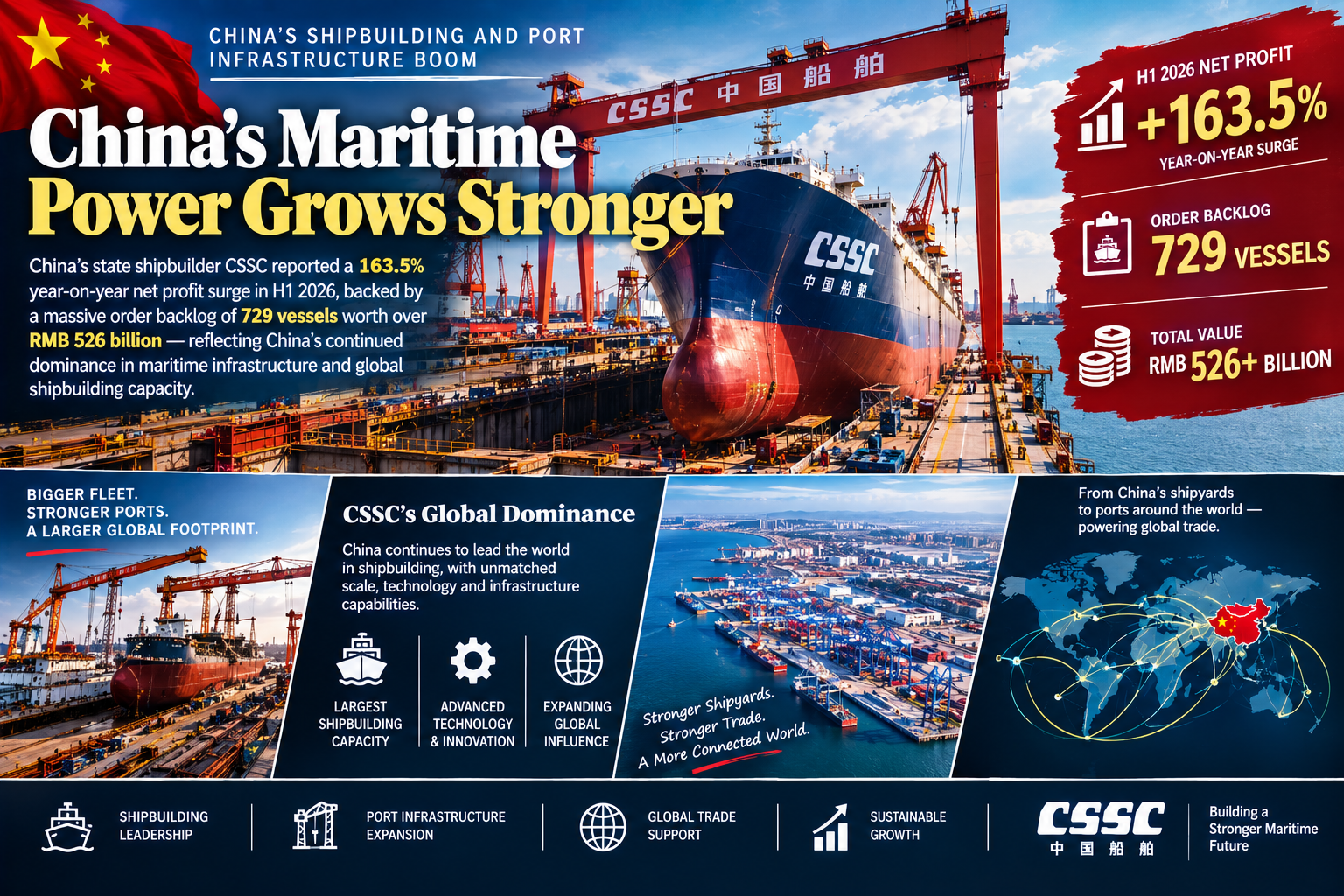
China’s Shipbuilding and Port Infrastructure Boom
: CSSC’s 163.5% profit surge and 729-vessel backlog underscore the scale of China’s shipbuilding industry and its growing maritime infrastructure footprint.
The numbers
For the six months ending June 30, 2026, CSSC posted operating revenue of RMB91.53 billion (about $13.28 billion), up 26% year-on-year, with net profit soaring 163.5% to RMB9.95 billion — a genuine profitability breakthrough rather than just a revenue bump.
What drove it
The company attributes the jump mainly to increased deliveries of high-end civil vessels, a higher proportion of premium ship types, and rising average vessel prices. On deliveries specifically, CSSC completed 102 vessels in H1 2026, covering 9.56 million dwt — 60.71% of its full-year target and a 27.5% year-on-year increase. It also picked up meaningful repair revenue: 397 ship repair projects generating RMB 3.069 billion.

The order backlog
Your figure is accurate too. As of end-June 2026, CSSC had 729 undelivered civil and offshore vessels on hand, totaling 93.89 million dwt and RMB 526.27 billion in contractual value. New orders in H1 alone were strong: 177 civil and offshore vessels worth RMB119.39 billion, with ordered deadweight tonnage up 128.82% year-on-year and order value up 93.06%.
By vessel type, the backlog skews toward oil tankers (30% of order volume by ship count), container ships (20%), bulk carriers (15%), and LNG/gas carriers (10%).
Context: this sits on top of a September 2025 mega-merger — CSSC absorbed China Shipbuilding Industry Corporation (CSIC) — which is why 2026 numbers look so outsized versus 2025; a lot of the growth reflects consolidation, not just organic demand. Worth flagging if this goes into a blog post, so the “163.5%” doesn’t read as pure market-driven growth without that caveat.
Infastructure
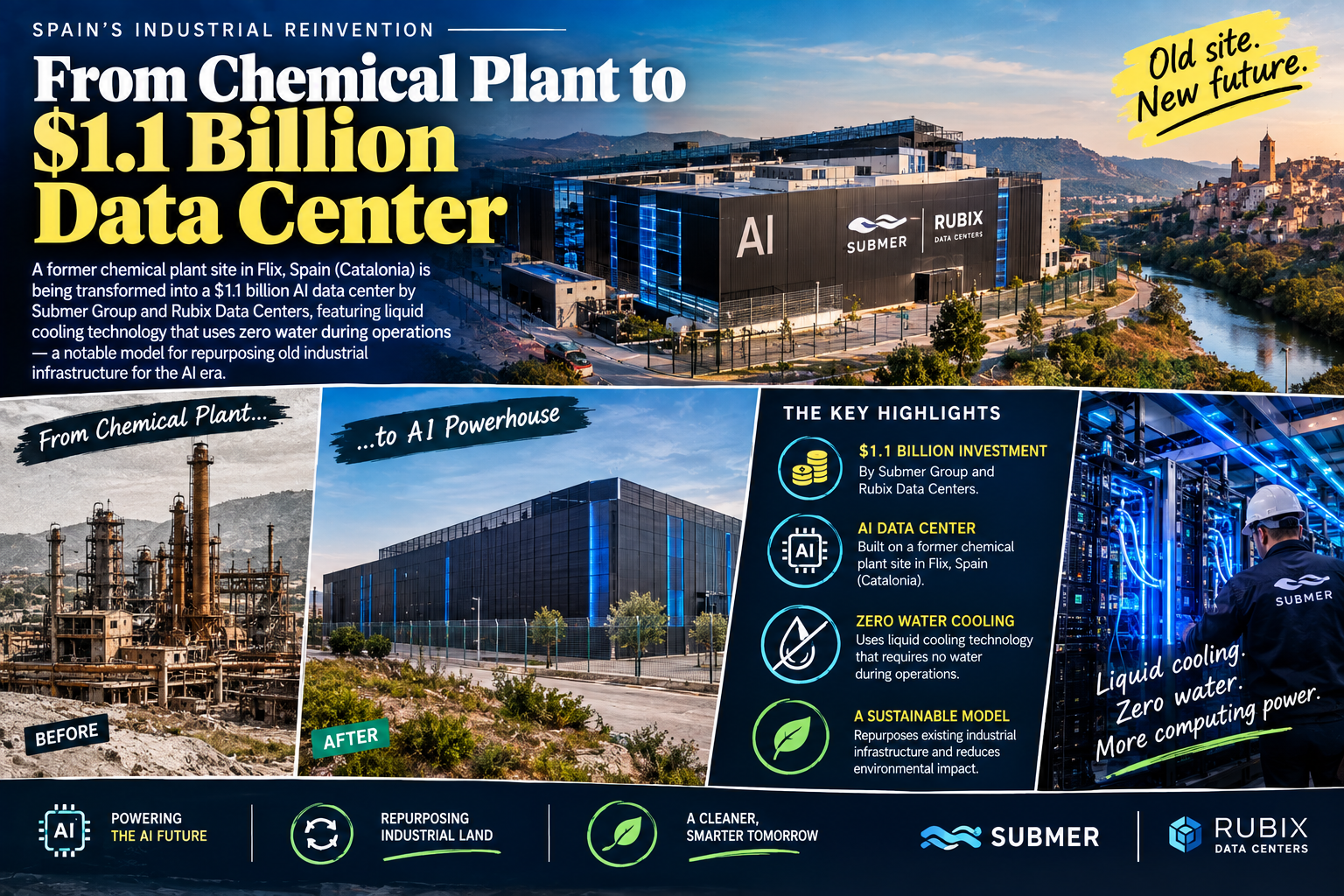
Spain’s Industrial Reinvention — Chemical Plant to $1.1 Billion Data Center
A former chemical plant in Spain is being reinvented as a $1.1 billion AI data center, showcasing industrial land reuse and water-free liquid cooling.
The Announcement
Submer Group — a Barcelona-headquartered, full-stack AI infrastructure company — announced on Saturday, July 11, 2026 that it will invest more than €1 billion (approximately $1.14 billion) to build a next-generation, sustainable AI data center on the site of the former Ercros chemical plant in Flix, a town in the Ribera d’Ebre county of Tarragona province, Catalonia. The reveal happened at a high-profile event attended by Salvador Illa, President of the Government of Catalonia, and Miquel Sàmper, Catalonia’s Minister of Business and Labor.
The Site’s Backstory
The location carries real symbolic weight. The Ercros chemical factory — once a defining symbol of the region’s industrial identity — ceased operations in January 2023, following a long industrial decline in the Ribera d’Ebre region. Since closure, Ercros has run only a solar farm on the site. Notably, the plant itself was acquired earlier this year by the Portuguese group Bondalti, adding another layer to its ownership history right before this transformation.
Technical Scope
- The facility will occupy roughly 13,000 square meters
- It will have an installed electrical capacity of 85 to 90 megawatts
- Construction is planned in two phases
- It will use advanced liquid cooling technology that requires zero water during operations — a meaningful sustainability detail, since traditional data center cooling is often a heavy water consumer, a growing point of local controversy around AI infrastructure projects worldwide
- Renders show a layout of four data halls arranged around a central building
- The project is targeted to be operational by the end of 2027
The Companies Behind It
- Submer Group, the parent company, was originally focused purely on immersion cooling technology for data centers, and has been actively diversifying — it launched an AI cloud platform called InferX last year, and created Rubix Data Centers in June 2026 specifically as its new AI data center development-and-operation arm.
- Rubix will both build and operate the facility using a “develop-and-operate” model — meaning rather than building and walking away, it will run the site long-term for a third-party tenant under agreed service levels. Rubix claims access to roughly 8GW of power across vacant sites spanning the Americas, EMEA, and APAC regions, suggesting Flix is one piece of a much larger global expansion strategy.
The Human and Economic Impact
- Once fully operational, the project is expected to generate 150 highly skilled permanent jobs, spanning operations and maintenance, critical facilities engineering, facilities management, security, site services, and operator support.
- This is explicitly framed as economic renewal for a region that’s faced real industrial decline — Ribera d’Ebre losing a major chemical employer in 2023 and gaining a much larger AI infrastructure investment in its place is a genuinely compelling “old industry to new industry” transition story.
Quotes Worth Using
- Submer CEO Patrick Smets tied the choice of location directly to symbolism: “The Flix site has notable industrial heritage, and it is where our vision for AI infrastructure can start to take shape… As demand accelerates, we will expand across the full stack, from land and power to cloud and edge, and we are building where it creates the most lasting value.”
- Rubix CEO John Eland emphasized long-term commitment, pushing back against any “build and leave” narrative: “It’s not simply about developing the project and leaving. Our commitment to Flix is long-term… [we are] not simply passing through Flix.”

The Policy Framework Behind It
This isn’t a one-off private deal — it’s explicitly part of Catalonia’s Reindustrialization Framework/, a set of formal government “round tables” and task forces specifically designed to help former industrial sites transition into new productive uses, with direct support from the Government of Catalonia’s Department of Business and Labor. This makes it a useful case study for how European regions are proactively trying to convert legacy industrial land into AI-era infrastructure rather than leaving it derelict.
One Caveat Worth Flagging
Industry coverage notes that site preparation on a former chemical works inherently brings remediation and ground-condition risk that hasn’t yet been publicly quantified — a reasonable due-diligence question for a project moving fast on a former industrial/chemical site.
Why This Story Works for Your Channel
This has a clean, visual “before and after” narrative (chemical plant → cutting-edge AI campus), ties directly into the massive global AI infrastructure investment story (the $31.6 trillion PwC forecast from your earlier list), and offers a genuinely different angle than the US-centric AI infrastructure stories — showing how Europe, and specifically Spain, is positioning itself in the global AI infrastructure race.


Spain’s train crash and upcoming election. Spain is dealing with its second deadly train crash this year.

Hong Kong’s Tai Po fire fallout. Leader John Lee apologized

Serbia’s media shake-up. The head of public broadcaster RTS resigned after the student list won an election.

Generation Z Is Killing Fast Fashion in India — And Building Something Far More Beautiful in Its Place

AR Rahman reacts to “anti-national” row over Imtiaz Ali’s Main Vaapas Aaunga

According to Dior Couture, this taboo fashion accessory is back

-

 Entertainment11 hours ago
2026 is a big year at the box office
-

 Entertainment11 hours ago
Ramayana Part 1 arrives this week.
-

 Entertainment11 hours ago
Rajinikanth’s Jailer 2 enters the top 20.
-

 Entertainment11 hours ago
Bigg Boss 20 drama. Manoj Tiwari defended his daughter
-

 Entertainment11 hours ago
Other Diwali releases. Nayanthara’s Mookuthi Amman .