
National & Defence
Operation Sindoor at One: 22 Minutes That Rewrote India’s Security Doctrine

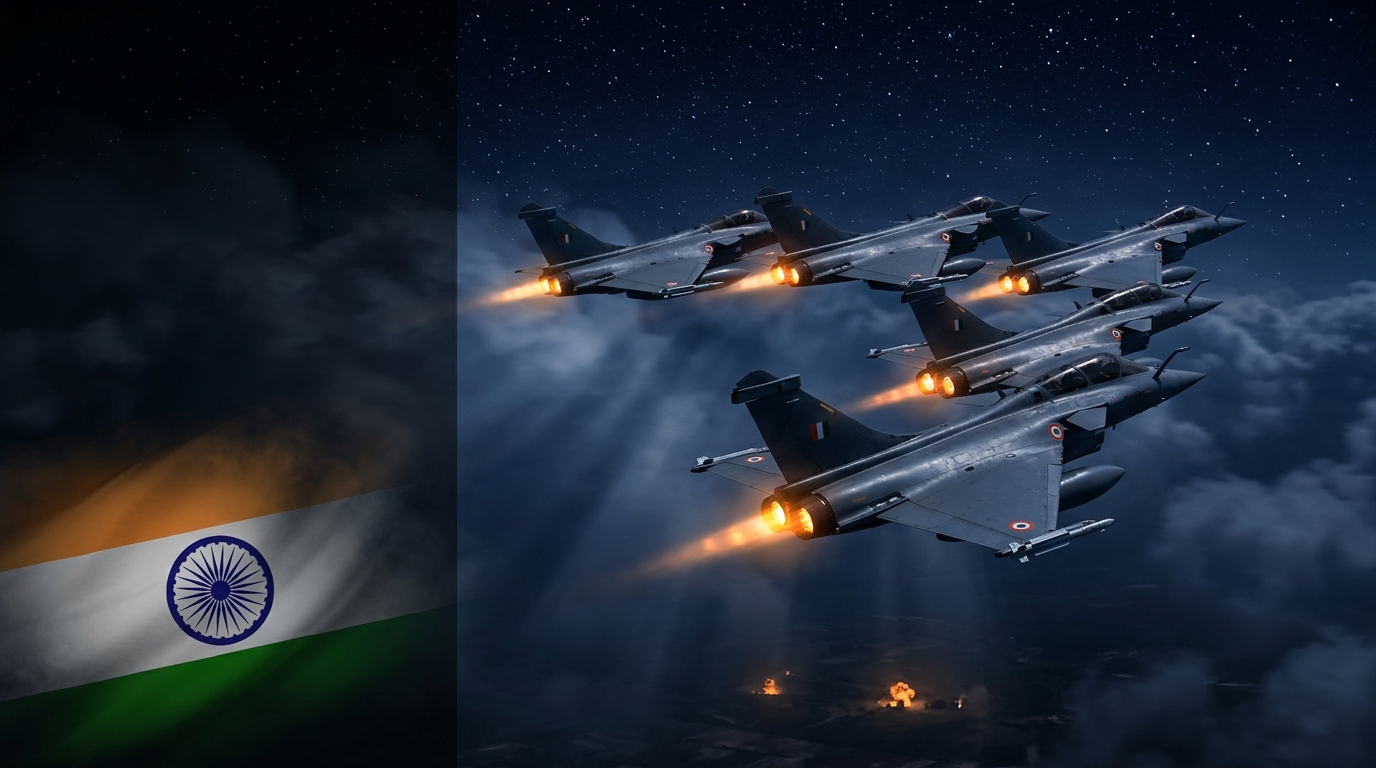
One year after India’s most decisive cross-border military strike in five decades, the Indian Armed Forces stood at a press conference in Jaipur — not to declare victory alone, but to deliver a warning: Operation Sindoor has not ended. It is only paused. GIN Defence Desk | May 8, 2026 | National · Security
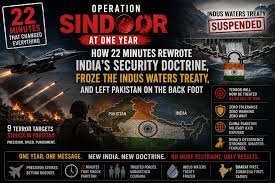
On the intervening night of May 6–7, 2025, within a span of just 22 minutes, the Indian Armed Forces launched a coordinated, precision multi-domain strike on nine terror infrastructure targets deep inside Pakistan and Pakistan-administered Azad Kashmir — changing the rules of engagement in South Asia forever.
The operation was India’s direct response to the Pahalgam massacre of April 22, 2025, where 26 civilians — mostly Hindu tourists — were identified by religion and killed by Pakistan-backed militants at Baisaran meadow in Jammu and Kashmir. The attack triggered nationwide outrage and set in motion one of the most meticulously planned military campaigns in Indian history.
The Indian Air Force’s strike package deployed Rafale jets equipped with SCALP Storm Shadow cruise missiles and HAMMER precision-guided bombs, alongside Sukhoi Su-30 MKIs and Mirage 2000s — all operating from within Indian airspace. The primary targets included the Jaish-e-Mohammed headquarters in Bahawalpur and the Lashkar-e-Taiba base in Muridke — two of the most fortified terror sanctuaries on Pakistani soil.
“We had achieved our objectives. But when the Pakistani establishment decided to side with terror and make it their own fight, we had no choice but to respond. It was about self-defence — much beyond a counter-terror operation.” — Air Marshal Awadhesh Kumar Bharti, IAF
As Pakistan retaliated with drones, missiles, and attempted strikes on Indian military installations, India escalated — targeting 11 Pakistani airbases including Nur Khan, Sargodha, Jacobabad, and Bholari, along with radar stations and command centres. Satellite imagery and battle damage assessments confirmed extensive destruction to runways, radar infrastructure, and aircraft shelters. A ceasefire came into force at 5:00 PM on May 10, 2025.
On the anniversary, a joint press conference by the Army, Air Force, and Navy in Jaipur revealed fresh operational details. Over 100 terrorists were confirmed killed across the nine camps. Lt Gen Rajiv Ghai noted that Pakistani military awards had been granted posthumously — underlining the scale of losses suffered. The Indian Navy’s role was confirmed: warships and submarines were forward-deployed near Pakistan’s coast, compelling Pakistani naval units into a purely defensive posture confined to their harbours.
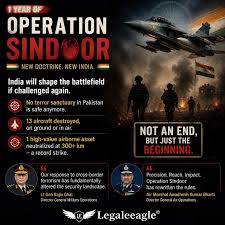
Strategic analysts now describe Operation Sindoor as a watershed moment — India’s first unambiguous shift from strategic restraint to rapid, technology-driven, coordinated retaliation. The operation validated the Atmanirbhar Bharat defence doctrine: BrahMos cruise missiles, Akash air-defence systems, Akashteer command units, and loitering munitions performed decisively without reliance on foreign logistics or US platforms. India had not just achieved military objectives — it had demonstrated a clear technological edge over a Chinese-supported adversary.
“Operation Sindoor was not an end. It was just the beginning. India’s fight against terror will go on.” — Armed Forces joint statement, Jaipur, May 7, 2026
The IAF released a commemorative video at 1:44 AM on May 7, 2026 — the exact moment the first wave of strikes was launched one year prior — alongside a single, unambiguous message to the world: Justice is Served.

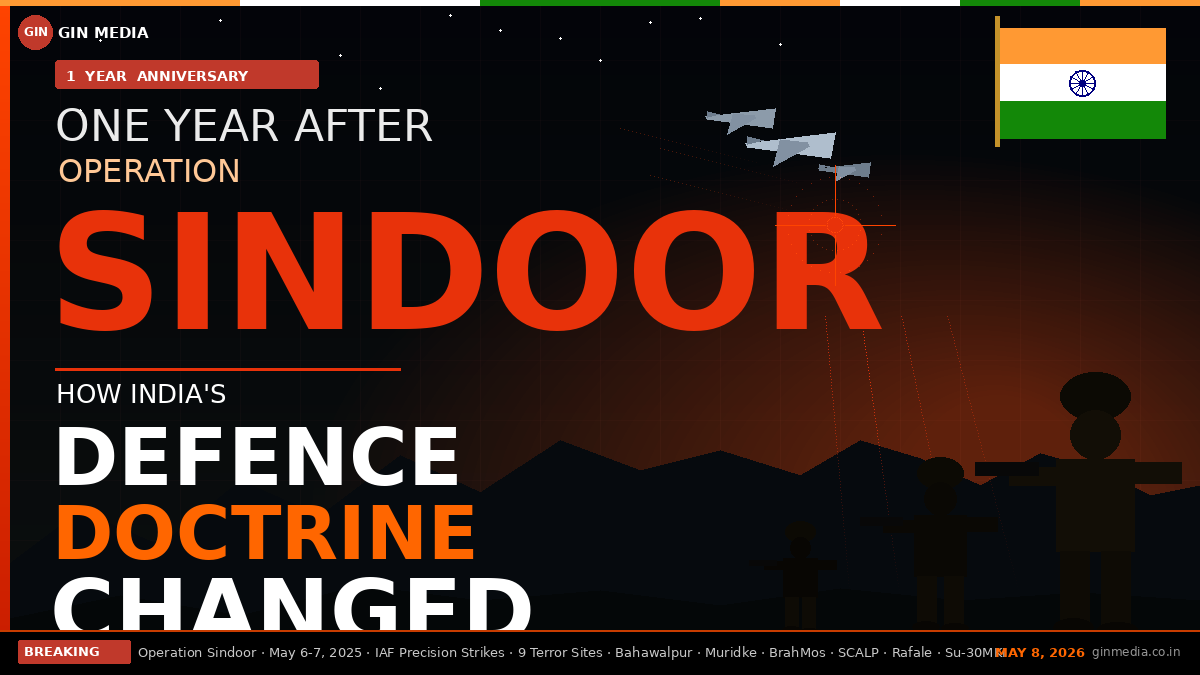
One Year On: How Operation Sindoor Rewrote India’s Security Doctrine
GIN DeskMay 8, 2026National Affairs
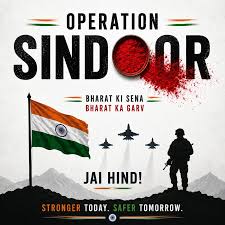
A year after India’s most consequential military strike in nearly five decades, the reverberations of Operation Sindoor continue to shape New Delhi’s strategic posture across South Asia.
On the intervening night of May 6–7, 2025, the Indian Air Force launched a precision multi-domain strike on nine terror infrastructure sites deep inside Pakistan and Pakistan-administered Azad Kashmir. The campaign — codenamed Operation Sindoor — was India’s direct response to the Pahalgam terror attack of April 22, 2025, in which 26 civilians were killed. New Delhi blamed the assault on militants backed by Pakistani state actors, a charge Islamabad denied.
The IAF strike package deployed Rafale jets, Mirage 2000s, and Sukhoi Su-30 MKIs, firing SCALP Storm Shadow cruise missiles and Hammer precision bombs from within Indian airspace. High-value targets included the Jaish-e-Mohammed headquarters in Bahawalpur and the Lashkar-e-Taiba base in Muridke — some of the most fortified terror camps on Pakistani soil.
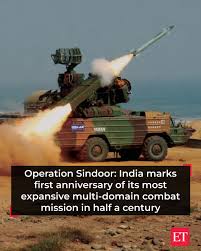
“India will identify, track, and punish every terrorist and their backers.” — Prime Minister Narendra Modi
What followed over the next four days was the largest beyond-visual-range aerial engagement on the India-Pakistan border, with more than 114 aircraft — 72 from the IAF and 42 from the Pakistan Air Force — involved in stand-off combat at distances exceeding 100 km. On the night of May 9–10, India escalated with strikes on eight PAF airbases and three radar installations, effectively grounding Pakistan’s ability to mount a sustained response. A ceasefire came into force at 5:00 p.m. on May 10, 2025.
Military analysts noted that Operation Sindoor achieved a defining strategic objective: it demonstrated, for the first time, that India was willing and capable of striking deep into Pakistan using exclusively indigenous or India-assembled platforms — BrahMos cruise missiles, Akashteer air-defence units, and loitering munitions — without dependence on US logistics or Western platforms. The operation marked a decisive shift in India’s national security doctrine toward self-reliance.
As India marks the first anniversary of the operation today, the IAF released a commemorative video at exactly 1:05 AM — the same time the first wave of strikes was launched one year ago — accompanied by the message: “Justice served. Precise in action, eternal in memory.”


Venezuela Twin Earthquakes Kill Nearly 2,000, Leave 43,000 Missing as Political Crisis Compounds the Catastrophe

PM Modi Becomes First Indian PM to Address Seychelles’ National Assembly, Hails 50 Years of “Maritime Brotherhood”

Trisha’s Delayed Birthday Post for Tamil Nadu CM Vijay Sparks Viral Political and Social Media Storm

Generation Z Is Killing Fast Fashion in India — And Building Something Far More Beautiful in Its Place

AR Rahman reacts to “anti-national” row over Imtiaz Ali’s Main Vaapas Aaunga

According to Dior Couture, this taboo fashion accessory is back

-
 Entertainment5 days ago
AR Rahman reacts to “anti-national” row over Imtiaz Ali’s Main Vaapas Aaunga
-

 Entertainment5 days ago
New Disney CEO Josh D’Amaro Invited to Join Oscars Academy in 2026 Class Alongside Jacob Elordi, Jenna Ortega
-

 Politics5 days ago
‘Passport Not Proof of Citizenship’: MEA Statement Sparks Political Storm Amid SIR Voter Roll Revision
-
 Politics19 hours ago
Venezuela Twin Earthquakes Kill Nearly 2,000, Leave 43,000 Missing as Political Crisis Compounds the Catastrophe
-
 Politics3 days ago
Trisha’s Delayed Birthday Post for Tamil Nadu CM Vijay Sparks Viral Political and Social Media Storm