Environment
India and EU Join Forces with ₹169 Crore EV Battery Recycling Mission — A Circular Economy Leap

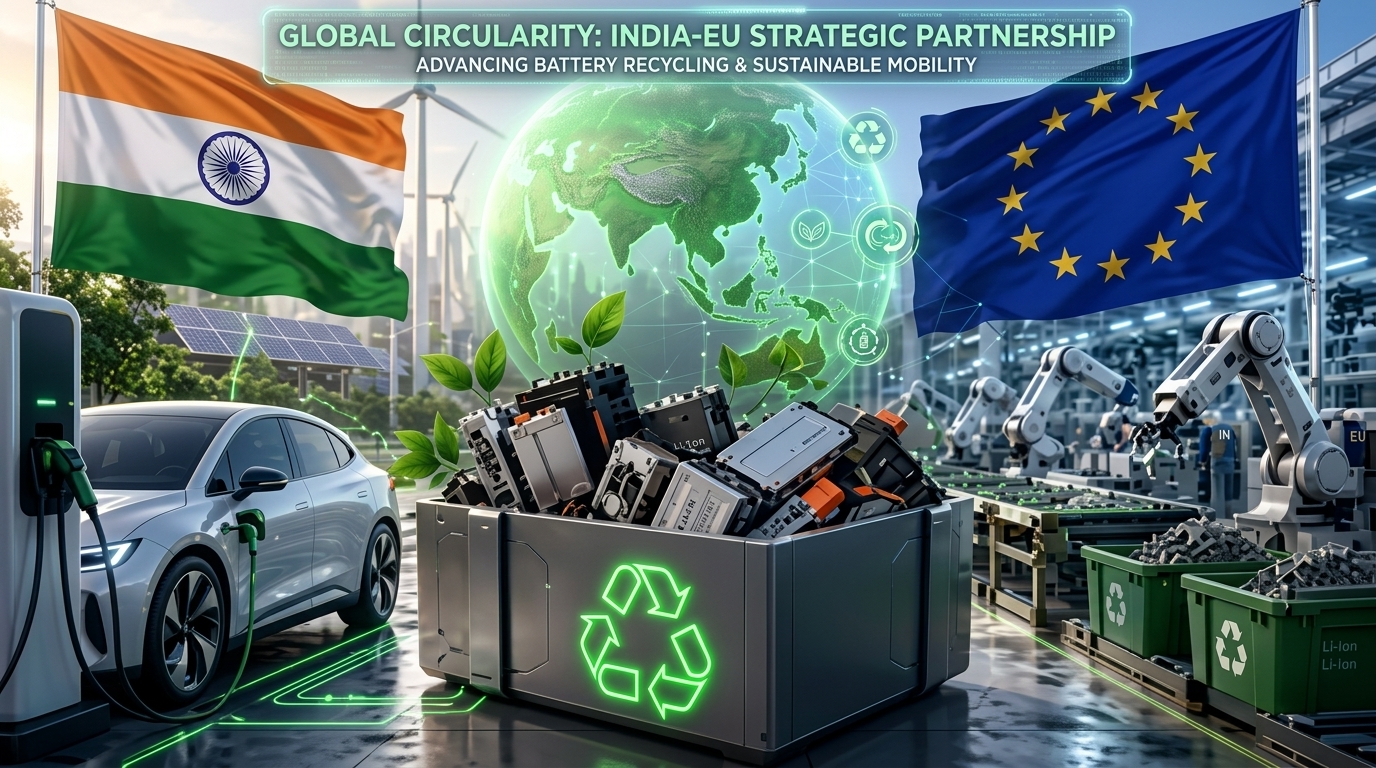
India and the European Union announced a landmark ₹169 crore joint initiative on May 5, 2026 to develop advanced electric vehicle battery recycling technologies — a partnership that strikes at the heart of both nations’ clean energy security and critical mineral independence. GIN Tech & Environment Desk | May 8, 2026 | Technology · Green Economy
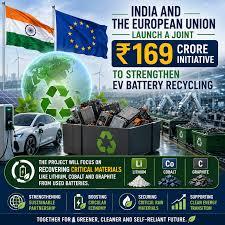
The initiative, launched under the India-EU Trade and Technology Council’s Working Group 2 on Green and Clean Energy Technologies, is backed by a combined €15.2 million funding pool — with the EU contributing through its Horizon Europe programme and India’s Ministry of Heavy Industries supporting the domestic component. Proposals are open until September 15, 2026, inviting joint consortia of companies, SMEs, startups, research institutions, and universities from both sides.
The technical focus areas are precisely targeted: high-efficiency recovery of critical battery materials including lithium, graphite, cobalt, and nickel; safe and digitalised battery collection systems integrating the informal recycling sector; development of second-life battery applications; and pilot-scale demonstration of innovative recycling processes. A flagship component is the establishment of a joint India-EU pilot line inside India — a physical facility for real-world industrial testing and deployment of recycling technologies.
“This launch is a pivotal moment in the India-EU strategic partnership — catalysing momentum for a digitalised, inclusive logistics model that integrates the informal sector while ensuring the highest safety standards.” — Prof. Ajay Kumar Sood, Principal Scientific Adviser to the Government of India
The strategic logic is compelling for both sides. India, the world’s third-largest oil consumer, imports over 85 per cent of its crude oil — an energy vulnerability the EV transition aims to correct. But that transition creates a new dependency: critical minerals for batteries, most of which are currently mined and processed in China. By developing domestic recycling capacity, India can recover these scarce materials from used batteries, reducing mining dependency and building a circular economy.
NITI Aayog estimates India will generate approximately 128 GWh of recyclable battery capacity by 2030. The EV battery recycling market in India is expected to grow exponentially by 2035. The India-EU initiative directly addresses this opportunity window — and positions both partners to build resilient, mutually beneficial supply chains in one of the 21st century’s most strategically important industrial sectors.


Environment
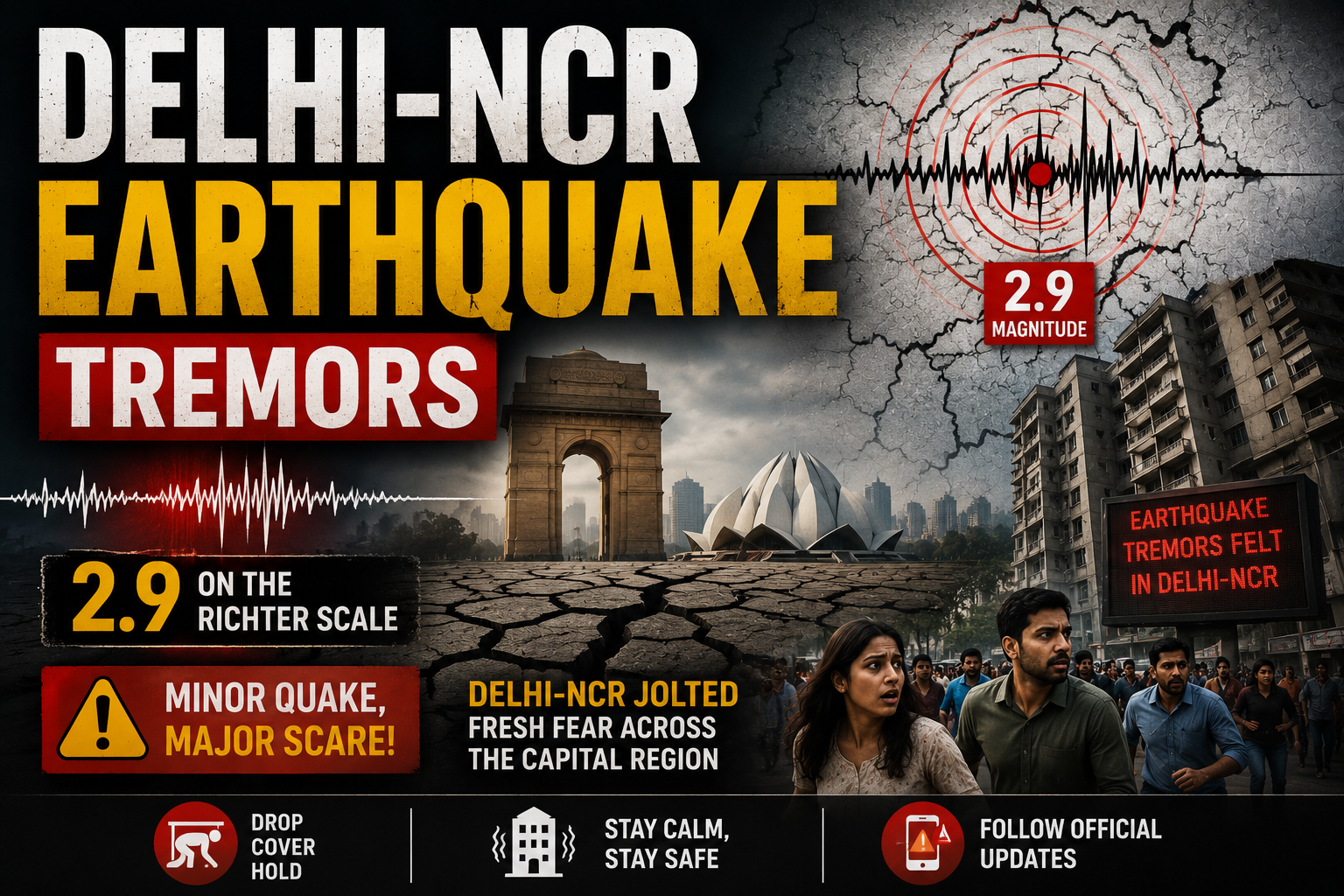
“Delhi Shakes: Tremors Rattle NCR Overnight”
Residents across Delhi-NCR felt mild earthquake tremors after a 2.9-magnitude quake struck the region. The brief jolt prompted people to step outdoors, though authorities reported no immediate major damage or injuries.
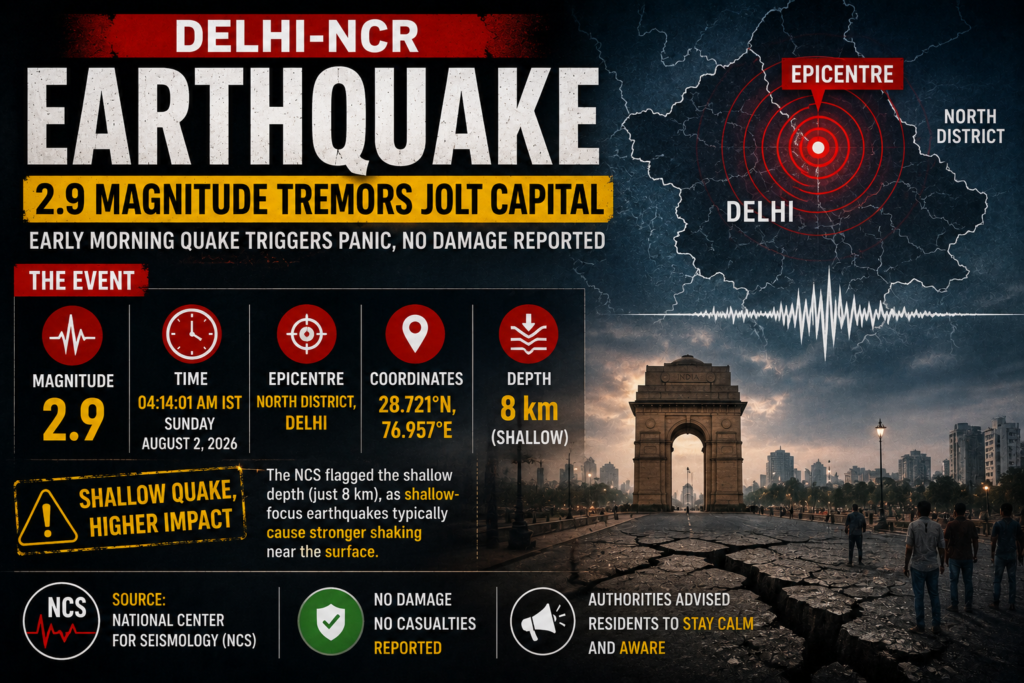
The Event
An earthquake of magnitude 2.9 jolted Delhi’s North District in the early hours of Sunday, August 2, 2026, at exactly 04:14:01 AM IST, according to the National Center for Seismology (NCS). The epicentre was located at latitude 28.721°N, longitude 76.957°E, at a shallow depth of just 8 km.
The NCS specifically flagged the shallow depth in its reporting, since shallow-focus earthquakes typically carry higher risk of noticeable shaking relative to their magnitude. No damage or casualties were reported.
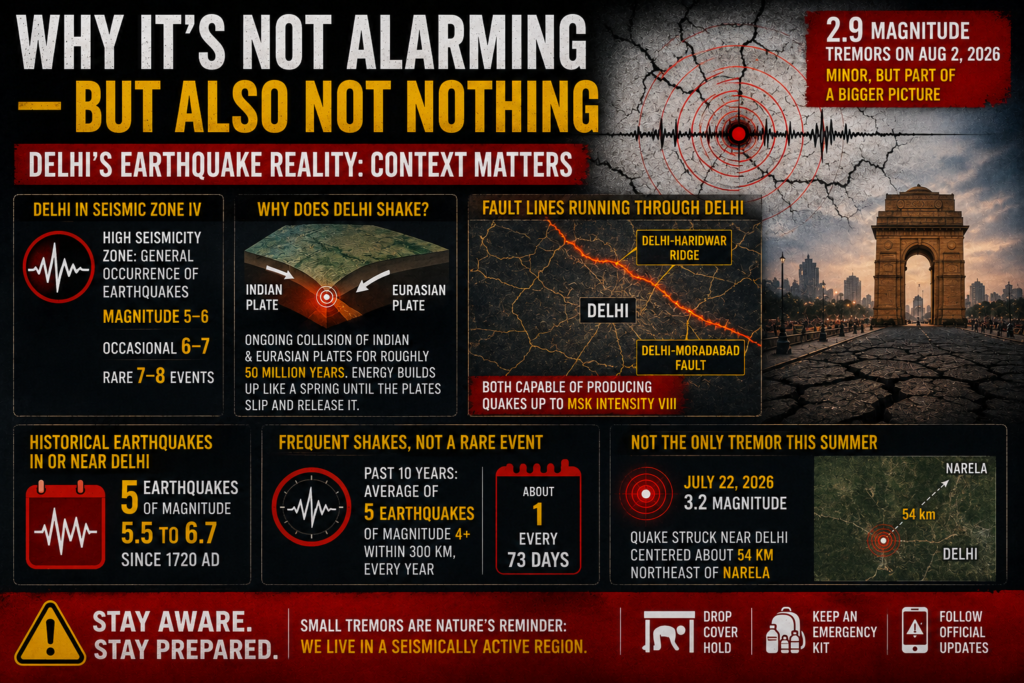
Why It’s Not Alarming — But Also Not Nothing
This was a minor, low-magnitude tremor, but it fits into a broader pattern context is important for your coverage:
- Delhi sits in seismic Zone IV, which has fairly high seismicity — the general occurrence of earthquakes in this zone ranges from magnitude 5-6, with occasional 6-7 and rare 7-8 events. This makes Delhi one of India’s high-risk seismic areas.
- This seismic activity stems from the ongoing collision of the Indian and Eurasian tectonic plates — a process that’s been happening continuously for roughly 50 million years, with energy building up like a spring until the plate margins finally slip.
- Historically, five earthquakes of magnitude 5.5 to 6.7 have struck in or near Delhi since 1720 AD, and two major fault lines — the Delhi-Haridwar ridge and Delhi-Moradabad faults — run through the territory, both capable of producing quakes up to MSK intensity VIII.
- Over the past 10 years, Delhi has seen an average of 5 earthquakes of magnitude 4+ within 300 km every year — about one every 73 days.
- Notably, this wasn’t even the only nearby tremor this summer — a 3.2 magnitude quake struck near Delhi on July 22, 2026, centered about 54 km northeast of Narela.
Public Reaction
Social commentary following the event captured the split reaction typical of Delhi residents: some treated it lightly (“2.9 is just a nudge back to sleep”-style comments, per social reactions), while others used it as a call to action — one commenter noted that Delhi-NCR being in Zone IV means “we must have better disaster management drills in residential societies,” urging people to be prepared rather than sorry.
Environment
“ASSAM IN CRISIS: The Flood That Won’t Stop”
Assam faces a severe monsoon flood crisis as heavy rainfall inundates towns and villages, forcing thousands from their homes and disrupting daily life. This report examines the causes, impact, rescue efforts, and the growing challenges posed by extreme weather.



Apple’s foldable “iPhone Ultra” and Chrome’s Manifest V2 extension cutoff

Amazon expanding drone delivery to ~500 US cities

Google’s $12.2 billion stake deal with Marvell

Generation Z Is Killing Fast Fashion in India — And Building Something Far More Beautiful in Its Place

AR Rahman reacts to “anti-national” row over Imtiaz Ali’s Main Vaapas Aaunga