
Business
US national debt crosses $40 trillion
US national debt crosses $40 trillion, intensifying concerns over America’s borrowing trajectory and the impact of elevated Treasury yields on financial markets.


The Exact Numbers
The Treasury confirmed the debt at $40,012,700,535,679 on August 18–19, 2026 — roughly $119,275 per American citizen. This came just five months after crossing the $39 trillion mark, and represents a roughly one-third increase in under five years. The debt has more than doubled since 2017 (from $19.95 trillion when Trump began his first term) and adds nearly $7 billion every single day, according to the Peter G. Peterson Foundation.
Why It’s Accelerating So Fast Right Now
- July 2026 alone saw a $432.3 billion monthly deficit — the highest single-month figure in more than five years
- The federal government’s cumulative FY2026 deficit hit $1.8 trillion by end of July, with the CBO revising its full-year deficit projection up to $2.1 trillion — $200 billion worse than its February estimate
- A major driver: the Supreme Court struck down several of Trump’s tariffs, forcing the Treasury to refund over $100 billion in illegally collected import taxes — directly widening the deficit
- Annual net interest payments crossed $1 trillion for the first time in FY2025 ($1.03 trillion) — meaning debt-servicing costs alone are now a trillion-dollar line item, projected to balloon to $2.1 trillion by 2036
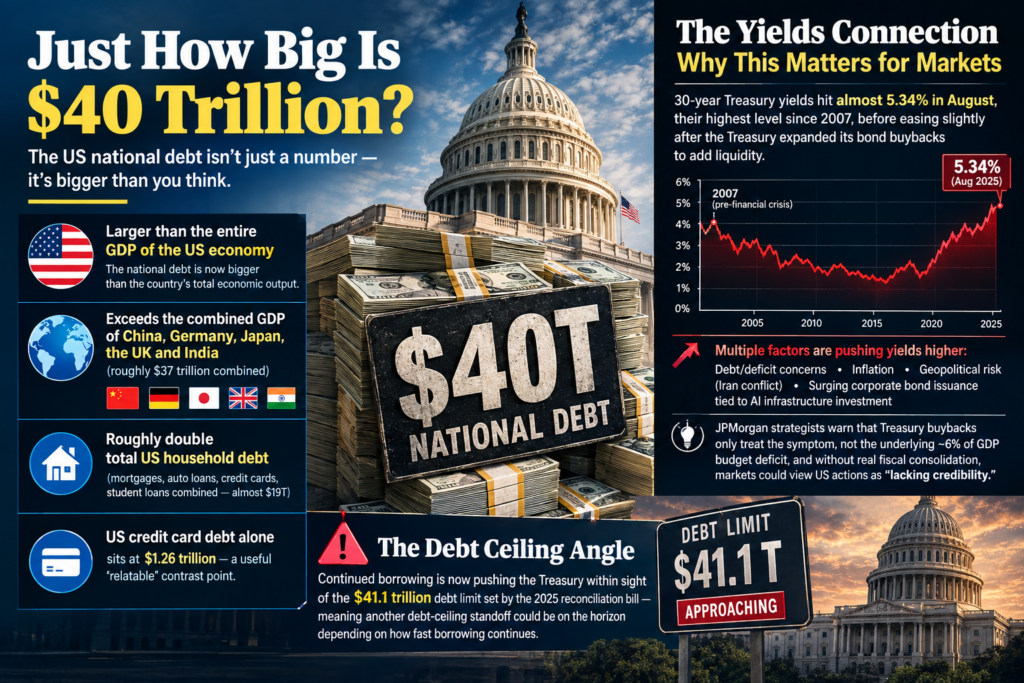
Just How Big Is $40 Trillion? (Great Visual Material)
- The US national debt is now larger than the entire GDP of the US economy
- It exceeds the combined GDP of China, Germany, Japan, the UK, and India (roughly $37 trillion combined)
- It’s roughly double total US household debt (mortgages, auto loans, credit cards, student loans combined — almost $19 trillion)
- US credit card debt alone, for comparison, sits at $1.26 trillion — a useful “relatable” contrast point
The Yields Connection — Why This Matters for Markets
This is the direct link to the AI-stock volatility story: 30-year Treasury yields hit almost 5.34% in August, their highest level since 2007 (pre-financial-crisis levels), before easing slightly after the Treasury expanded its bond buybacks to add liquidity. Multiple forces are compounding here — debt/deficit concerns, inflation, geopolitical risk from the Iran conflict, and notably surging corporate bond issuance tied to AI infrastructure investment — all pushing yields, and therefore borrowing costs across the whole economy, higher. JPMorgan strategists warned that Treasury buybacks only treat the symptom, not the underlying ~6%-of-GDP budget deficit, and that without real fiscal consolidation, markets could start viewing US actions as “lacking credibility.”
The Debt Ceiling Angle
Continued borrowing is now pushing the Treasury within sight of the $41.1 trillion debt limit set by the 2025 reconciliation bill — meaning another debt-ceiling standoff could be on the horizon depending on how fast borrowing continues.
The Long-Term Trajectory — Genuinely Alarming Numbers
- The CBO’s February 2026 warning called the fiscal trajectory “unsustainable,” projecting gross federal debt will reach approximately $64 trillion by 2036
- Real GDP growth is expected to average just 1.8% annually from 2027–2036 — meaning debt is set to keep outpacing the economy’s ability to grow its way out
- The Social Security trust fund faces potential insolvency as early as 2032–2033, adding another dimension to the fiscal-crisis narrative
- GAO estimates federal fraud costs the government $233–$521 billion annually — a recurring talking point in the political blame game
The Political Blame Game
Both parties are using the milestone rhetorically while avoiding real fixes: the Bipartisan Policy Center’s Margaret Spellings called the trajectory “plainly unsustainable… we’re speeding toward a cliff and refusing to turn the wheel,” while a common observation across coverage is that voters want deficit reduction in the abstract but resist the specific tax hikes or benefit cuts required to achieve it — “sacrifice is reserved for our political opponents,” as one analyst put it. The Trump administration has sought to pin the blame on Democrats, even as the tariff-refund ruling under its own policies widened the shortfall this year.











Business
India: RBI policy, rupee and IT earnings
India’s markets face a crucial week as the RBI policy decision and TCS earnings approach, while rupee weakness and global pressures weigh on the Nifty.

Business
Pressure on US automakers. Reuters reports that GM, Ford and Stellantis could see their combined US market share dip to 36% for the quarter
GM, Ford and Stellantis could see their combined U.S. market share fall to around 36%, highlighting growing pressure on Detroit’s biggest automakers.

Detroit Three Slip to Record-Low US Market Share as Gas Prices Drive Buyers to Hybrids
GM, Ford and Stellantis are heading for their weakest US showing on record. Cox Automotive estimates their combined third-quarter market share at around 36%, an all-time low, while hybrid-heavy Asian brands including Toyota and Honda are expected to account for more than half of new vehicle sales.
The driver is fuel costs. The Iran war has pushed US gasoline to a national average of $4.43 a gallon in September, according to AAA, up from $3.20 a year earlier, and buyers are turning to hybrids and more efficient models.
Toyota is the clearest winner. Its electrified sales climbed 28.5% to 363,367 units, or 57.4% of its US sales, and its Corolla hybrid jumped nearly 36%. GM kept the top US sales spot, but its lead over Toyota shrank to 37,751 vehicles, and Cox has said Toyota could overtake GM in the coming years if the trend continues. GM’s quarterly sales fell 5.5% to 670,974 units. Honda posted a record hybrid quarter of more than 106,000 units, with sales up 9.3%. Stellantis sales were roughly flat at 324,277.

Ford is under particular pressure. Cox expects its sales to fall 8.8% through the first three quarters of the year, with its market share dropping nearly a full point to 12.5%. Cox also forecast that Hyundai Motor Group would outsell Ford for the first time, 511,421 vehicles to 504,172, though Ford argues that Hyundai and Kia are separate companies and that it outsold the two combined year to date.
Overall US sales for the quarter are estimated at about 4.1 million, down about 1% from a year earlier. The average new-vehicle transaction price rose 1.9% to $50,089 in August.
What to watch: Ford’s reported third-quarter sales, gasoline prices, and whether Detroit’s automakers shift more of their production toward hybrids.
Business
Chip-sector M&A. A chip supplier announced it is buying Synaptics for $5.7 billion in cash
Synaptics shares jumped 14% after a chip supplier announced a $5.7 billion all-cash deal to acquire the company.

onsemi Switches to $5.7 Billion All-Cash Deal for Synaptics After Rival Bid Surfaces
Shares of Synaptics jumped about 14% after chipmaker onsemi (ON Semiconductor) agreed to buy it in an all-cash deal valued at about $5.7 billion. The revised agreement, announced late Thursday, October 1, pays $123 per share in cash and replaces the all-stock deal the companies signed on June 25, which was valued at about $7 billion.
The change followed competing interest. A filing shows Synaptics had received an unsolicited, non-binding proposal from another strategic party, which likely drove the renegotiation. Synaptics’ board unanimously concluded that the amended deal remains in shareholders’ interests.
Shares of Synaptics opened more than 14% higher on Friday, moving close to the cash offer. The stock had closed at $106.15 the previous day. onsemi shares rose about 6% in premarket trading from a prior close of $80.08, with investors welcoming that the cash structure avoids issuing new shares that would have diluted existing holders.

Under the original agreement, Synaptics holders were to receive 1.350 onsemi shares for each share they own. The new deal will be funded with cash on hand and about $2.45 billion in committed debt financing from Morgan Stanley. onsemi expects the acquisition to add to its non-GAAP earnings per share immediately, and has identified $200 million of annual run-rate synergies.
The deal still needs approval from Synaptics shareholders and regulators, with completion expected by mid-2027. It came amid a broader rally in semiconductor stocks.


Spain’s train crash and upcoming election. Spain is dealing with its second deadly train crash this year.

Hong Kong’s Tai Po fire fallout. Leader John Lee apologized

Serbia’s media shake-up. The head of public broadcaster RTS resigned after the student list won an election.

Generation Z Is Killing Fast Fashion in India — And Building Something Far More Beautiful in Its Place

AR Rahman reacts to “anti-national” row over Imtiaz Ali’s Main Vaapas Aaunga

According to Dior Couture, this taboo fashion accessory is back

-

 Entertainment19 hours ago
2026 is a big year at the box office
-

 Entertainment19 hours ago
Ramayana Part 1 arrives this week.
-

 Entertainment19 hours ago
Rajinikanth’s Jailer 2 enters the top 20.
-

 Entertainment19 hours ago
Bigg Boss 20 drama. Manoj Tiwari defended his daughter
-

 Entertainment19 hours ago
Other Diwali releases. Nayanthara’s Mookuthi Amman .