
Business
Warren Buffett steps down as Berkshire Hathaway chairman
Warren Buffett steps down as Berkshire Hathaway chairman after 56 years, with Howard Buffett taking over as chairman and Greg Abel leading the company as CEO.

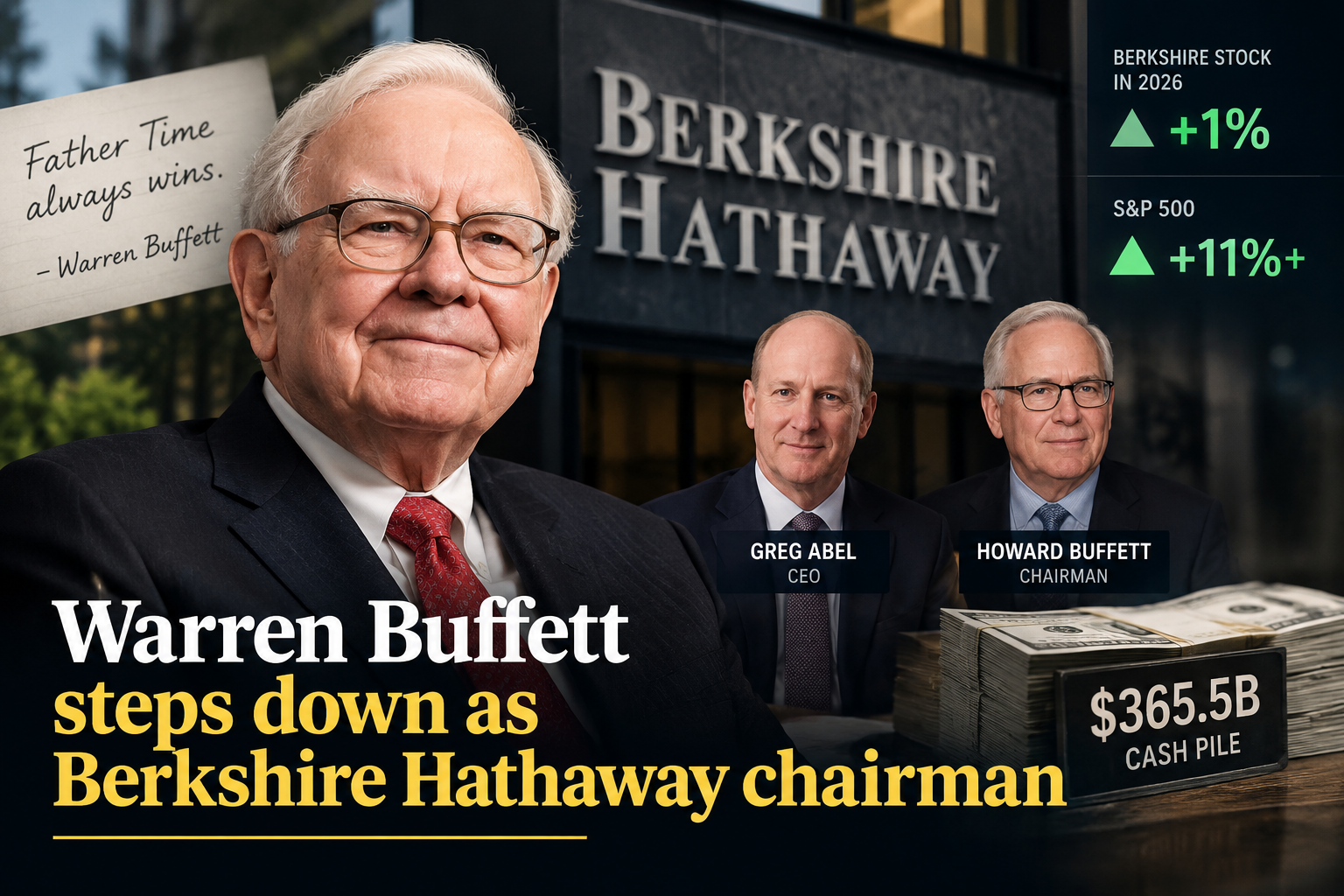
The Full Timeline of the Handover
This wasn’t a sudden move — it’s the final step of a plan that’s been unfolding for years, and arguably decades:
- 2006: A 75-year-old Buffett first publicly discussed succession planning in a shareholder letter
- 2018: Buffett put Greg Abel in charge of all Berkshire’s non-insurance businesses (manufacturing, retail, railroads, utilities), while fellow Vice Chairman Ajit Jain took the insurance side
- 2021: Berkshire confirmed Abel as Buffett’s chosen successor, after Charlie Munger let it slip at a shareholder meeting
- May 2025: At the annual meeting, Buffett announced he’d step down as CEO at year-end, staying on as chairman — a “surprise” that was really just the next scheduled milestone
- January 1, 2026: Abel formally became CEO
- September 18, 2026: Buffett handed over the chairman title too, becoming chairman emeritus, with Howard Buffett stepping in as chairman
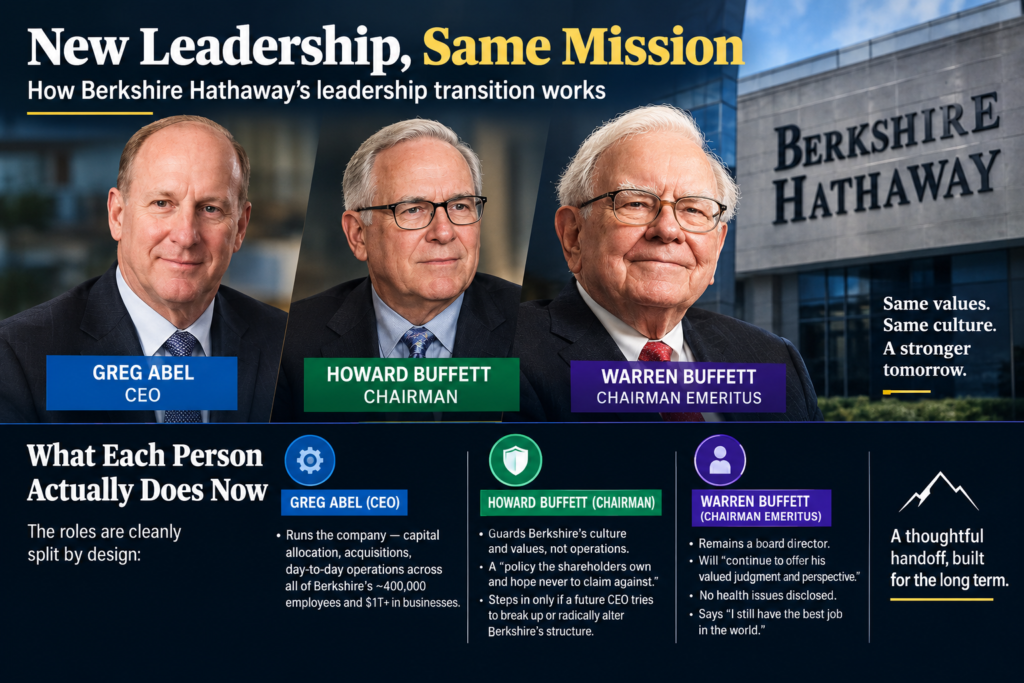
What Each Person Actually Does Now
This is the part worth clarifying for your segment — the roles are cleanly split by design:
- Greg Abel (CEO): Runs the company — capital allocation, acquisitions, day-to-day operations across all of Berkshire’s roughly 400,000 employees and $1 trillion+ in businesses
- Howard Buffett (Chairman): A “non-executive” role focused specifically on guarding Berkshire’s culture and values, not running operations. Warren described him bluntly as “a policy the shareholders own and hope never to claim against” — meaning Howard’s real job is to step in only if a future CEO ever tries to break up or radically alter Berkshire’s structure
- Warren Buffett (Chairman Emeritus): Remains a board director and says he’ll “continue to offer his valued judgment and perspective” — importantly, the announcement revealed no health issues, and Buffett himself wrote “I still have the best job in the world,” suggesting he may keep showing up to the office
Why the Separation of Roles Matters
Commentators have noted this is a genuinely unusual structure: Buffett explicitly separated business leadership (given to Abel, an outsider with a 25-year track record at Berkshire, based purely on merit) from the family/culture-guardian role (given to his son). This is being read as a deliberate hedge against the common failure mode where family successors take over operational control they may not be suited for — Berkshire instead keeps the “keys to the machine” with a proven operator while keeping a family member as a values check.
Reactions and Open Questions
- The market’s reaction was notably calm — seen as validation that the transparent, long-telegraphed succession worked as intended, in sharp contrast to messier corporate transitions elsewhere
- Investor Adam Mead (author of “The Complete Financial History of Berkshire Hathaway”) suggested Buffett may be trying to minimize the market shock whenever he eventually dies, by decoupling that event from any operational transition now — since operationally, nothing changes when that day comes
- Analysts note real uncertainty remains about exactly how Berkshire will function with Buffett in a title-only role for the first time in 56 years — some flagged unanswered questions they hope get addressed in Berkshire’s upcoming Q3 10-Q (early November) or the annual letter (late February)
The Numbers That Make Abel’s Job Hard
- Berkshire sits on a record $365.5 billion cash pile, and investors are watching whether Abel deploys it as aggressively as Buffett historically did
- Abel has begun ramping up share buybacks — $4.5 billion in Q2 2026 alone — as one visible signal of capital deployment
- Buffett’s own track record is the shadow Abel operates under: a 19.7% compounded annual return since 1965, nearly double the S&P 500’s performance over the same stretch — and Berkshire’s share price rose over 5,500,000% in that time, versus about 39,000% for the S&P 500
- Berkshire posted $44.5 billion in operating earnings last year with nearly 400,000 employees — the sheer scale Abel now has sole responsibility for






Business
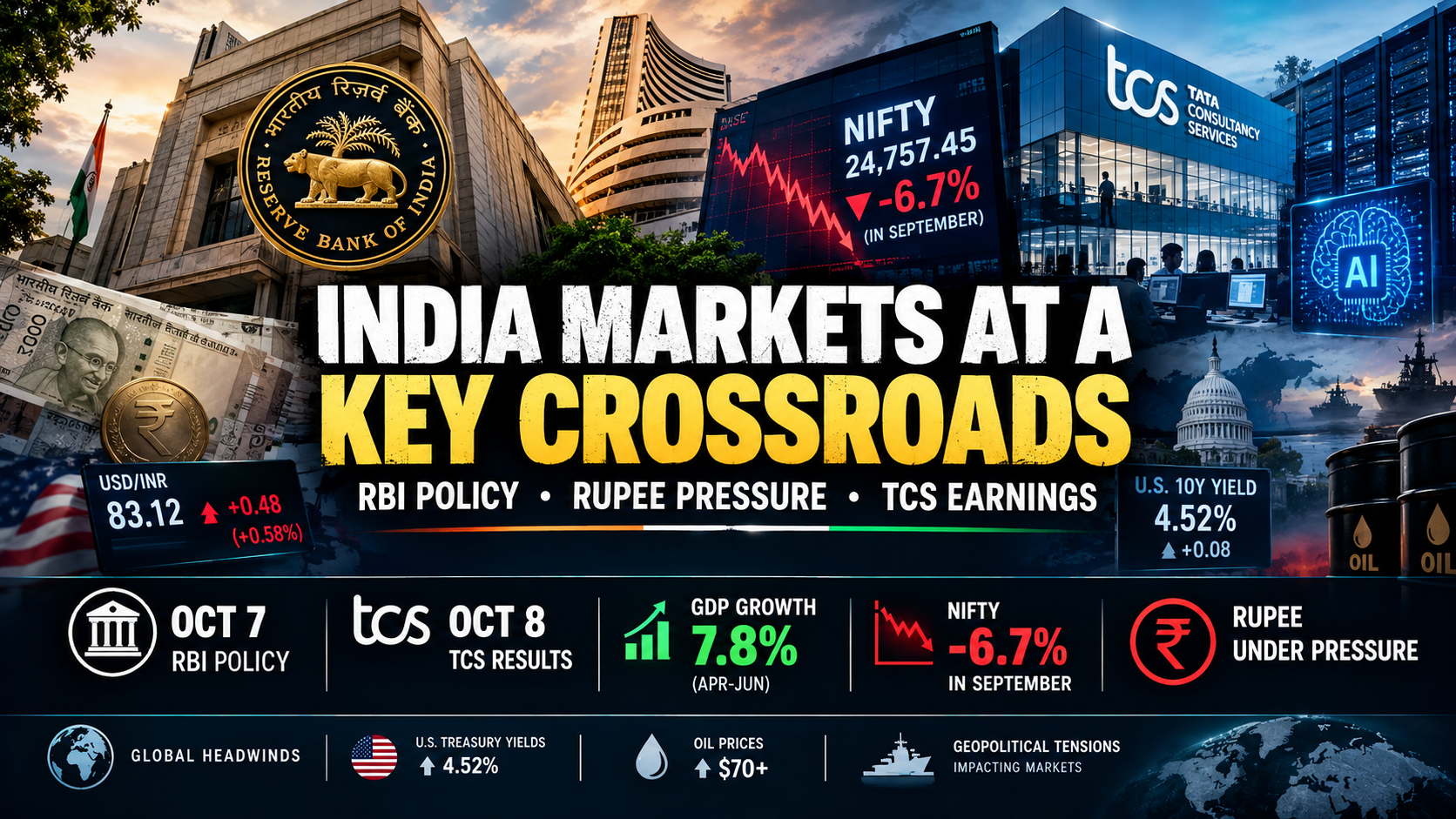
India: RBI policy, rupee and IT earnings
India’s markets face a crucial week as the RBI policy decision and TCS earnings approach, while rupee weakness and global pressures weigh on the Nifty.
Business
Pressure on US automakers. Reuters reports that GM, Ford and Stellantis could see their combined US market share dip to 36% for the quarter
GM, Ford and Stellantis could see their combined U.S. market share fall to around 36%, highlighting growing pressure on Detroit’s biggest automakers.

Detroit Three Slip to Record-Low US Market Share as Gas Prices Drive Buyers to Hybrids
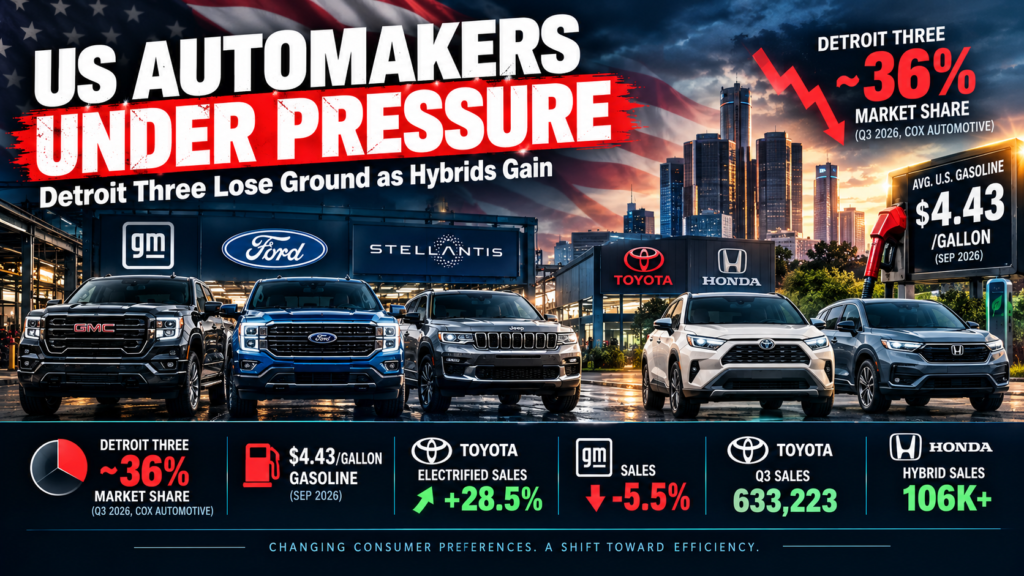
GM, Ford and Stellantis are heading for their weakest US showing on record. Cox Automotive estimates their combined third-quarter market share at around 36%, an all-time low, while hybrid-heavy Asian brands including Toyota and Honda are expected to account for more than half of new vehicle sales.
The driver is fuel costs. The Iran war has pushed US gasoline to a national average of $4.43 a gallon in September, according to AAA, up from $3.20 a year earlier, and buyers are turning to hybrids and more efficient models.
Toyota is the clearest winner. Its electrified sales climbed 28.5% to 363,367 units, or 57.4% of its US sales, and its Corolla hybrid jumped nearly 36%. GM kept the top US sales spot, but its lead over Toyota shrank to 37,751 vehicles, and Cox has said Toyota could overtake GM in the coming years if the trend continues. GM’s quarterly sales fell 5.5% to 670,974 units. Honda posted a record hybrid quarter of more than 106,000 units, with sales up 9.3%. Stellantis sales were roughly flat at 324,277.
Ford is under particular pressure. Cox expects its sales to fall 8.8% through the first three quarters of the year, with its market share dropping nearly a full point to 12.5%. Cox also forecast that Hyundai Motor Group would outsell Ford for the first time, 511,421 vehicles to 504,172, though Ford argues that Hyundai and Kia are separate companies and that it outsold the two combined year to date.
Overall US sales for the quarter are estimated at about 4.1 million, down about 1% from a year earlier. The average new-vehicle transaction price rose 1.9% to $50,089 in August.
What to watch: Ford’s reported third-quarter sales, gasoline prices, and whether Detroit’s automakers shift more of their production toward hybrids.
Business
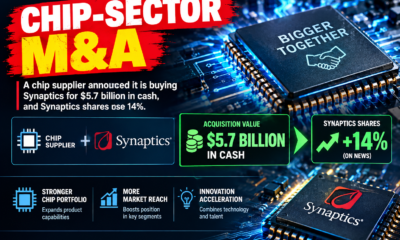
Chip-sector M&A. A chip supplier announced it is buying Synaptics for $5.7 billion in cash
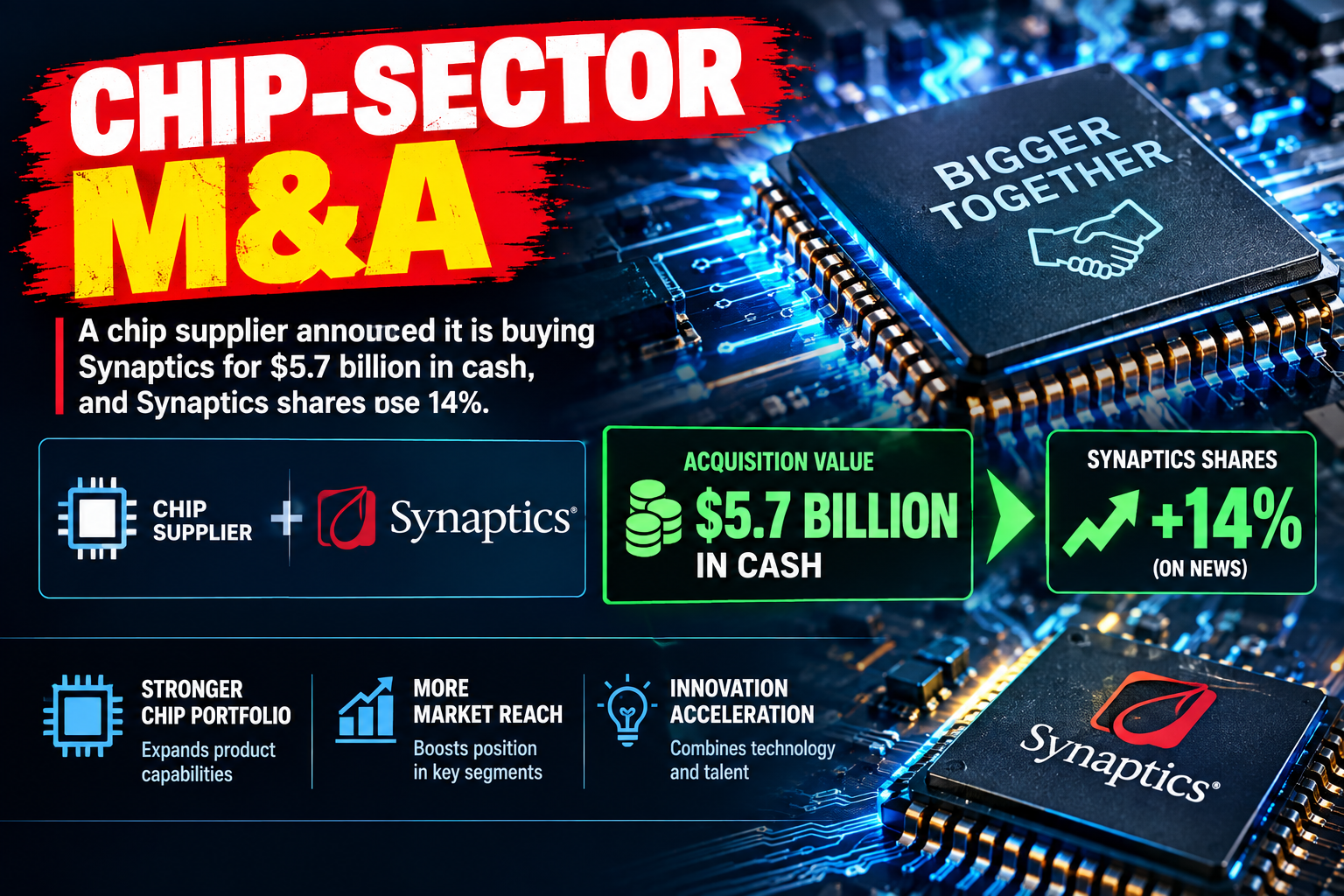
Synaptics shares jumped 14% after a chip supplier announced a $5.7 billion all-cash deal to acquire the company.
onsemi Switches to $5.7 Billion All-Cash Deal for Synaptics After Rival Bid Surfaces
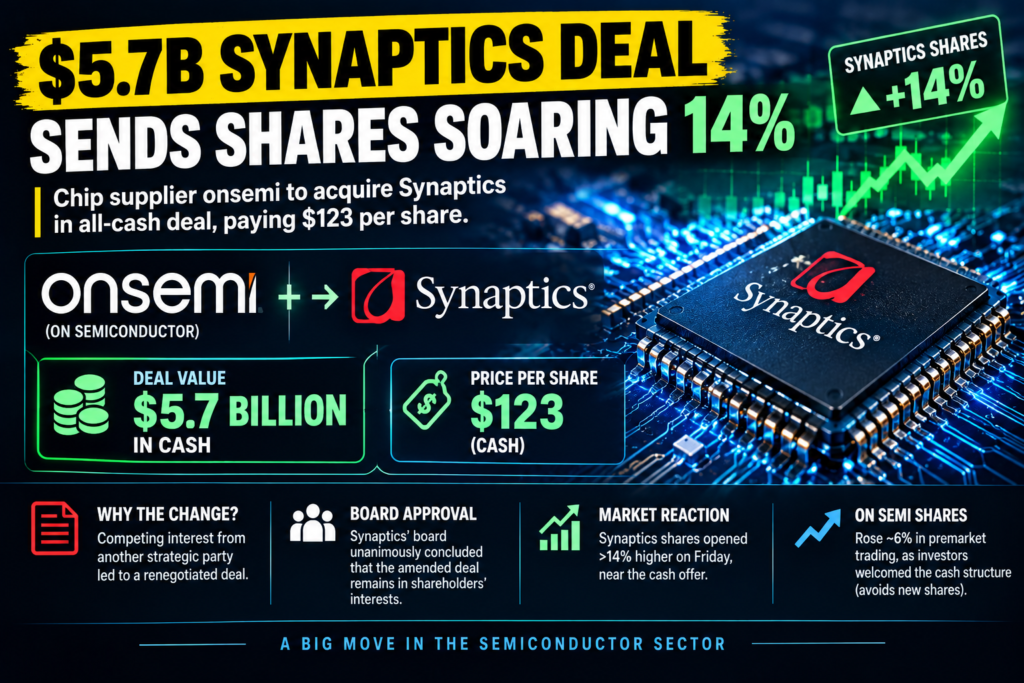
Shares of Synaptics jumped about 14% after chipmaker onsemi (ON Semiconductor) agreed to buy it in an all-cash deal valued at about $5.7 billion. The revised agreement, announced late Thursday, October 1, pays $123 per share in cash and replaces the all-stock deal the companies signed on June 25, which was valued at about $7 billion.
The change followed competing interest. A filing shows Synaptics had received an unsolicited, non-binding proposal from another strategic party, which likely drove the renegotiation. Synaptics’ board unanimously concluded that the amended deal remains in shareholders’ interests.
Shares of Synaptics opened more than 14% higher on Friday, moving close to the cash offer. The stock had closed at $106.15 the previous day. onsemi shares rose about 6% in premarket trading from a prior close of $80.08, with investors welcoming that the cash structure avoids issuing new shares that would have diluted existing holders.
Under the original agreement, Synaptics holders were to receive 1.350 onsemi shares for each share they own. The new deal will be funded with cash on hand and about $2.45 billion in committed debt financing from Morgan Stanley. onsemi expects the acquisition to add to its non-GAAP earnings per share immediately, and has identified $200 million of annual run-rate synergies.
The deal still needs approval from Synaptics shareholders and regulators, with completion expected by mid-2027. It came amid a broader rally in semiconductor stocks.


Spain’s train crash and upcoming election. Spain is dealing with its second deadly train crash this year.

Hong Kong’s Tai Po fire fallout. Leader John Lee apologized

Serbia’s media shake-up. The head of public broadcaster RTS resigned after the student list won an election.

Generation Z Is Killing Fast Fashion in India — And Building Something Far More Beautiful in Its Place

AR Rahman reacts to “anti-national” row over Imtiaz Ali’s Main Vaapas Aaunga

According to Dior Couture, this taboo fashion accessory is back

-

 Entertainment15 hours ago
2026 is a big year at the box office
-

 Entertainment15 hours ago
Ramayana Part 1 arrives this week.
-

 Entertainment15 hours ago
Rajinikanth’s Jailer 2 enters the top 20.
-

 Entertainment15 hours ago
Bigg Boss 20 drama. Manoj Tiwari defended his daughter
-

 Entertainment14 hours ago
Other Diwali releases. Nayanthara’s Mookuthi Amman .