
Business
Oil-war economics reshape global tradeThe ongoing US-Iran conflict continues rippling through commodity and shipping markets
US-Iran tensions are reshaping global oil flows, with Brazil boosting exports, China redirecting demand and tanker insurance premiums rising around the Strait of Hormuz.


How the Strait of Hormuz Actually “Closed”
This is a genuinely fascinating mechanical story: the strait didn’t close because of a physical blockade — it closed because insurance evaporated. On March 2, 2026, the International Group of P&I Clubs (a mutual risk pool covering 90% of the world’s ocean-going tonnage) — all 12 members simultaneously — issued 72-hour cancellation notices for war coverage. By March 5, coverage had vanished, and within hours more than 150 tankers were idling outside the chokepoint, unable to move without insurance. Before that, within 48 hours of the initial US-Israeli strikes on Iran (February 28, 2026), war risk premiums had already surged fivefold and Lloyd’s Joint War Committee redesignated the entire Arabian Gulf as a conflict zone — tanker traffic collapsed by more than 80%.
The Insurance Cost Explosion — In Concrete Numbers
- Before the war: war risk premiums ran about 0.15%–0.25% of a vessel’s hull value — roughly $150,000–$375,000 for a single transit on a $100–150 million tanker
- At the peak of the crisis: premiums surged to 3%–10% of hull value — meaning a $100 million tanker faces $3 million to $10 million in war risk insurance for one trip, a roughly 20–40x increase
- One report even cites figures as high as $10–14 million per voyage for some “US-nexus” tankers, which have picked up the grim nickname “missile magnets”
- Historical comparison for context: the 1980s “Tanker War” between Iran and Iraq (when Iraq attacked 283 vessels and Iran 168 over eight years) saw typical rates around 5% — meaning current premiums are tracking close to, or beyond, that historic benchmark
Why Rates Are So Volatile
Marcus Baker, global head of marine, cargo and logistics at insurance broker Marsh, described it as a “roller coaster” — rates spiked initially, dropped back after a memorandum of understanding was signed, then surged again as Iran resumed tanker attacks, including strikes on two UAE supertankers that killed a sailor. Roughly 6,000 seafarers have reportedly been trapped in the region at various points, with the International Maritime Organisation working on evacuation routes.
The Market’s Response: A New Insurance Facility
Because demand for Hormuz war-risk coverage exceeded what individual Lloyd’s syndicates could absorb alone, the market built a purpose-designed $400 million consortium facility — split between hull/P&I coverage and cargo coverage — to pool capacity across underwriters. Lloyd’s of London writes an estimated 70–80% of the world’s marine war-risk business, making London’s pricing decisions genuinely pivotal to global oil logistics.
Brazil’s Windfall — The Direct Beneficiary
This is where your original headline comes in, and it’s a clean, relatable story:
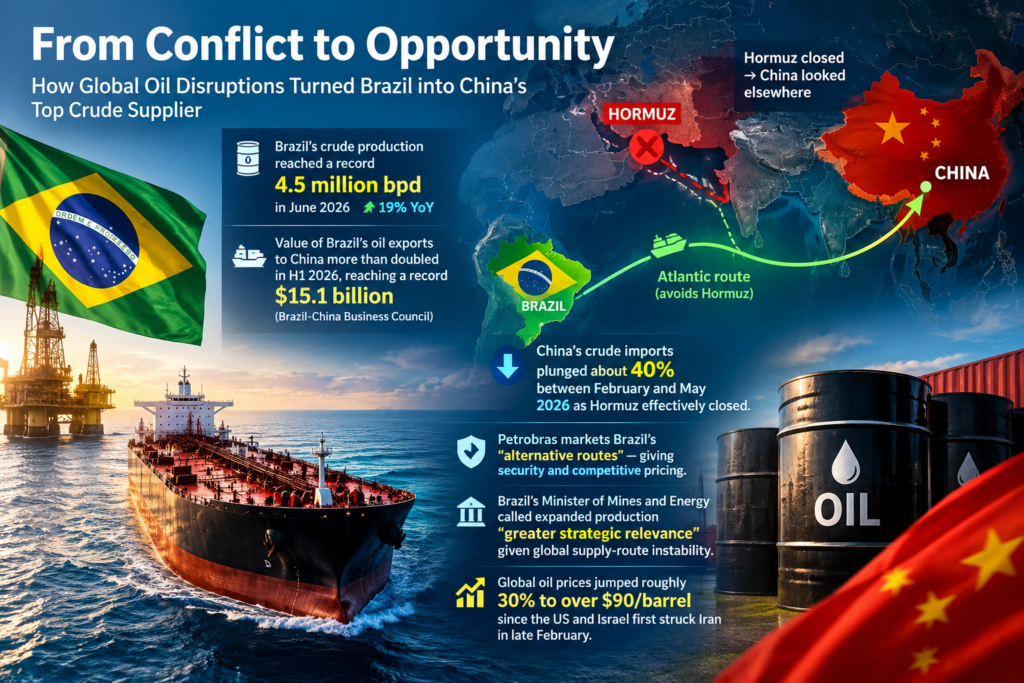
- Brazil’s crude production hit a record 4.5 million barrels per day in June 2026, up 19% year-over-year
- The value of Brazil’s oil exports to China more than doubled in the first half of 2026, reaching a record $15.1 billion, according to the Brazil-China Business Council
- China’s total crude imports plunged about 40% between February and May as Hormuz effectively closed — forcing Beijing to look elsewhere, and Brazil’s Atlantic-facing geography (avoiding Hormuz entirely) made it a natural substitute
- Petrobras has explicitly marketed this positioning, stating it has “alternative routes from the area of conflict, which gives security and competitive pricing,” and Brazil’s Minister of Mines and Energy called the expanded production of “greater strategic relevance” given global supply-route instability
- Global oil prices jumped roughly 30% to over $90/barrel since the US and Israel first struck Iran in late February — the price spike that’s making Brazil’s expanded output so lucrative
Why This Matters for Your Broader Coverage
This ties together three segments you’ve already covered: it’s the root cause of the ExxonMobil/Chevron record profits (topic 1 from earlier), a direct driver of the elevated Treasury yields squeezing the AI-stock trade, and now it’s reshaping which countries win and lose in global energy trade — Brazil emerging as a structural winner, Middle East producers and shippers absorbing the disruption, and consumers everywhere paying higher prices at the pump.









Business
India: RBI policy, rupee and IT earnings
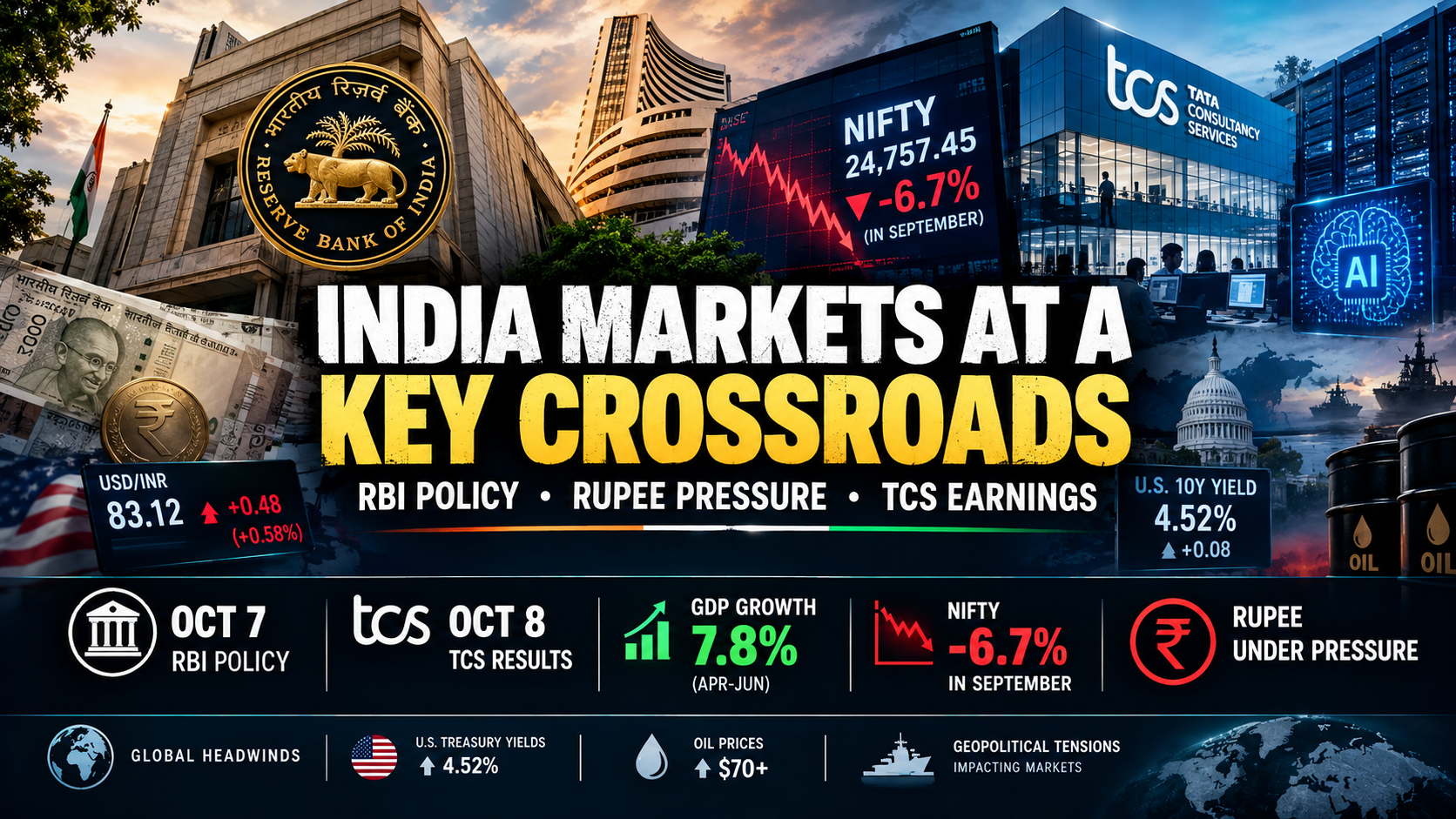
India’s markets face a crucial week as the RBI policy decision and TCS earnings approach, while rupee weakness and global pressures weigh on the Nifty.
Business
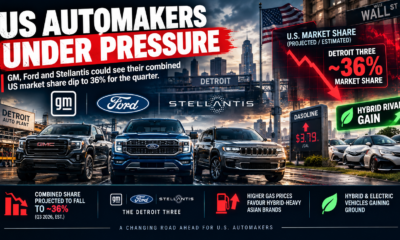
Pressure on US automakers. Reuters reports that GM, Ford and Stellantis could see their combined US market share dip to 36% for the quarter
GM, Ford and Stellantis could see their combined U.S. market share fall to around 36%, highlighting growing pressure on Detroit’s biggest automakers.

Detroit Three Slip to Record-Low US Market Share as Gas Prices Drive Buyers to Hybrids
GM, Ford and Stellantis are heading for their weakest US showing on record. Cox Automotive estimates their combined third-quarter market share at around 36%, an all-time low, while hybrid-heavy Asian brands including Toyota and Honda are expected to account for more than half of new vehicle sales.
The driver is fuel costs. The Iran war has pushed US gasoline to a national average of $4.43 a gallon in September, according to AAA, up from $3.20 a year earlier, and buyers are turning to hybrids and more efficient models.
Toyota is the clearest winner. Its electrified sales climbed 28.5% to 363,367 units, or 57.4% of its US sales, and its Corolla hybrid jumped nearly 36%. GM kept the top US sales spot, but its lead over Toyota shrank to 37,751 vehicles, and Cox has said Toyota could overtake GM in the coming years if the trend continues. GM’s quarterly sales fell 5.5% to 670,974 units. Honda posted a record hybrid quarter of more than 106,000 units, with sales up 9.3%. Stellantis sales were roughly flat at 324,277.
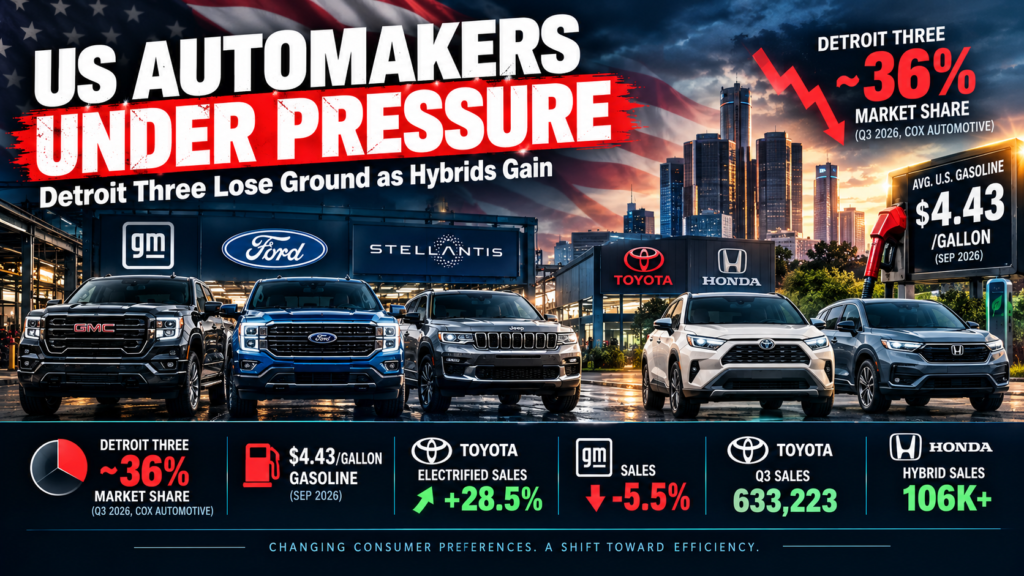
Ford is under particular pressure. Cox expects its sales to fall 8.8% through the first three quarters of the year, with its market share dropping nearly a full point to 12.5%. Cox also forecast that Hyundai Motor Group would outsell Ford for the first time, 511,421 vehicles to 504,172, though Ford argues that Hyundai and Kia are separate companies and that it outsold the two combined year to date.
Overall US sales for the quarter are estimated at about 4.1 million, down about 1% from a year earlier. The average new-vehicle transaction price rose 1.9% to $50,089 in August.
What to watch: Ford’s reported third-quarter sales, gasoline prices, and whether Detroit’s automakers shift more of their production toward hybrids.
Business
Chip-sector M&A. A chip supplier announced it is buying Synaptics for $5.7 billion in cash
Synaptics shares jumped 14% after a chip supplier announced a $5.7 billion all-cash deal to acquire the company.
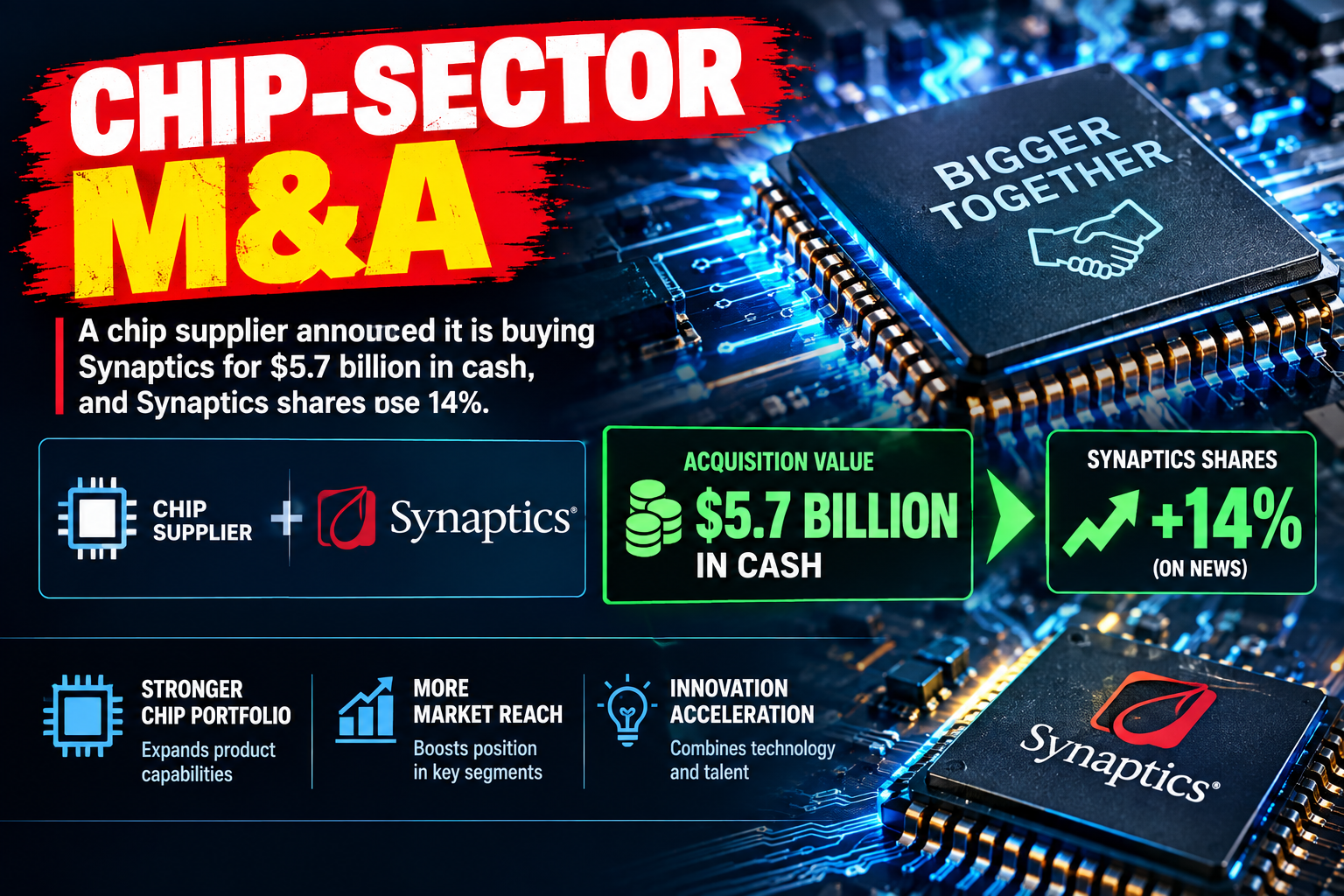
onsemi Switches to $5.7 Billion All-Cash Deal for Synaptics After Rival Bid Surfaces
Shares of Synaptics jumped about 14% after chipmaker onsemi (ON Semiconductor) agreed to buy it in an all-cash deal valued at about $5.7 billion. The revised agreement, announced late Thursday, October 1, pays $123 per share in cash and replaces the all-stock deal the companies signed on June 25, which was valued at about $7 billion.
The change followed competing interest. A filing shows Synaptics had received an unsolicited, non-binding proposal from another strategic party, which likely drove the renegotiation. Synaptics’ board unanimously concluded that the amended deal remains in shareholders’ interests.
Shares of Synaptics opened more than 14% higher on Friday, moving close to the cash offer. The stock had closed at $106.15 the previous day. onsemi shares rose about 6% in premarket trading from a prior close of $80.08, with investors welcoming that the cash structure avoids issuing new shares that would have diluted existing holders.
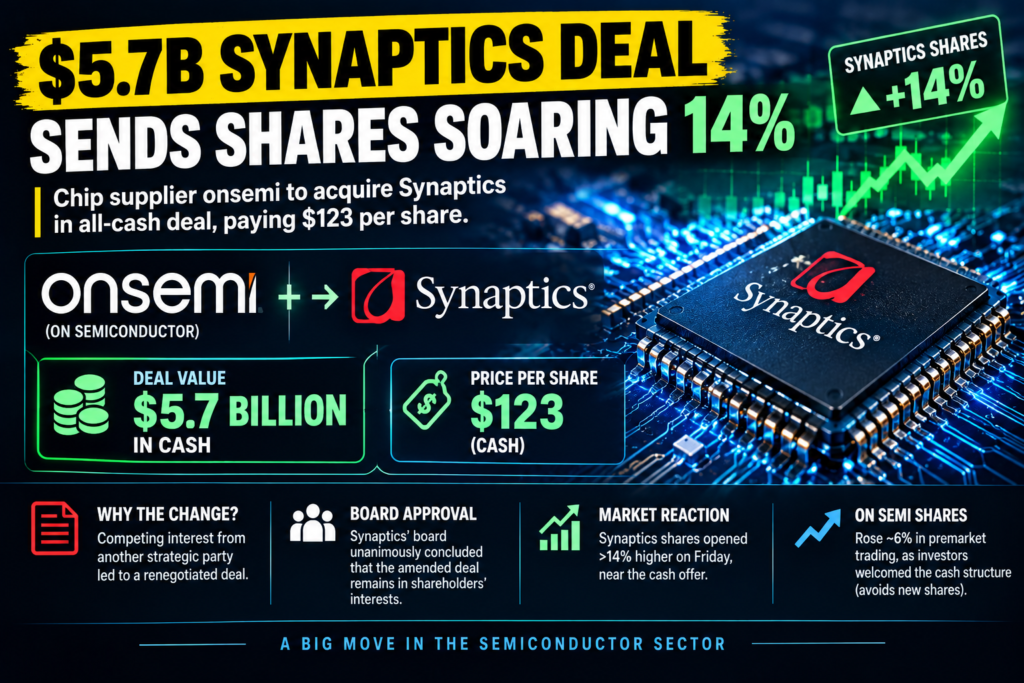
Under the original agreement, Synaptics holders were to receive 1.350 onsemi shares for each share they own. The new deal will be funded with cash on hand and about $2.45 billion in committed debt financing from Morgan Stanley. onsemi expects the acquisition to add to its non-GAAP earnings per share immediately, and has identified $200 million of annual run-rate synergies.
The deal still needs approval from Synaptics shareholders and regulators, with completion expected by mid-2027. It came amid a broader rally in semiconductor stocks.


Spain’s train crash and upcoming election. Spain is dealing with its second deadly train crash this year.

Hong Kong’s Tai Po fire fallout. Leader John Lee apologized

Serbia’s media shake-up. The head of public broadcaster RTS resigned after the student list won an election.

Generation Z Is Killing Fast Fashion in India — And Building Something Far More Beautiful in Its Place

AR Rahman reacts to “anti-national” row over Imtiaz Ali’s Main Vaapas Aaunga

According to Dior Couture, this taboo fashion accessory is back

-

 Entertainment19 hours ago
2026 is a big year at the box office
-

 Entertainment19 hours ago
Ramayana Part 1 arrives this week.
-

 Entertainment19 hours ago
Rajinikanth’s Jailer 2 enters the top 20.
-

 Entertainment19 hours ago
Bigg Boss 20 drama. Manoj Tiwari defended his daughter
-

 Entertainment19 hours ago
Other Diwali releases. Nayanthara’s Mookuthi Amman .