
Business
Copper prices surge 50%A combination of geopolitics policy shifts.
Copper prices surge 50% as supply concerns, geopolitical shifts and rising demand fuel a rally reminiscent of past commodity supercycles.


The Numbers
Copper has had one of the wildest runs of any major commodity this year. A year ago, prices were around $4.25/lb — by early August 2026, US copper futures climbed to roughly $6.90/lb, an all-time high, after LME copper broke above $13,000/ton (peaking near $13,387–$13,842/ton in January). That’s a roughly 60-65% rise year-over-year. Copper had already gained nearly 44% in 2025, its best year since 2009.
Why It’s Surging — Four Overlapping Forces
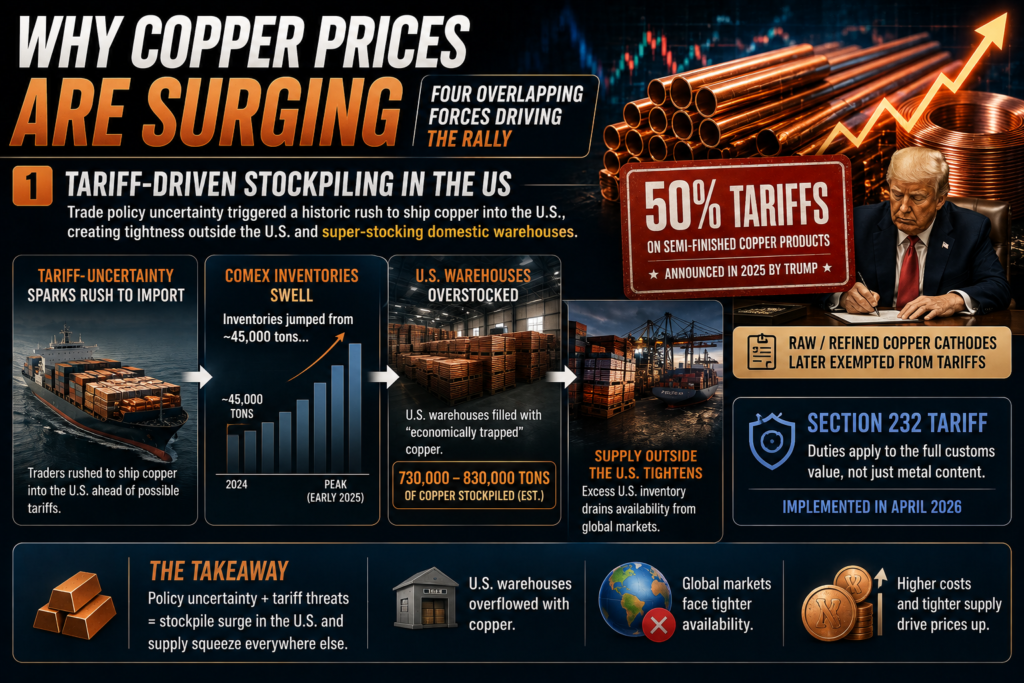
1. Tariff-driven stockpiling in the US
Trump signed a proclamation for 50% tariffs on semi-finished copper products in 2025, though raw/refined cathodes were later exempted. That uncertainty triggered a rush to ship copper into the US ahead of possible duties — COMEX inventories swelled from ~45,000 tons to a brief high, then U.S. warehouses became so stuffed with “economically trapped” metal (730,000–830,000 tons by one estimate) that supply outside the US tightened sharply. A further Section 232 tariff (applying duties to the full customs value, not just metal content) added cost pressure in April 2026.
2. AI and data centers
This is the story with the most staying power for your viewers: hyperscale AI data centers can use up to 50,000 tons of copper per facility, and AI/data-center demand alone is projected to hit 500,000 tons a year by 2030. Combined with electric vehicles and grid modernization, S&P Global forecasts total copper demand jumping from 28 million tons in 2025 to 42 million tons by 2040 — a 50% increase — creating a possible 10-million-ton supply shortfall if new mines don’t come online.
3. Genuine supply problems
Major mines have been hit by real disruptions: a near-total shutdown at Freeport-McMoRan’s Grasberg mine in Indonesia, weather-related outages in Chile (the world’s top producer), and issues at Quebrada Blanca and Highland Valley Copper. New mines take roughly 10 years to develop, so supply can’t respond quickly. China’s crackdown on scrap-copper exports has added further strain.
4. The Iran war and Middle East shipping disruptions
The closure of shipping lanes tied to the US-Iran conflict (the same story driving oil prices — see topic 1) has also squeezed copper supply chains in Q2 2026, compounding the tightness from mine disruptions and tariffs.

The Skeptic’s Case — Not Everyone Buys the Rally
This is a good “on the other hand” beat for a segment:
- Analysts at StoneX and Bank of America have said the move is driven more by supply fears, tariff hedging, and speculative momentum than by real-time physical scarcity — one analyst called the rally “unsustainable.”
- Goldman Sachs actually forecasts prices sliding back toward $11,000/ton by year-end once tariff uncertainty resolves, projecting a 160,000-ton global surplus.
- One mining analyst put it bluntly: “mining companies are pushing a compelling long-term shortage narrative — and the market believes it,” suggesting belief has outpaced fundamentals.
- LME inventories did see a sharp single-day increase in mid-August as trading firm Trafigura moved metal back into exchange warehouses, and futures pulled back from record highs on profit-taking.
Why It Matters Beyond Traders
Copper is nicknamed “Dr. Copper” because it’s historically used as a barometer for overall economic health — it’s in power grids, construction, wiring, and electronics. But several analysts note that this rally looks less like a “healthy economy” signal and more like a supply-and-policy story, making the old “Dr. Copper” read harder to trust right now.











Business
Migrant crisis strains Spain-Morocco relations
The deadly Ceuta border crisis is becoming more than a humanitarian emergency, putting pressure on Spain-Morocco relations and raising wider questions about EU trade, migration and security cooperation

What Happened
Between July 30 and August 1, 2026, an estimated 50,000–70,000 migrants — mostly Moroccans — breached the border and crossed into Ceuta, Spain’s small North African enclave, either by land, by swimming, or by climbing the breakwater barrier. This was the largest single migrant surge into Ceuta in its history, dwarfing even the notable 2021 incident when about 8,000 people crossed. To put the scale in perspective: Ceuta’s entire population is only around 84,000 — so the crossing was equivalent to more than half the city’s population arriving in roughly 48 hours.
The Death Toll — Numbers Kept Climbing
This was a genuinely chaotic, fast-moving story with the toll rising over several days as bodies were recovered:
- Initial reports: 18 dead (July 30–31)
- Then 57, then 67 (Aug 1)
- Then 72–88 depending on the source (Spanish government vs. Sky News vs. local officials)
- By August 6, Ceuta’s regional president told the European Parliament the toll had reached at least 100
Deaths came from drowning and from a stampede as crowds tried to climb over the breakwater fence at Tarajal beach. Some bodies were found later, washed up along the coastline.

Why It Happened — The Trigger
Spain’s Interior Ministry and officials pointed to a Spanish Supreme Court ruling issued earlier in July that said migrants who swim into Spanish territory could not be immediately deported unless they’d crossed a physical border barrier. Spain says criminal smuggling gangs spread rumors/misinformation about this ruling, encouraging a rush of crossings. Morocco rejected blame, arguing Spain should have anticipated the fallout from its own court decision.
There’s also a notable geopolitical theory circulating: some observers suggest Morocco may have facilitated or turned a blind eye to the surge as diplomatic pressure tied to broader tensions — Spain has been critical of Israel and the US over the Gaza/Iran conflict, while Morocco has taken a friendlier posture toward the US and Israel. Morocco has historically used migration flows as leverage in disputes with Spain, including over sovereignty claims to Ceuta and Melilla themselves (Morocco disputes Spanish control, though Spain has held Ceuta since 1580).
The Aftermath and Response
- Most who crossed (an estimated 48,000+) returned to Morocco within 48–72 hours, many voluntarily after finding no food, shelter, or services in an overwhelmed Ceuta.
- Spain installed a 500-meter floating sea barrier at the Tarajal breakwater to close the loophole exposed by the court ruling.
- Ceuta’s two reception centers “collapsed” under the strain, with 3,000–5,000 migrants still stuck in the city as of early August.
- Italy temporarily suspended Schengen (passport-free EU travel) with Spain, and France’s interior minister ordered extra border checks — a significant and controversial move within the EU.
- 22 EU member states sent a joint letter calling for “strengthening of external borders.”
- Spanish PM Pedro Sánchez strongly criticized the EU response, calling some member states’ reactions “selfish, polarising and unlawful” and driven by “prejudice, fake news, ignorance, or political interest” — pushing back hard against calls to suspend Spain from Schengen.

The Bigger Picture
Spain’s migration policy has actually leaned toward regularizing undocumented workers already in the country to support its economy — a contrast to the anti-migration, pro-deportation stance common elsewhere in the EU and the US under Trump. Despite the Ceuta drama, Spain has historically had fewer irregular arrivals than Italy or Greece. But Ceuta arrivals specifically spiked 164% in the first half of 2026 versus 2025 (2,582 vs. 978), even as Spain’s national arrival numbers actually fell.
The underlying driver, as with most Ceuta surges, is stark economic inequality just a few miles apart: Morocco’s GDP per capita was about $4,153 in 2024, compared with $26,774 in Ceuta.
Business
Reddit’s Q2 earnings beat, but stock drops
Reddit beat Q2 forecasts with strong revenue growth, but shares dropped as investors worried about slowing U.S. user growth and volatile search-engine referrals.

The Numbers Were Genuinely Strong
Reddit reported second-quarter 2026 results on July 30 that beat Wall Street on almost every line:
- Revenue: $804.9 million, up 61% year-over-year — beating estimates of ~$730–732 million
- EPS: $1.25 vs. ~$0.95–0.96 expected (a ~30% beat)
- Advertising revenue: $762 million, up 64% year-over-year
- Net income: $253 million; free cash flow: $261 million, more than doubled from a year ago
- Global daily active users (DAUq): 130.3 million, up 18% year-over-year — ahead of the 129.9 million analysts expected
- Data licensing (“Other revenue”), driven by deals with Google and OpenAI, grew 24% to $43 million
- Reddit even raised its Q3 guidance to $860–870 million, above consensus, and bought back $235 million of its own stock

But the Stock Cratered Anyway
Despite the beat, shares fell somewhere between 10% and 23% depending on the trading session measured (initial after-hours drops of 12–13%, extending toward 20–23% in subsequent sessions) — reportedly Reddit’s largest single-day drop since its March 2024 IPO.
Why Investors Panicked: Three Threads
1. “Choppy” search referral traffic
CEO Steve Huffman used the word “choppy” to describe how much traffic Reddit gets from people clicking through from Google search results — and that single phrase in the investor letter reportedly moved the stock more than the earnings beat itself. Reddit built years of growth on Google search sending people to Reddit threads; as AI search summaries increasingly answer questions directly without a click-through, that funnel is a real structural risk.
2. US daily active users actually declined sequentially
This is the number that spooked people most: US daily active users slipped from 53.5 million in Q1 to 53.2 million in Q2 — a small dip in absolute terms, but symbolically important because the US audience is Reddit’s most valuable by far (US ad revenue per user was $11.85, versus just $2.26 internationally — more than 5x the value). Global growth looked fine only because international users picked up the slack.

3. Growth deceleration and reduced transparency
Revenue growth of 61% was actually a step down from Q1’s 69% — in a market pricing Reddit for near-perfection, “still great but slowing” got punished. Reddit also announced it will stop reporting logged-in vs. logged-out user metrics starting Q3 2026, which investors read as reduced transparency at exactly the moment they most want visibility into whether AI search is eating into the user base.
The Bigger AI-Era Tension
This ties into a broader story worth flagging for your segment: Reddit sits in an unusual position as both a victim and beneficiary of AI. It’s one of the most valuable data sources for training AI models (licensing deals with Google and OpenAI), and Huffman has publicly argued “there is no artificial intelligence without actual intelligence — and that comes from Reddit.” But at the same time, AI-powered search answers threaten the exact search-traffic pipeline that built Reddit’s audience in the first place — making it a good case study of AI’s double-edged effect on legacy internet platforms.

Analyst Take
Even after the plunge, the stock traded around 33x earnings for a company still compounding revenue at 61% with roughly 31% net margins — several analysts called that comparatively cheap, with the Street’s average price target implying meaningful upside. But the consensus caution is clear: investors want to see US daily users turn positive again before trusting the growth story fully.
Business
AI infrastructure spending boom
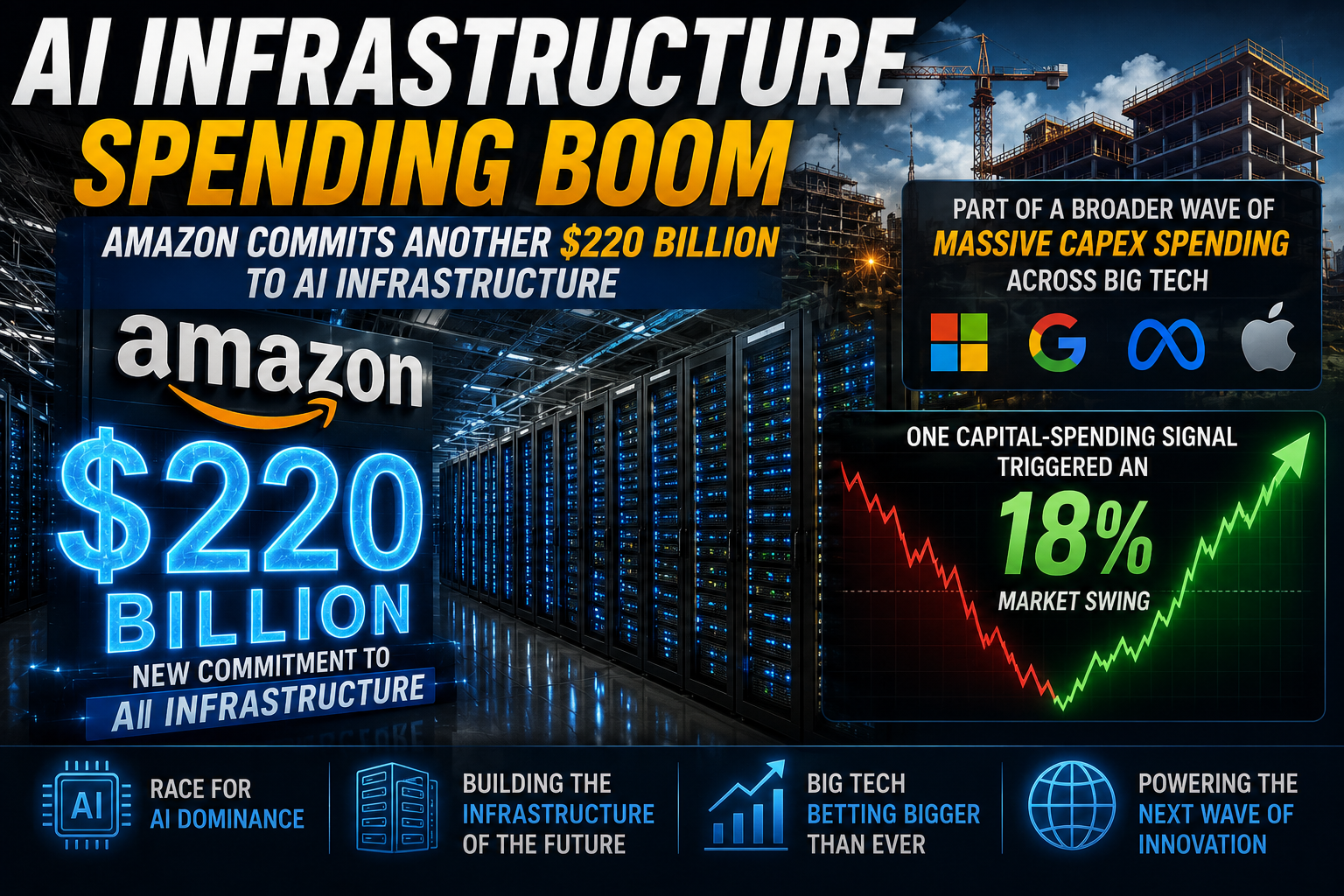
Amazon’s latest $220 billion AI infrastructure commitment underscores Big Tech’s massive spending boom and its growing impact on financial markets.
Amazon’s Big Number
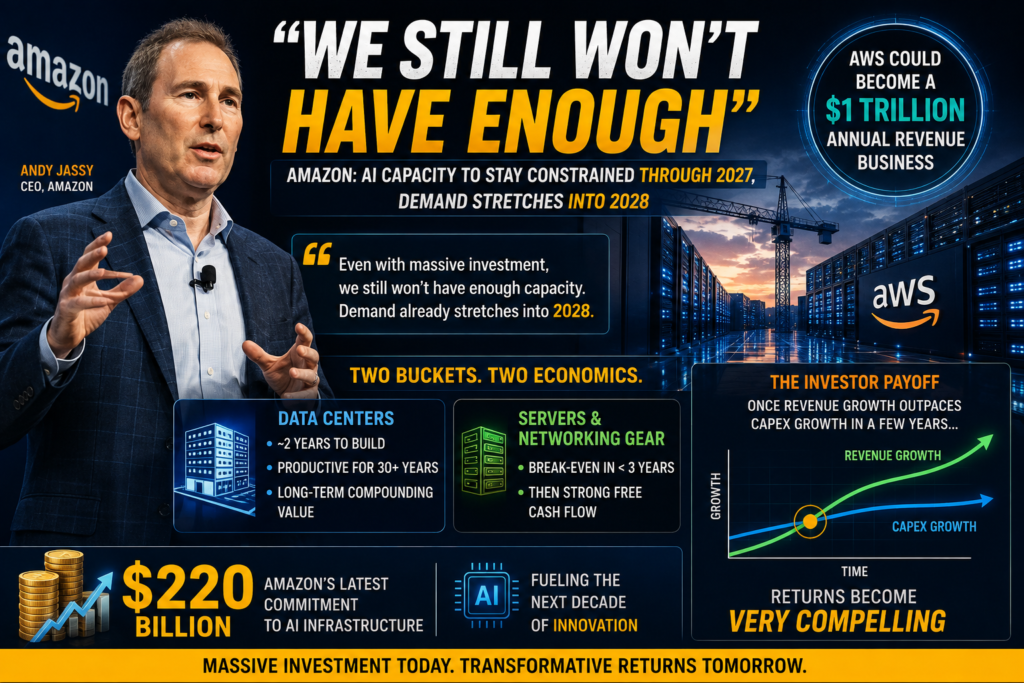
On its Q2 2026 earnings call (early August), Amazon CEO Andy Jassy raised the company’s 2026 cash capex forecast to ~$220 billion, up from the $200 billion guided back in February — a 10% jump in under six months. The increase is tied specifically to rising memory-chip costs, not an expansion of the buildout footprint itself. Jassy singled this out explicitly: the higher cost of memory pushed the number up from the prior estimate of about $200 billion.
To put the scale in context: Amazon spent about $132 billion on capex in 2025. The 2026 figure represents nearly a 67% year-over-year jump.
“We Still Won’t Have Enough”
Despite the massive spend, Jassy said Amazon expects AI capacity to stay constrained through 2027 — and noted demand already stretches into 2028. He split the reasoning into two buckets: data centers (which take ~2 years to build but stay productive 30+ years) versus servers/networking gear (break-even in under 3 years, then strong free cash flow). His pitch to investors: once revenue growth outpaces capex growth in a few years, the resulting returns are “very compelling.” He also floated that AWS could eventually become a trillion-dollar annual revenue business.
Why AWS Is Justifying It
- AWS revenue rose 36.7% year-over-year in Q2 to $42.2 billion — its fastest growth in 18 quarters, and the fifth straight quarter of acceleration.
- Operating margin expanded to 39%, up ~650 basis points year-over-year.
- Q2 capex alone was $54.2 billion, up 68% year-over-year.
- Amazon is racing to serve a $496 billion order backlog that’s grown 2.5x in a year.
It’s an Industry-Wide Arms Race
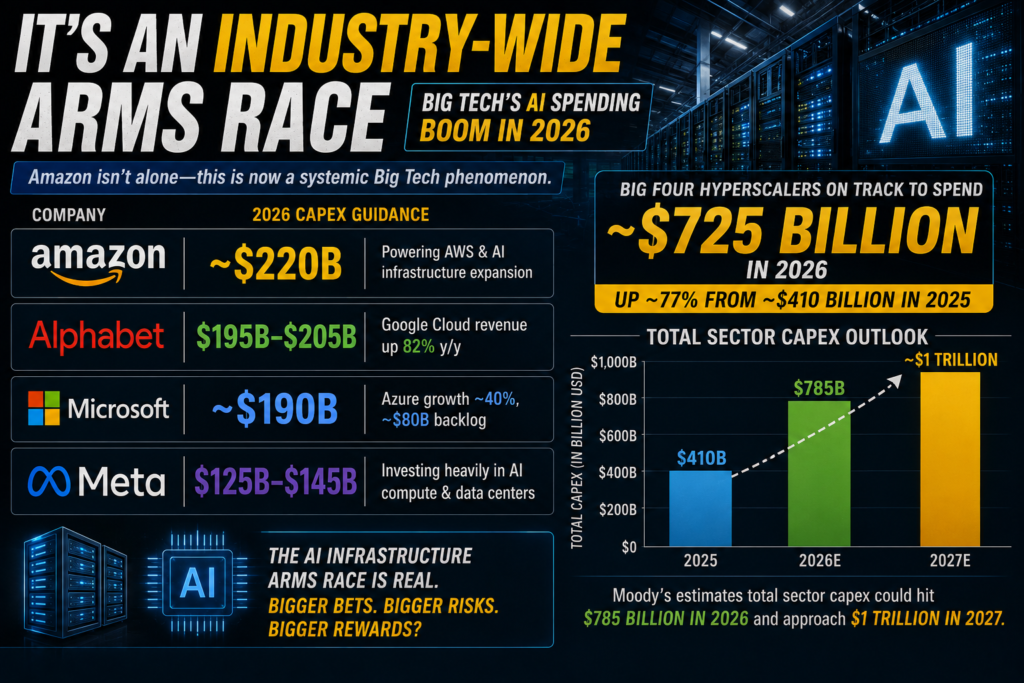
Amazon isn’t alone — this is now a systemic Big Tech phenomenon:
| Company | 2026 Capex Guidance |
|---|---|
| Amazon | ~$220B |
| Alphabet | $195B–$205B (Google Cloud revenue up 82% y/y) |
| Microsoft | ~$190B (Azure growth ~40%, ~$80B backlog) |
| Meta | $125B–$145B |
Combined, the “Big Four” hyperscalers are on track to spend roughly $725 billion in 2026 — up about 77% from ~$410 billion in 2025. Moody’s estimates total sector capex could hit $785 billion in 2026 and approach $1 trillion in 2027.
The Financing Question — and the Risk
This spending is straining even the biggest balance sheets: Alphabet, Amazon, Meta, and Oracle are expected to see forward free cash flow shrink toward zero or turn negative because of AI-driven data center spending. Hyperscalers have issued roughly $175 billion in debt this year already — far above the five-year average of about $30 billion — and bond investors are growing more cautious, with credit spreads on hyperscaler debt widening. Notably, when directly asked how Amazon plans to fund the extra $20 billion, Jassy demurred, saying only “nothing to share today.”
The comparisons being drawn are pointed: several analysts have likened this buildout to the dot-com infrastructure boom — massive spending ahead of proven returns, with a real risk that some of it proves excessive if AI demand ever cools.
The Physical/Human Cost Angle
Worth a mention for a segment: this AI buildout is tightly linked to the power grid — data centers and model training require enormous electricity and water for cooling, and power demand growing faster than supply could mean higher utility bills and strain on local infrastructure for ordinary consumers near these facilities.


Apple’s foldable “iPhone Ultra” and Chrome’s Manifest V2 extension cutoff

Amazon expanding drone delivery to ~500 US cities

Google’s $12.2 billion stake deal with Marvell

Generation Z Is Killing Fast Fashion in India — And Building Something Far More Beautiful in Its Place

AR Rahman reacts to “anti-national” row over Imtiaz Ali’s Main Vaapas Aaunga