
Business
Vietnam’s entry into emerging-market index stirs India-comparison debate
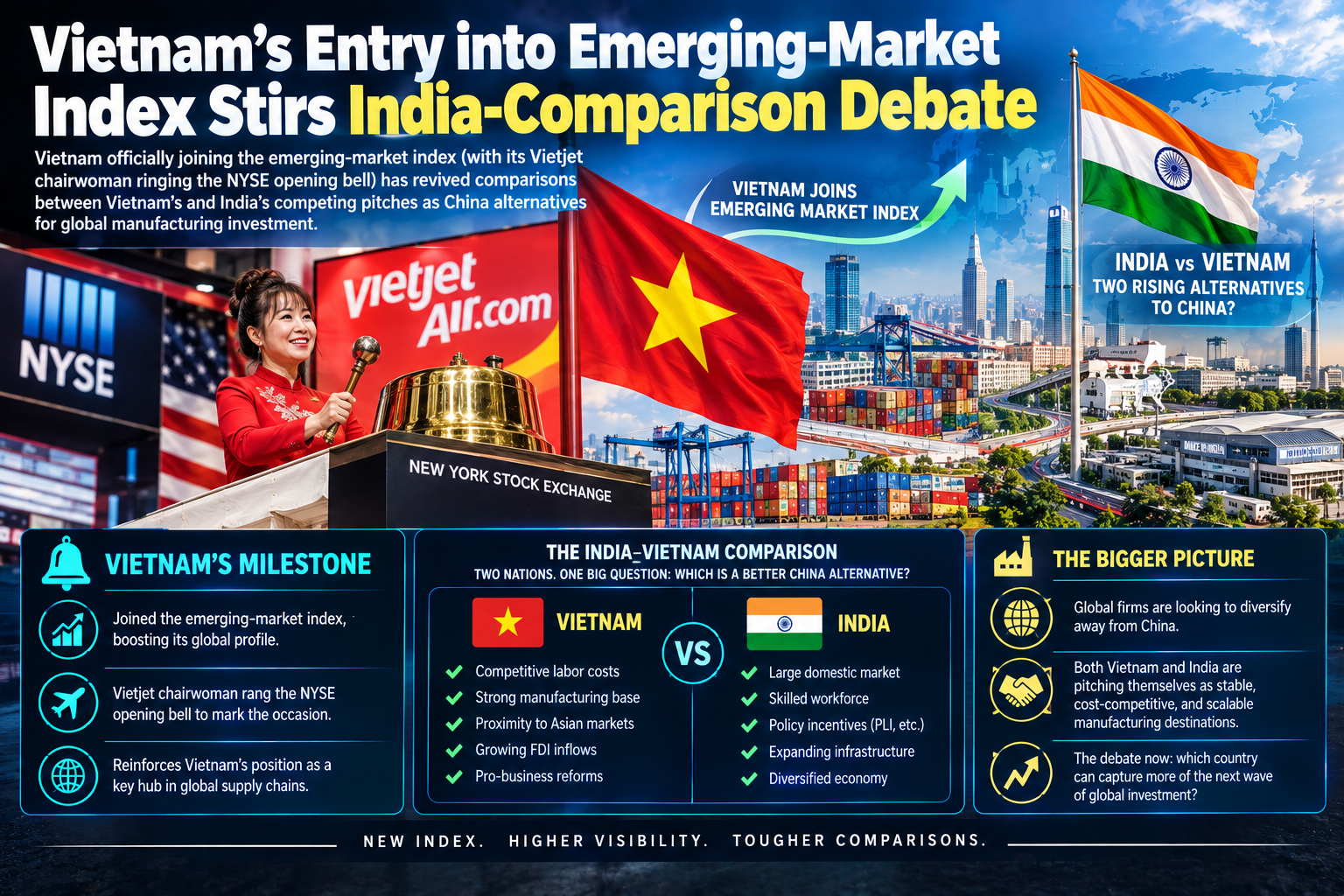
Vietnam’s emerging-market index entry is reviving comparisons with India as both countries compete for manufacturing investment beyond China.

What Actually Happened
On Monday, September 21, 2026, Vietnam’s stock market was officially reclassified from frontier market to secondary emerging market status in FTSE Russell’s index series — ending an 8-year watchlist process that began in 2018. Days later, Vietjet Chairwoman Nguyen Thi Phuong Thao attended the NYSE opening bell in New York, framing it as “a new chapter for the country’s capital markets” and signaling intent to pursue “potential listings in New York” for Vietnamese companies, plus a slate of agreements between Sovico, Vietjet, and HDBank with international counterparts during the US/Canada visit.
The Mechanics — How the Money Flows In
- Inclusion happens in four phases through 2027: a 10% weighting addition in September 2026, then 20% in March 2027, followed by 35% each in June and September 2027
- FTSE Russell estimates the upgrade could bring up to $6 billion into Vietnam, though other estimates range wider — VinaCapital pegs passive-only inflows at $5–6 billion, while HSBC’s broader range (including active repositioning) runs $3.4–10.4 billion
- A more ambitious World Bank estimate of $25 billion exists, but that reflects a longer-term structural scenario including deeper domestic reform and eventual MSCI inclusion by 2030 — not the FTSE move alone
- Notably, the VN-Index had already rallied roughly 50% from its April 2025 lows by the time the upgrade was formally announced — meaning much of the “easy” pre-positioning gain may already be priced in, a classic “sell the news” risk flagged by analysts drawing on precedent from Saudi Arabia’s and Kuwait’s earlier FTSE upgrades
Why This Happened — Real Reform, Not Just Sentiment
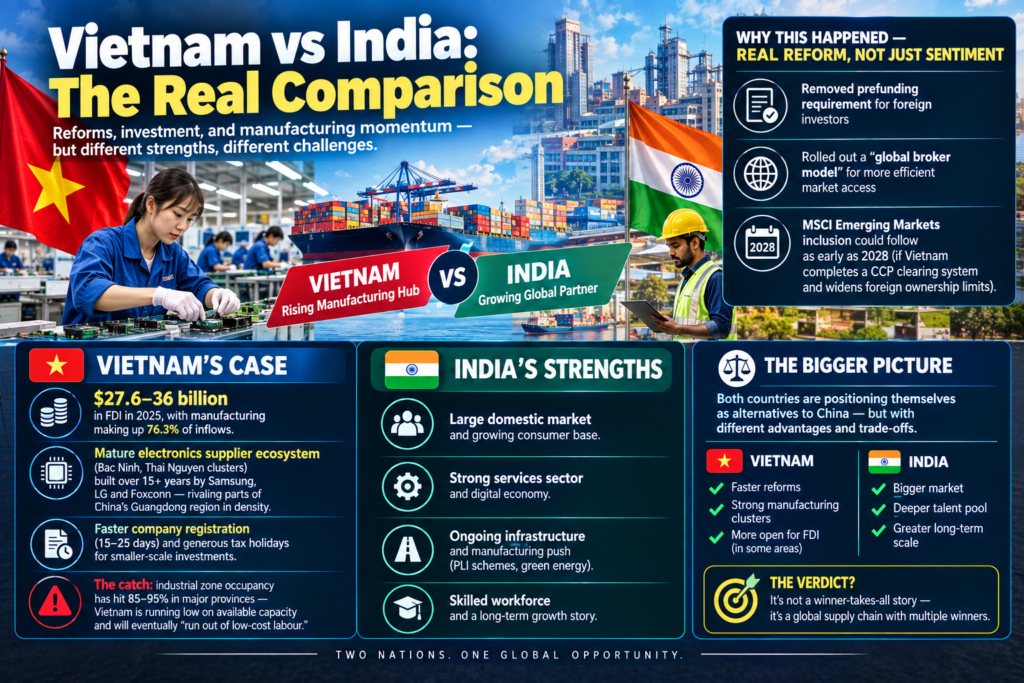
The upgrade followed genuine structural changes: the removal of a prefunding requirement for foreign investors and the rollout of a “global broker model” allowing more efficient market access. Vietnam could go further still — MSCI Emerging Markets inclusion (a separate, larger index) could follow as early as 2028 if Vietnam completes a central counterparty (CCP) clearing system and widens foreign ownership limits.
The India Comparison — Where It Gets Interesting for Your Segment
This is genuinely a live, nuanced debate rather than a simple “who’s winning” story:
Vietnam’s case:
- Attracted $27.6–36 billion in FDI in 2025, with manufacturing making up 76.3% of inflows
- Has a mature, dense electronics supplier ecosystem (Bac Ninh, Thai Nguyen clusters) built over 15+ years by Samsung, LG, and Foxconn — genuinely rivaling parts of China’s Guangdong region in density
- Faster company registration (15–25 days) and generous tax holidays for smaller-scale investments
- The catch: industrial zone occupancy has hit 85–95% in major provinces — Vietnam is running low on available capacity and, per one analysis, will eventually “run out of low-cost labour” as a structural constraint
India’s case:
- FDI inflows of $81.04 billion in FY2024-25 (up 14% year-over-year) — roughly 3x Vietnam’s scale
- Manufacturing FDI specifically grew 18% to $19.04 billion
- Apple’s iPhone exports from India crossed ₹2 trillion (~$23 billion) in 2025 — an 85% jump — with India’s share of global iPhone production reaching roughly 25%
- A JETRO survey found India led all countries surveyed at 81.5% investor intent, ahead of Vietnam (56.9%)
- India’s advantage is scale and a large domestic market; Vietnam’s advantage is speed, an already-mature electronics ecosystem, and proximity to Chinese component supply chains
The Realistic Takeaway (Good for a Balanced Segment)
Most current analysis actually rejects the simple “Vietnam vs. India, pick a winner” framing — global manufacturers like Apple, Samsung, Bosch, and Toyota now operate in both countries simultaneously, often splitting strategically: high-value, IP-intensive, or domestic-market-facing operations to India, and assembly-oriented, East-Asia-facing production to Vietnam. One analysis bluntly summarized the broader “China Plus One” landscape: “no one gets the whole pie” — the global value chain has fractured into multiple winners rather than a single successor to China.
This ties directly back into your ISM Phase 2 semiconductor segment from earlier — India and Vietnam are increasingly framed as complementary hubs (Vietnam for near-term OSAT/assembly capacity, India for larger, longer-horizon chip investments) rather than pure rivals.








Business
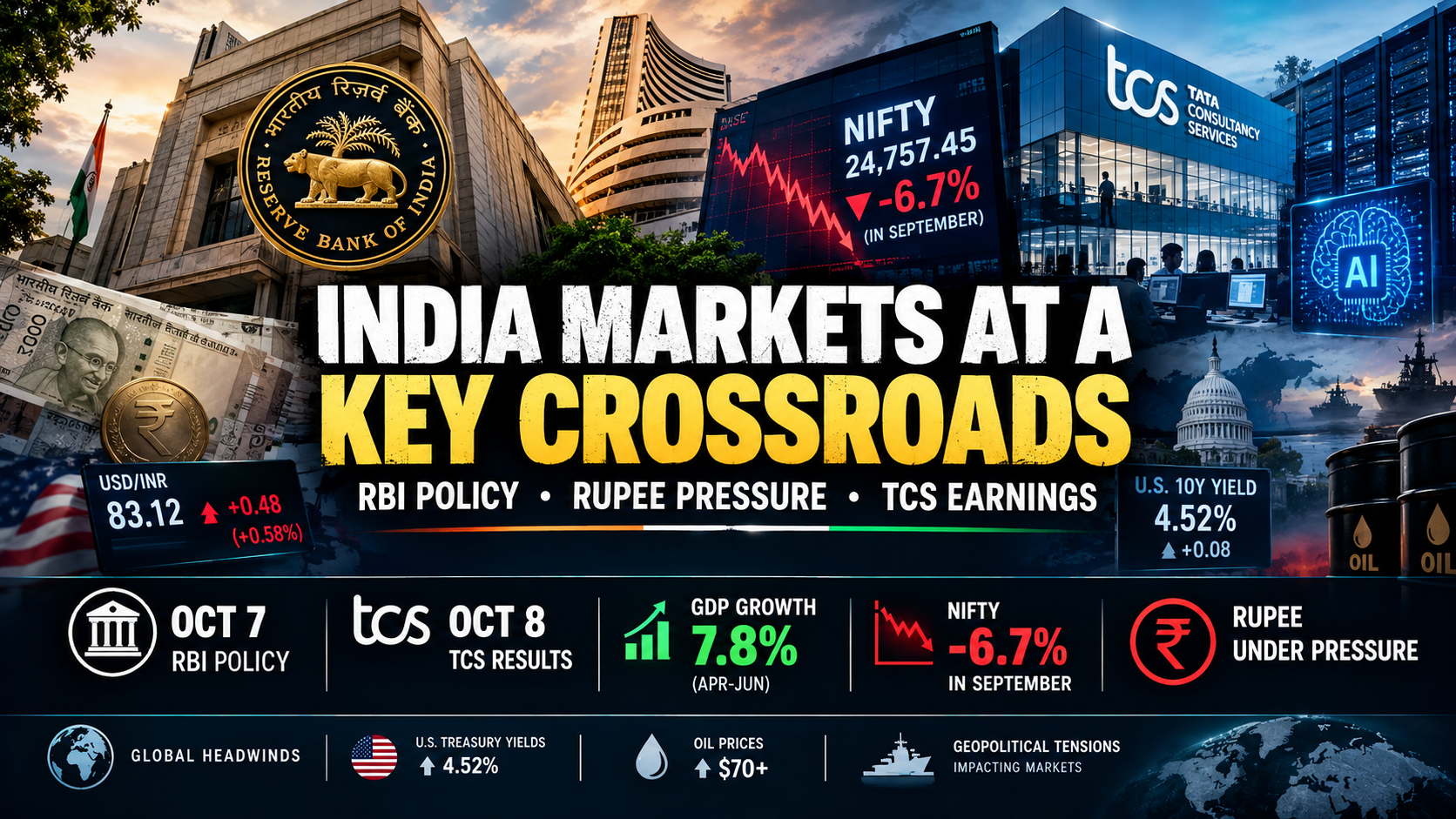
India: RBI policy, rupee and IT earnings
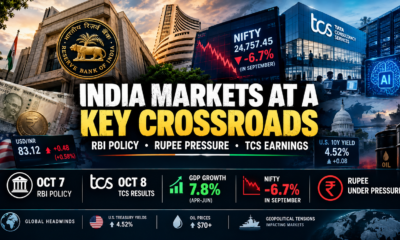
India’s markets face a crucial week as the RBI policy decision and TCS earnings approach, while rupee weakness and global pressures weigh on the Nifty.
Business
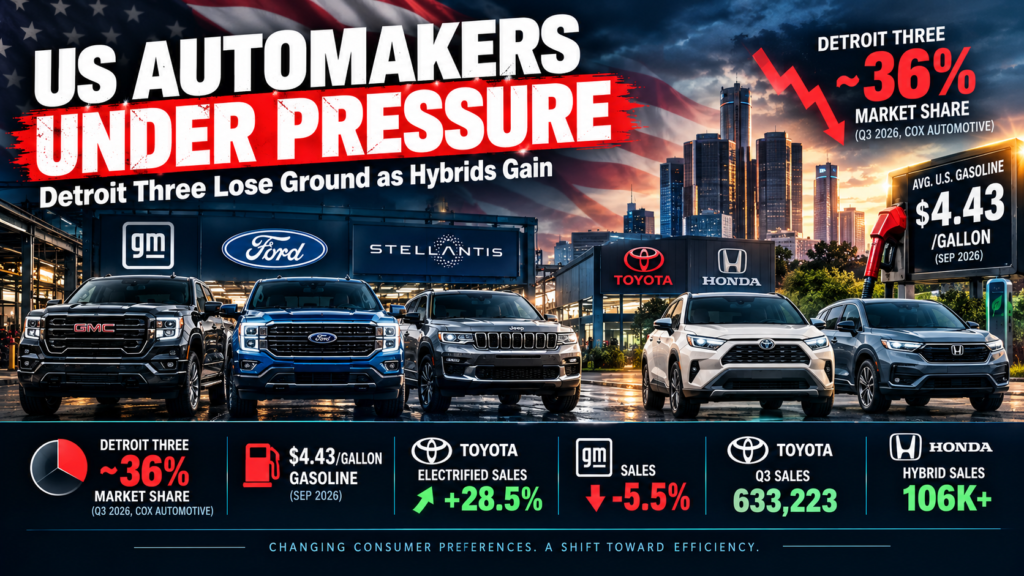
Pressure on US automakers. Reuters reports that GM, Ford and Stellantis could see their combined US market share dip to 36% for the quarter
GM, Ford and Stellantis could see their combined U.S. market share fall to around 36%, highlighting growing pressure on Detroit’s biggest automakers.

Detroit Three Slip to Record-Low US Market Share as Gas Prices Drive Buyers to Hybrids
GM, Ford and Stellantis are heading for their weakest US showing on record. Cox Automotive estimates their combined third-quarter market share at around 36%, an all-time low, while hybrid-heavy Asian brands including Toyota and Honda are expected to account for more than half of new vehicle sales.
The driver is fuel costs. The Iran war has pushed US gasoline to a national average of $4.43 a gallon in September, according to AAA, up from $3.20 a year earlier, and buyers are turning to hybrids and more efficient models.
Toyota is the clearest winner. Its electrified sales climbed 28.5% to 363,367 units, or 57.4% of its US sales, and its Corolla hybrid jumped nearly 36%. GM kept the top US sales spot, but its lead over Toyota shrank to 37,751 vehicles, and Cox has said Toyota could overtake GM in the coming years if the trend continues. GM’s quarterly sales fell 5.5% to 670,974 units. Honda posted a record hybrid quarter of more than 106,000 units, with sales up 9.3%. Stellantis sales were roughly flat at 324,277.
Ford is under particular pressure. Cox expects its sales to fall 8.8% through the first three quarters of the year, with its market share dropping nearly a full point to 12.5%. Cox also forecast that Hyundai Motor Group would outsell Ford for the first time, 511,421 vehicles to 504,172, though Ford argues that Hyundai and Kia are separate companies and that it outsold the two combined year to date.
Overall US sales for the quarter are estimated at about 4.1 million, down about 1% from a year earlier. The average new-vehicle transaction price rose 1.9% to $50,089 in August.
What to watch: Ford’s reported third-quarter sales, gasoline prices, and whether Detroit’s automakers shift more of their production toward hybrids.
Business
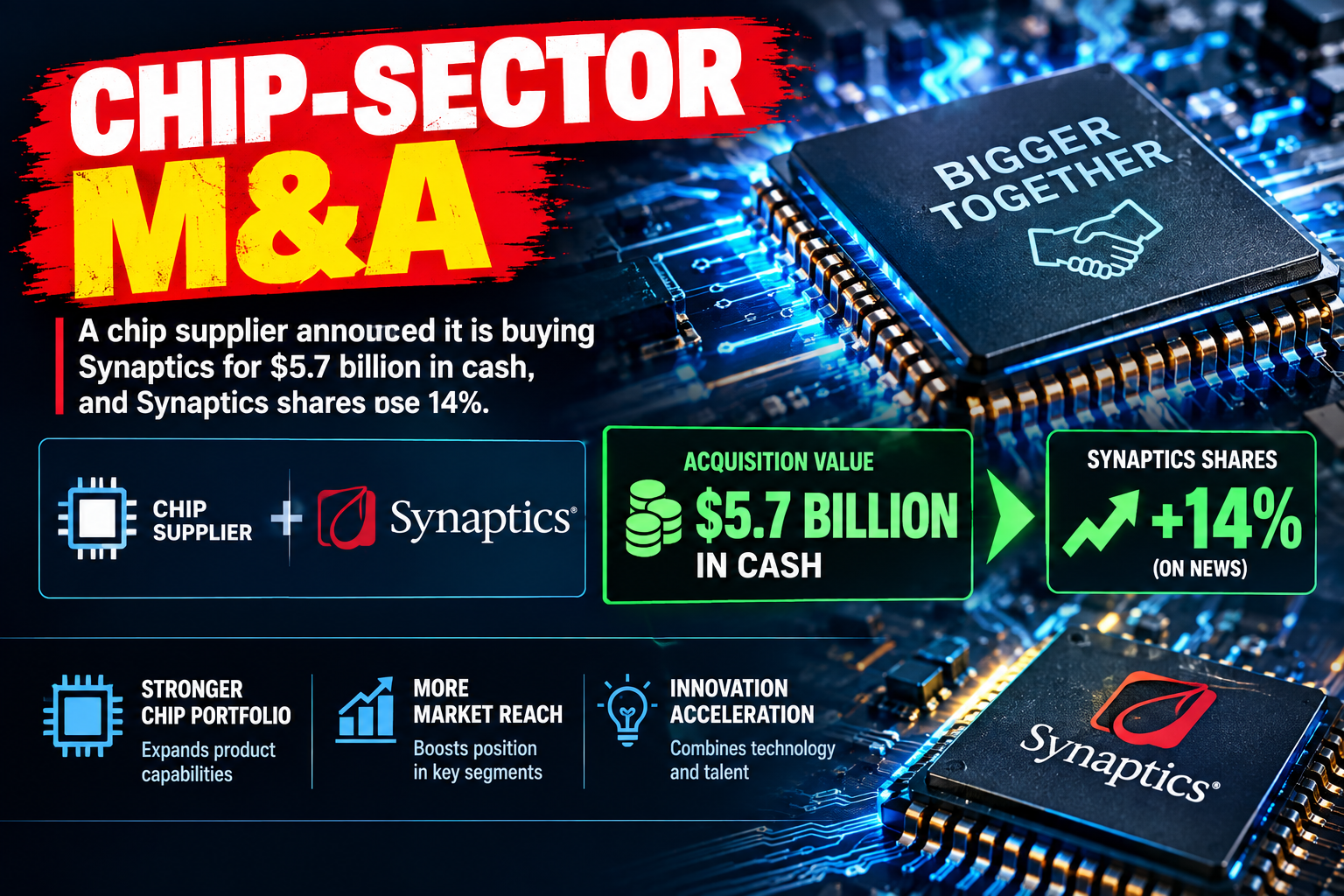
Chip-sector M&A. A chip supplier announced it is buying Synaptics for $5.7 billion in cash
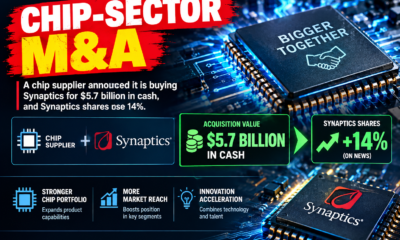
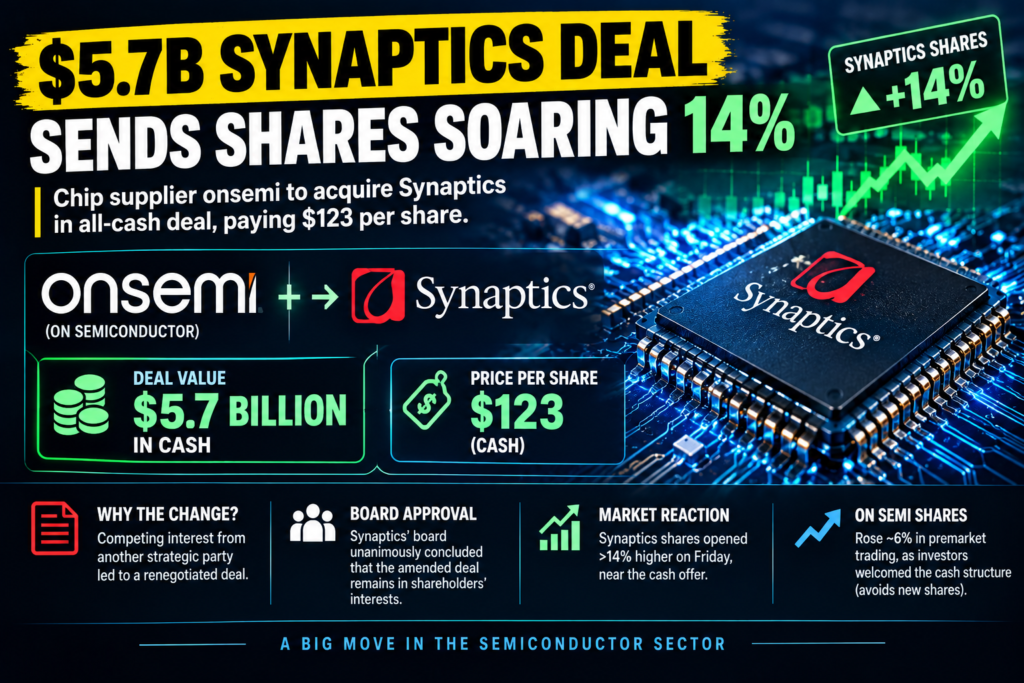
Synaptics shares jumped 14% after a chip supplier announced a $5.7 billion all-cash deal to acquire the company.
onsemi Switches to $5.7 Billion All-Cash Deal for Synaptics After Rival Bid Surfaces
Shares of Synaptics jumped about 14% after chipmaker onsemi (ON Semiconductor) agreed to buy it in an all-cash deal valued at about $5.7 billion. The revised agreement, announced late Thursday, October 1, pays $123 per share in cash and replaces the all-stock deal the companies signed on June 25, which was valued at about $7 billion.
The change followed competing interest. A filing shows Synaptics had received an unsolicited, non-binding proposal from another strategic party, which likely drove the renegotiation. Synaptics’ board unanimously concluded that the amended deal remains in shareholders’ interests.
Shares of Synaptics opened more than 14% higher on Friday, moving close to the cash offer. The stock had closed at $106.15 the previous day. onsemi shares rose about 6% in premarket trading from a prior close of $80.08, with investors welcoming that the cash structure avoids issuing new shares that would have diluted existing holders.
Under the original agreement, Synaptics holders were to receive 1.350 onsemi shares for each share they own. The new deal will be funded with cash on hand and about $2.45 billion in committed debt financing from Morgan Stanley. onsemi expects the acquisition to add to its non-GAAP earnings per share immediately, and has identified $200 million of annual run-rate synergies.
The deal still needs approval from Synaptics shareholders and regulators, with completion expected by mid-2027. It came amid a broader rally in semiconductor stocks.


Spain’s train crash and upcoming election. Spain is dealing with its second deadly train crash this year.

Hong Kong’s Tai Po fire fallout. Leader John Lee apologized

Serbia’s media shake-up. The head of public broadcaster RTS resigned after the student list won an election.

Generation Z Is Killing Fast Fashion in India — And Building Something Far More Beautiful in Its Place

AR Rahman reacts to “anti-national” row over Imtiaz Ali’s Main Vaapas Aaunga

According to Dior Couture, this taboo fashion accessory is back

-

 Entertainment15 hours ago
2026 is a big year at the box office
-

 Entertainment15 hours ago
Ramayana Part 1 arrives this week.
-

 Entertainment15 hours ago
Rajinikanth’s Jailer 2 enters the top 20.
-

 Entertainment15 hours ago
Bigg Boss 20 drama. Manoj Tiwari defended his daughter
-

 Entertainment14 hours ago
Other Diwali releases. Nayanthara’s Mookuthi Amman .