
Business
Middle East crude volatility still shaping market mood
Crude prices have eased, but persistent Middle East uncertainty continues to influence oil markets and investor sentiment in India and beyond.


Where Prices Stand Right Now
Crude has been on a four-session losing streak heading into today, dropping from around $98 to about $95.5/barrel on Monday (Sept 21), as traders responded to diplomatic de-escalation signals. This directly explains the “prices easing” backdrop to today’s Sensex/Nifty open you flagged earlier.
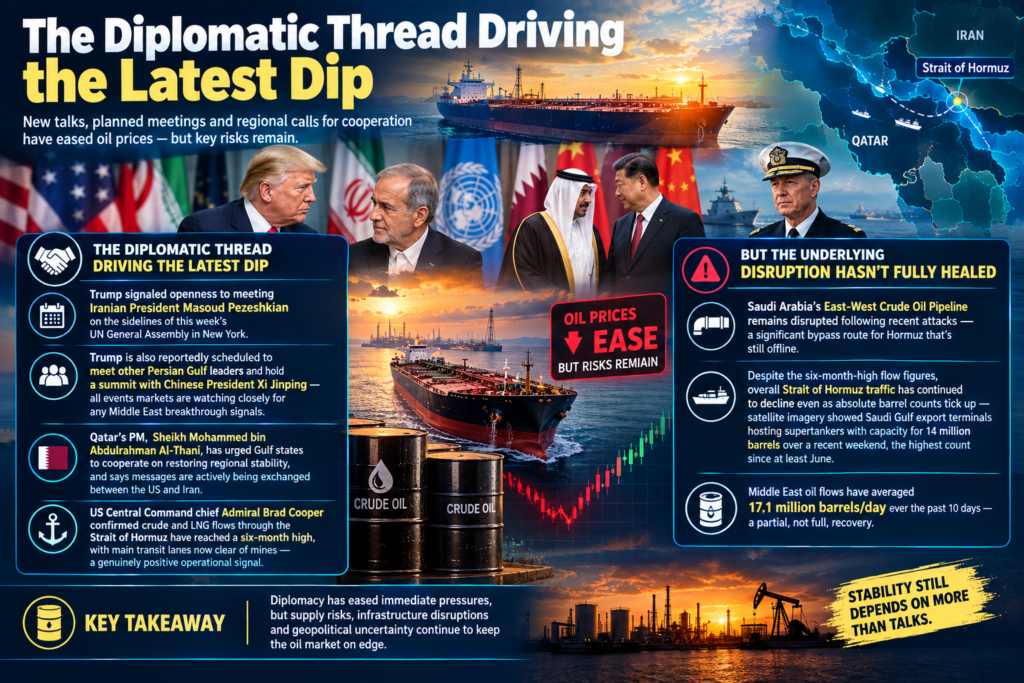
The Diplomatic Thread Driving the Latest Dip
- Trump signaled openness to meeting Iranian President Masoud Pezeshkian on the sidelines of this week’s UN General Assembly in New York
- Trump is also reportedly scheduled to meet other Persian Gulf leaders and hold a summit with Chinese President Xi Jinping — all events markets are watching closely for any Middle East breakthrough signals
- Qatar’s PM, Sheikh Mohammed bin Abdulrahman Al-Thani, has urged Gulf states to cooperate on restoring regional stability, and says messages are actively being exchanged between the US and Iran
- US Central Command chief Admiral Brad Cooper confirmed crude and LNG flows through the Strait of Hormuz have reached a six-month high, with main transit lanes now clear of mines — a genuinely positive operational signal
But the Underlying Disruption Hasn’t Fully Healed
- Saudi Arabia’s East-West Crude Oil Pipeline remains disrupted following recent attacks — a significant bypass route for Hormuz that’s still offline
- Despite the six-month-high flow figures, overall Strait of Hormuz traffic has continued to decline even as absolute barrel counts tick up — satellite imagery showed Saudi Gulf export terminals hosting supertankers with capacity for 14 million barrels over a recent weekend, the highest count since at least June
- Middle East oil flows have averaged 17.1 million barrels/day over the past 10 days — a partial, not full, recovery
Why This Has Been Such a Volatile Year (Useful Context/Timeline)
This has genuinely been one of the most chaotic years for oil markets in decades:
- Late March 2026: Brent peaked near $118/barrel
- By July 1: Declined sharply to around $70
- Late July: Rebounded above $100, then fluctuated $87–97 through August
- Early September: Surged back to $109 after renewed attacks on shipping and energy infrastructure
- Now (Sept 21-22): Easing again to around $95.5, on renewed diplomatic hope
The International Energy Agency has characterized this as the “largest supply disruption in the history of the global oil market.” Multiple ceasefires have been announced and then broken over the course of the year (April saw one dramatic 13% single-day price crash on a ceasefire announcement, followed by renewed strikes days later that reversed it) — which is exactly why Indian market commentators keep flagging this as a “persistent overhang” rather than a resolved risk: the pattern all year has been de-escalation hopes triggering price drops, followed by renewed strikes reversing them, and there’s no strong reason yet to believe this cycle has permanently broken.
Why This Matters Specifically for Indian Markets
This ties together everything you’ve covered — India imports the vast majority of its crude, so oil-price swings directly affect the rupee, inflation expectations, and corporate input costs, which is why FII selling, Sensex/Nifty volatility, and RBI policy commentary all keep referencing Middle East developments as a standing risk factor, even on days when prices happen to be falling.









Business
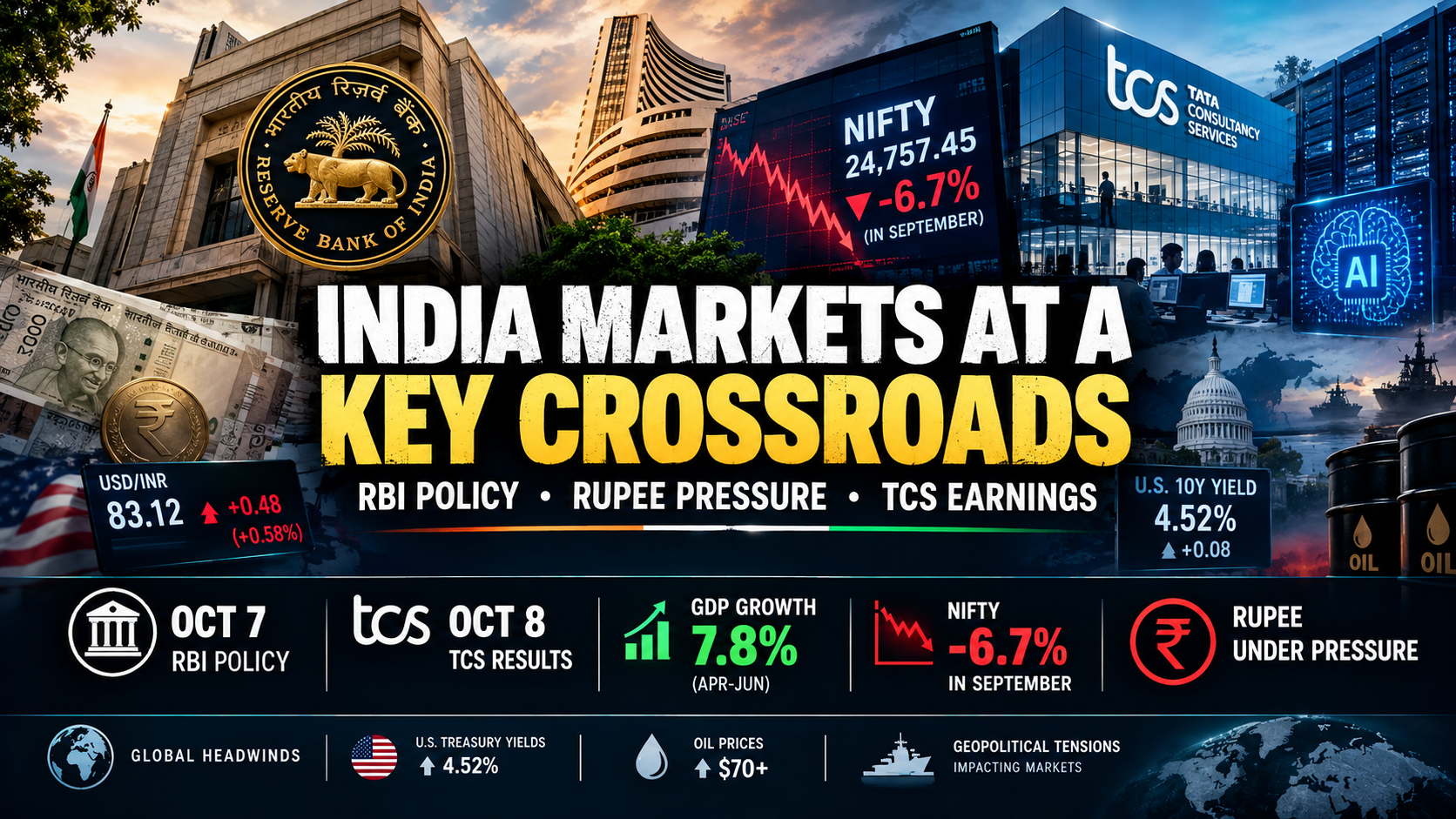
India: RBI policy, rupee and IT earnings
India’s markets face a crucial week as the RBI policy decision and TCS earnings approach, while rupee weakness and global pressures weigh on the Nifty.
Business
Pressure on US automakers. Reuters reports that GM, Ford and Stellantis could see their combined US market share dip to 36% for the quarter
GM, Ford and Stellantis could see their combined U.S. market share fall to around 36%, highlighting growing pressure on Detroit’s biggest automakers.

Detroit Three Slip to Record-Low US Market Share as Gas Prices Drive Buyers to Hybrids
GM, Ford and Stellantis are heading for their weakest US showing on record. Cox Automotive estimates their combined third-quarter market share at around 36%, an all-time low, while hybrid-heavy Asian brands including Toyota and Honda are expected to account for more than half of new vehicle sales.
The driver is fuel costs. The Iran war has pushed US gasoline to a national average of $4.43 a gallon in September, according to AAA, up from $3.20 a year earlier, and buyers are turning to hybrids and more efficient models.
Toyota is the clearest winner. Its electrified sales climbed 28.5% to 363,367 units, or 57.4% of its US sales, and its Corolla hybrid jumped nearly 36%. GM kept the top US sales spot, but its lead over Toyota shrank to 37,751 vehicles, and Cox has said Toyota could overtake GM in the coming years if the trend continues. GM’s quarterly sales fell 5.5% to 670,974 units. Honda posted a record hybrid quarter of more than 106,000 units, with sales up 9.3%. Stellantis sales were roughly flat at 324,277.
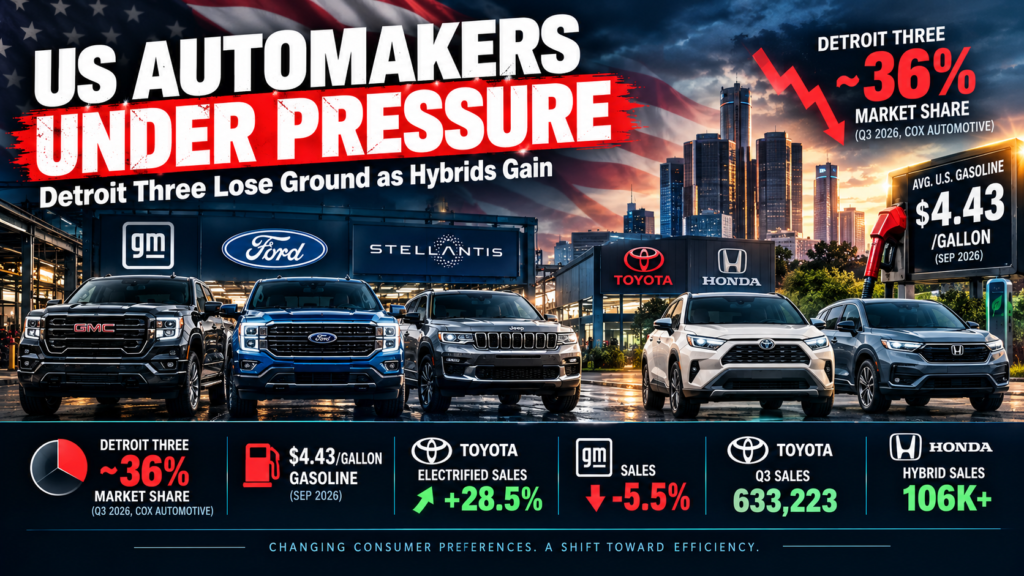
Ford is under particular pressure. Cox expects its sales to fall 8.8% through the first three quarters of the year, with its market share dropping nearly a full point to 12.5%. Cox also forecast that Hyundai Motor Group would outsell Ford for the first time, 511,421 vehicles to 504,172, though Ford argues that Hyundai and Kia are separate companies and that it outsold the two combined year to date.
Overall US sales for the quarter are estimated at about 4.1 million, down about 1% from a year earlier. The average new-vehicle transaction price rose 1.9% to $50,089 in August.
What to watch: Ford’s reported third-quarter sales, gasoline prices, and whether Detroit’s automakers shift more of their production toward hybrids.
Business
Chip-sector M&A. A chip supplier announced it is buying Synaptics for $5.7 billion in cash
Synaptics shares jumped 14% after a chip supplier announced a $5.7 billion all-cash deal to acquire the company.
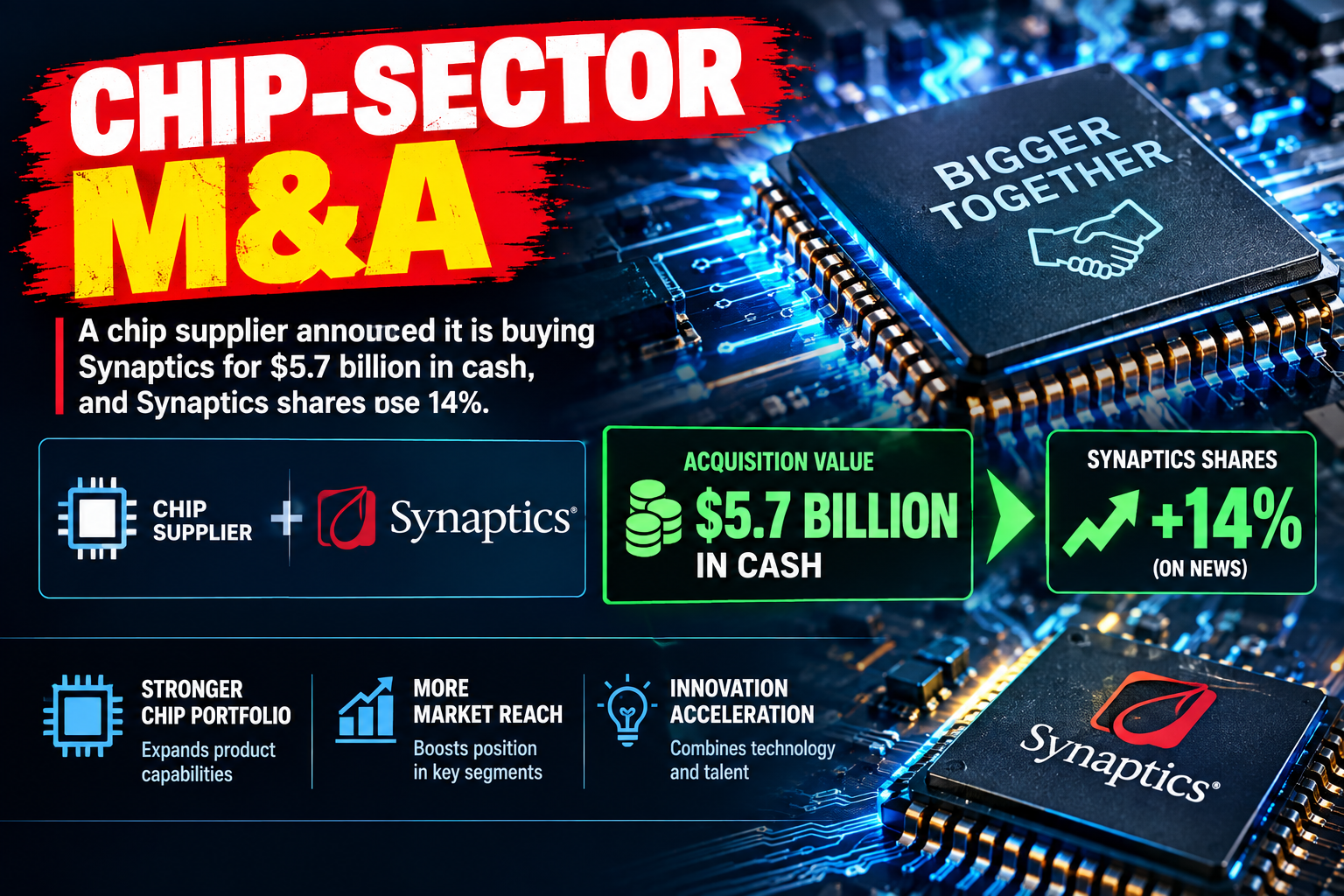
onsemi Switches to $5.7 Billion All-Cash Deal for Synaptics After Rival Bid Surfaces
Shares of Synaptics jumped about 14% after chipmaker onsemi (ON Semiconductor) agreed to buy it in an all-cash deal valued at about $5.7 billion. The revised agreement, announced late Thursday, October 1, pays $123 per share in cash and replaces the all-stock deal the companies signed on June 25, which was valued at about $7 billion.
The change followed competing interest. A filing shows Synaptics had received an unsolicited, non-binding proposal from another strategic party, which likely drove the renegotiation. Synaptics’ board unanimously concluded that the amended deal remains in shareholders’ interests.
Shares of Synaptics opened more than 14% higher on Friday, moving close to the cash offer. The stock had closed at $106.15 the previous day. onsemi shares rose about 6% in premarket trading from a prior close of $80.08, with investors welcoming that the cash structure avoids issuing new shares that would have diluted existing holders.

Under the original agreement, Synaptics holders were to receive 1.350 onsemi shares for each share they own. The new deal will be funded with cash on hand and about $2.45 billion in committed debt financing from Morgan Stanley. onsemi expects the acquisition to add to its non-GAAP earnings per share immediately, and has identified $200 million of annual run-rate synergies.
The deal still needs approval from Synaptics shareholders and regulators, with completion expected by mid-2027. It came amid a broader rally in semiconductor stocks.


Spain’s train crash and upcoming election. Spain is dealing with its second deadly train crash this year.

Hong Kong’s Tai Po fire fallout. Leader John Lee apologized

Serbia’s media shake-up. The head of public broadcaster RTS resigned after the student list won an election.

Generation Z Is Killing Fast Fashion in India — And Building Something Far More Beautiful in Its Place

AR Rahman reacts to “anti-national” row over Imtiaz Ali’s Main Vaapas Aaunga

According to Dior Couture, this taboo fashion accessory is back

-

 Entertainment15 hours ago
2026 is a big year at the box office
-

 Entertainment15 hours ago
Ramayana Part 1 arrives this week.
-

 Entertainment15 hours ago
Rajinikanth’s Jailer 2 enters the top 20.
-

 Entertainment15 hours ago
Bigg Boss 20 drama. Manoj Tiwari defended his daughter
-

 Entertainment14 hours ago
Other Diwali releases. Nayanthara’s Mookuthi Amman .