Sports
Real Madrid Transfer Business Heats Up
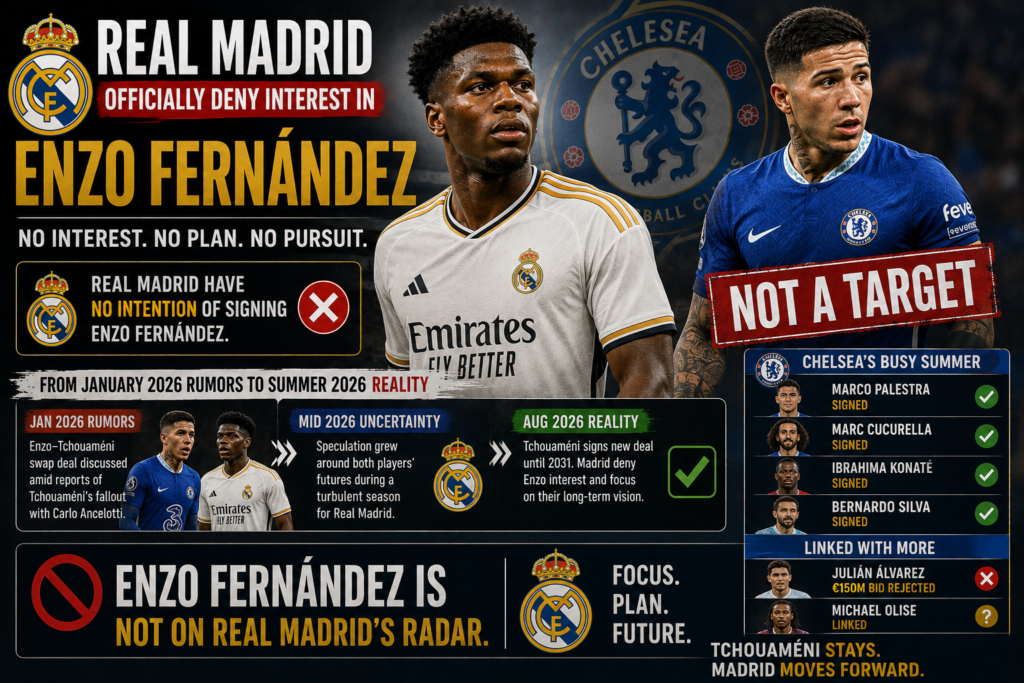
Real Madrid have denied interest in signing Enzo Fernández, with the club instead prioritising a contract extension for Aurélien Tchouaméni as part of its long-term squad-building strategy.


The Big Development: Tchouaméni Signs New Deal Through 2031
The headline move: Aurélien Tchouaméni has agreed a new five-year contract with Real Madrid, tying him to the club until 2031 — ending months of exit speculation and dealing a major blow to Manchester United, who had been actively monitoring the situation.
Key details:
- Tchouaméni joined Real Madrid from AS Monaco in 2022 for around €85 million as the long-term successor to Casemiro.
- His previous deal was due to expire in 2028; the new contract extends that by three more years.
- On salary: reports vary slightly, with some outlets citing around €9 million net per season, while transfer insider Ben Jacobs reported a figure closer to €13 million per year, which would make him one of the club’s highest earners.
- A dressing-room bust-up with teammate Federico Valverde earlier in the turbulent season had fueled doubts about his Real Madrid future.

Why He Stayed: The Mourinho Factor
The turning point was reportedly a direct conversation between new Real Madrid manager José Mourinho and Tchouaméni. Mourinho personally assured the midfielder he’d be a key player in his plans, and Tchouaméni reaffirmed his desire to stay. This is a notable managerial change worth flagging for your audience — Mourinho has taken over at the Bernabéu and is actively shaping his midfield around Tchouaméni, Jude Bellingham, and Federico Valverde.
The Manchester United Angle
This is as much a Manchester United story as a Real Madrid one — United had been monitoring Tchouaméni as a potential replacement for Casemiro, and manager Michael Carrick (who has taken over at Old Trafford) plans to overhaul his midfield this summer, but Tchouaméni’s renewal closes that door.
The Enzo Fernández Situation
Real Madrid has officially and firmly denied any interest in signing Chelsea’s Enzo Fernández, stating they have not registered interest and have no intention of pursuing him. Context matters here: Chelsea has already been busy this summer, signing Marco Palestra, Marc Cucurella, Ibrahima Konaté, and Bernardo Silva, while also being linked with Julián Álvarez (a failed €150m bid) and Bayern’s Michael Olise.
Interestingly, this denial comes after earlier transfer-window rumors (from January 2026) suggested a possible Enzo-for-Tchouaméni swap deal amid reports of Tchouaméni’s fallout with then-manager Carlo Ancelotti — a saga that has now resolved in the opposite direction, with Tchouaméni staying and Real Madrid distancing itself from Enzo entirely.
Why Real Madrid Isn’t Actively Buying Right Now
Mourinho continues to request additional signings from the board, but sources say new arrivals are on hold until further departures are finalized — Dani Ceballos, Dani Carvajal, David Alaba, and Fran García have already left the club this summer, suggesting Real Madrid is still in the middle of a broader midfield/squad rebuild rather than making marquee purchases.








Sports
FIFA World Cup private equity controversy
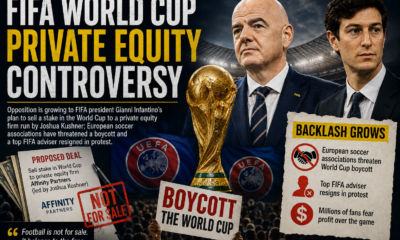
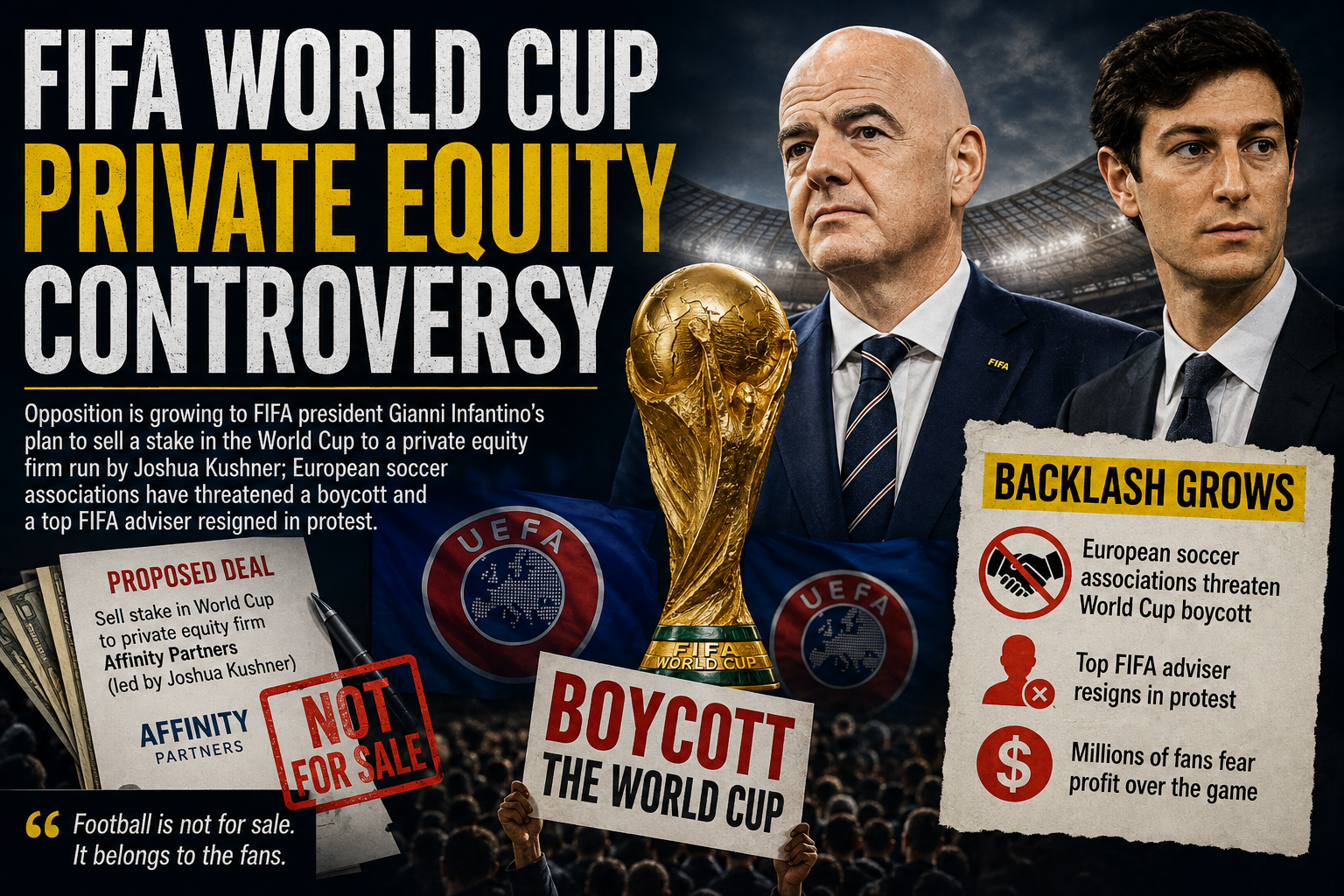
FIFA’s reported private-equity plan for the World Cup is facing growing resistance, with European soccer associations threatening a boycott and a top FIFA adviser resigning in protest.
The Plan (announced Tuesday, July 28)
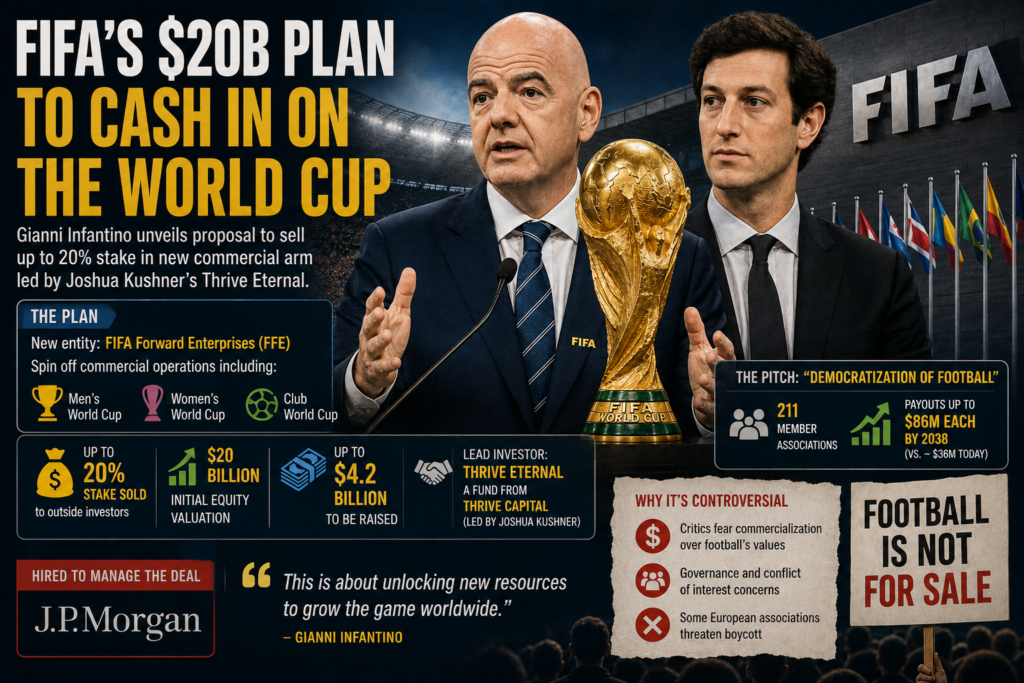
FIFA President Gianni Infantino unveiled a proposal to spin off FIFA’s commercial operations — including the men’s and women’s World Cups and Club World Cup — into a new subsidiary called FIFA Forward Enterprises (FFE). The plan would sell up to a 20% minority stake to outside investors, targeting an initial equity valuation of $20 billion and raising up to $4.2 billion. J.P. Morgan was hired to manage the deal.
The lead investor was set to be Thrive Eternal, a fund from Joshua Kushner’s Thrive Capital — Joshua being the brother of Jared Kushner, Trump’s son-in-law. Infantino framed it as “democratization of football,” promising FIFA’s 211 member associations dramatically higher payouts (up to $86 million each by 2038, versus roughly $36 million under the current structure).
Why It Blew Up Fast
Opposition was immediate and intense:
- UEFA (Europe’s 55 members, including World Cup holders Spain, plus Germany, France, England) voted to boycott all FIFA competitions — men’s and women’s World Cup included — for as long as the proposal remained alive, calling it “irresponsible and indefensible” and saying football’s future “cannot be dictated” by profit-seeking investors.
- CONCACAF (41 members, including 2026 co-hosts USA, Canada, Mexico) and the AFC (Asia) also formally rejected the plan.
- Two senior FIFA officials broke ranks internally — one resigned as a presidential adviser, another said staff had been “deceived” about the project.
- UK PM-level criticism: British PM Andy Burnham said Infantino was “the wrong man to lead” FIFA.
- US House Judiciary Democrats accused Infantino of running a “kickback hat trick,” tying it to his earlier FIFA Peace Prize award to Trump and a FIFA office lease inside Trump Tower.
The Political Subtext
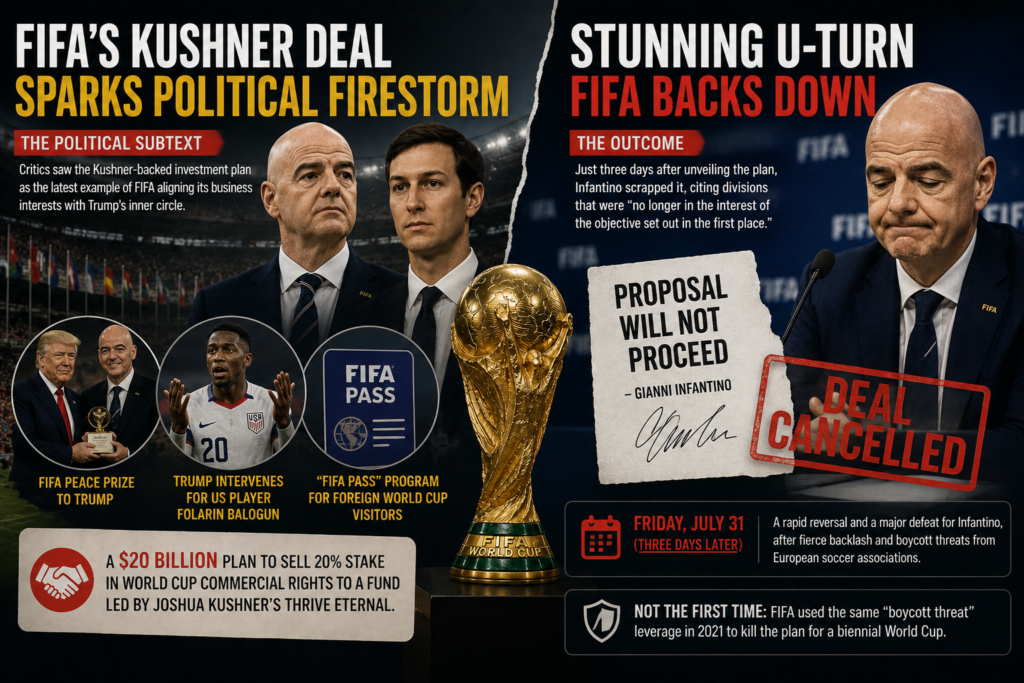
This landed on top of an already-scrutinized Infantino-Trump relationship: the FIFA Peace Prize given to Trump, Trump’s on-record intervention to get a red card suspension overturned for US player Folarin Balogun during the tournament, and the “FIFA Pass” program to help foreign World Cup visitors navigate immigration enforcement. Critics saw the Kushner-backed investment deal as the latest and most direct example of FIFA aligning its business interests with Trump’s inner circle.
The Outcome — FIFA Backed Down
Just three days later (Friday, July 31), Infantino scrapped the plan entirely: he said the “proposal will not proceed,” explaining that the project had created divisions that were “no longer in the interest of the objective set out in the first place.” It’s described as a stunning, rapid defeat — FIFA had used the same “boycott threat” leverage once before, in 2021, to kill a plan for a biennial World Cup.
Why It Matters Beyond Sports
This is a good segment to frame as a governance and money-in-sports story: it’s one of the clearest recent examples of member nations successfully checking a powerful global sports body’s leadership, and it ties into the broader “Trump-adjacent dealmaking” storyline that’s been recurring across sports, media, and business this year. It also raises fresh questions about how FIFA — sitting on record 2026 World Cup revenue near $12-15 billion — will fund its stated ambitions without private capital going forward.
Sports
Upcoming: European Athletics Championships (Birmingham, Aug 10–16) & Hockey World Cup (Belgium/Netherlands, Aug 15–30)
Two of the biggest international sporting events of the month are set to begin, with elite track and field stars competing in Birmingham and the world’s top hockey nations battling for the FIH World Cup title.

Tournament Overview
The tournament will be co-hosted by Belgium and the Netherlands from August 15-30, 2026, making it the first-ever co-hosted Men’s Hockey World Cup. It features 32 teams total (16 men’s, 16 women’s), with men’s and women’s competitions being staged simultaneously across two venues — Wagener Hockey Stadium in Amstelveen, Netherlands, and the newly built Belfius Hockey Arena in Wavre, Belgium. Belgium and the Netherlands won hosting rights in 2022, beating bids from England-Wales and South Africa.
India Men’s Team
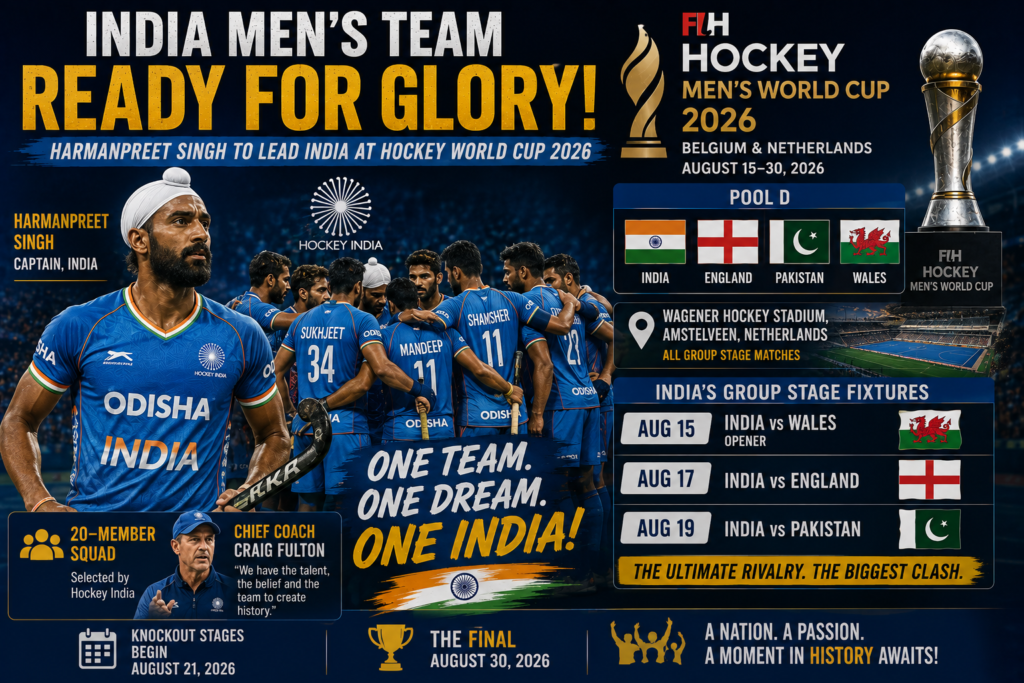
Harmanpreet Singh will captain India, with Hockey India naming a 20-member squad. India has been drawn in Pool D alongside England, Pakistan and Wales, and will play all group-stage matches at Wagener Hockey Stadium in Amstelveen.
Key fixtures (all times IST when broadcast in India):
- Aug 15: India vs. Wales (opener)
- Aug 17: India vs. England
- Aug 19: The blockbuster India vs. Pakistan clash — arguably the tournament’s most-watched match on the Indian broadcast calendar.
Chief Coach Craig Fulton has expressed confidence in the team’s potential to create a significant moment in Indian hockey history, and the knockout stages begin August 21, with the final on August 30.
India Women’s Team
<cite name=”women squad” index=”275-1″>Salima Tete continues as captain of India’s 20-member squad, described by chief coach Sjoerd Marijne as a balanced mix of experienced players and emerging talent.</cite> The squad is currently training at the national camp in Bengaluru, with the same core group also set to represent India at the upcoming Asian Games.
Confidence is high after India’s unbeaten, title-winning run at the FIH Nations Cup in New Zealand, which also earned promotion back into the FIH Pro League — solid momentum heading into the World Cup.
Key fixtures: India opens against China on August 16, followed by South Africa on August 18, and England on August 20.
New Format — Why It Matters
This edition introduces a new format with a second group stage replacing the traditional straight-to-quarterfinal knockout. The pool stage feeds into a second-round group phase (Pools E/F) for the top two finishers from each group, while bottom-two finishers enter classification pools (G/H) — guaranteeing every team at least five matches before the knockout stage, rather than early elimination after just three games. The women’s final will be held in Amsterdam on August 29, and the men’s final in Wavre on August 30.

Broadcast in India
Live telecast will air on the Star Sports Network, with live streaming available via the JioHotstar app and website.
Why This Story Has Big Engagement Potential
- The India-Pakistan hockey rivalry remains one of the most emotionally charged fixtures in Indian sport, second only to cricket’s version of the rivalry.
- This comes right on the heels of India’s strong CWG boxing performance and ahead of the BWF World Championships in Delhi — meaning mid-to-late August is shaping up as a genuinely packed Indian sports calendar, giving your channel a strong multi-week content runway.
- India last hosted the Men’s World Cup themselves in 2023 (Bhubaneswar/Rourkela), where Germany won gold — so there’s a natural “can India go one better this time” narrative angle.
Sports
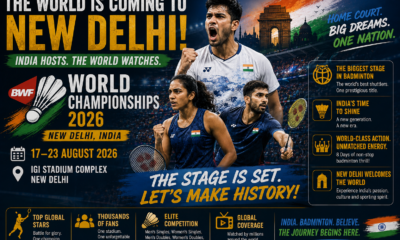
Upcoming: BWF World Championships in New Delhi (Aug 17–23)
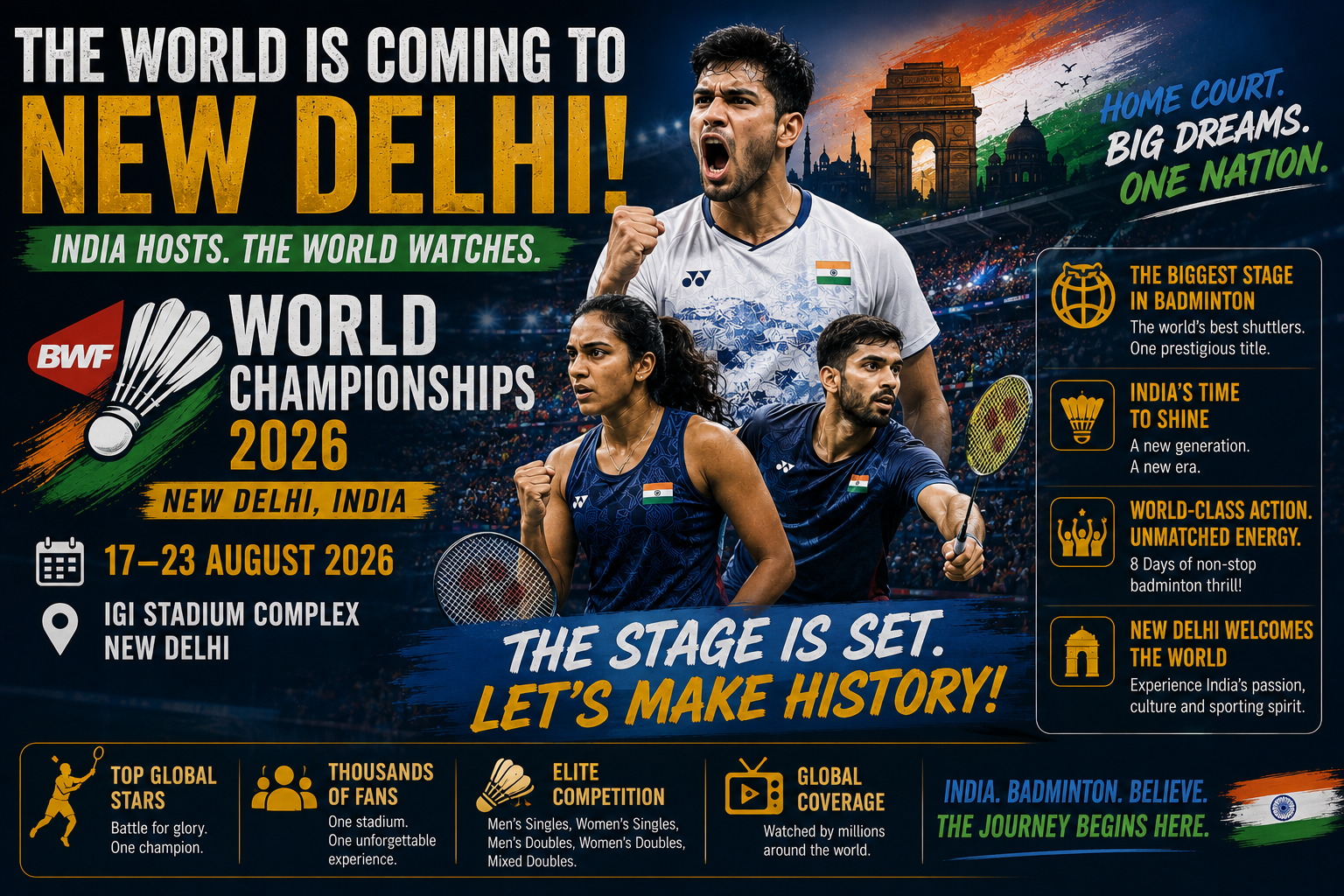
New Delhi is ready to welcome the world’s best shuttlers as India hosts the BWF World Championships 2026. The tournament is expected to be a major milestone for Indian badminton and a showcase of world-class talent.
Tournament Overview
The BWF World Championships 2026 will be held in New Delhi from August 17-23, marking India’s return as hosts after a gap of 17 years. Matches will be played at the Indira Gandhi Indoor Stadium, making this one of India’s biggest badminton events in recent history. This is the tournament’s 30th edition.
India’s 10-Member Contingent
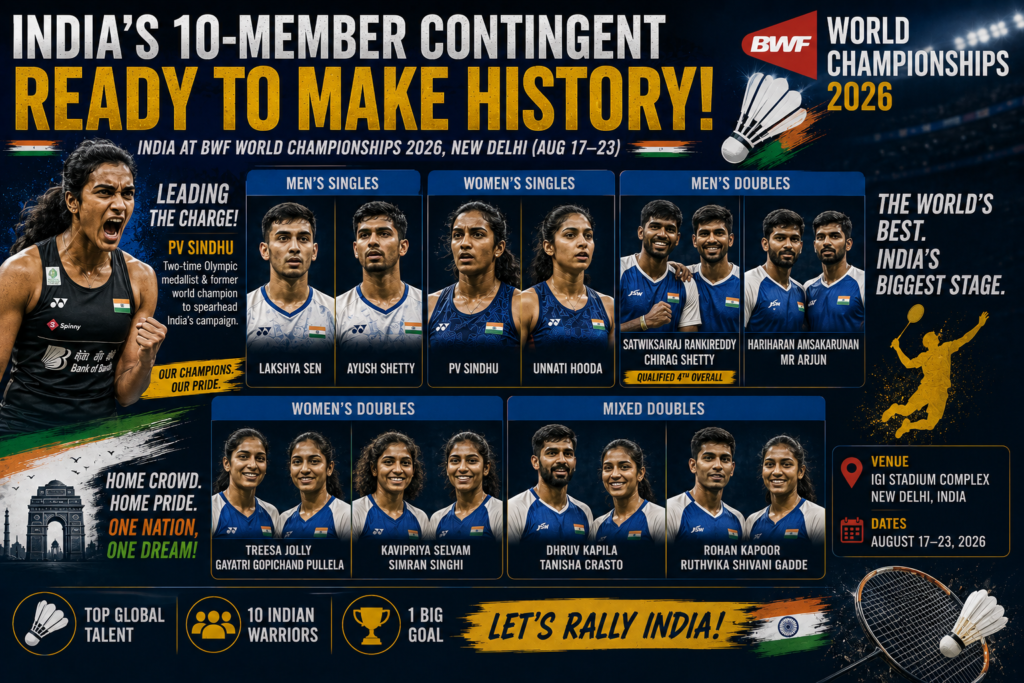
Two-time Olympic medallist and former world champion PV Sindhu will spearhead the squad, earning her spot in women’s singles as India’s host representative under BWF qualification rules.
Full lineup:
- Men’s singles: Lakshya Sen and Ayush Shetty
- Women’s singles: PV Sindhu, joined by rising talent Unnati Hooda
- Men’s doubles: Satwiksairaj Rankireddy/Chirag Shetty (India’s top-ranked entry, qualified fourth overall) and Hariharan Amsakarunan/MR Arjun
- Women’s doubles: Treesa Jolly/Gayatri Gopichand Pullela, and Kavipriya Selvam/Simran Singhi
- Mixed doubles: Dhruv Kapila/Tanisha Crasto, and Rohan Kapoor/Ruthvika Shivani Gadde
Notably, established stars like Kidambi Srikanth and HS Prannoy feature only on reserve lists, signaling a generational shift toward younger talent.
The Draw — Just Released (Aug 6)
This is your freshest hook:
- Toughest draw: Ayush Shetty, an Asian Championships silver medallist, faces defending champion and top seed Shi Yuqi of China in the very first round — a rematch of this year’s Asian Championships final, which Shi Yuqi won.
- Kindest draw: PV Sindhu has received a relatively comfortable opener against Ireland’s Sophia Nobel (world No. 141), and has notably avoided both World No. 1 An Se Young and defending champion Akane Yamaguchi until the later stages. A potential third-round clash against China’s Wang Zhi Yi could await her.
- Lakshya Sen: The 2021 Worlds bronze medallist opens against Austria’s world No. 132 Collins Valentine Filimon, with a possible second-round meeting against Egypt’s Ahmed Elgamal or Israel’s Daniil Dubovenko, and a potential third-round showdown against second seed Kunlavut Vitidsarn of Thailand.
- Satwik-Chirag: India’s highest-seeded entry (5th seeds) received a first-round bye in men’s doubles.
Star Power in the Field
The BWF confirmed that defending champions in all five events will participate, including Shi Yu Qi of China (men’s singles), Kim Won Ho/Seo Seung Jae of Korea (men’s doubles), Liu Sheng Shu/Tan Ning of China (women’s doubles), Akane Yamaguchi of Japan (women’s singles), and Chen Tang Jie/Toh Ee Wei of Malaysia (mixed doubles).

Why This Is a Big Story for Your Channel
This is India’s first time hosting the World Championships in 17 years, giving it genuine “home Games” energy — expect massive local ticket demand, strong crowd-backing for Sindhu and Lakshya Sen, and heavy media buildup in the two weeks before it starts. The Ayush Shetty vs. Shi Yuqi opening-round blockbuster alone is a great preview hook, since it’s a direct rematch of a recent final.


Apple’s foldable “iPhone Ultra” and Chrome’s Manifest V2 extension cutoff

Amazon expanding drone delivery to ~500 US cities

Google’s $12.2 billion stake deal with Marvell

Generation Z Is Killing Fast Fashion in India — And Building Something Far More Beautiful in Its Place

AR Rahman reacts to “anti-national” row over Imtiaz Ali’s Main Vaapas Aaunga