
Sports
Ajinkya Rahane Announces Retirement from All Formats
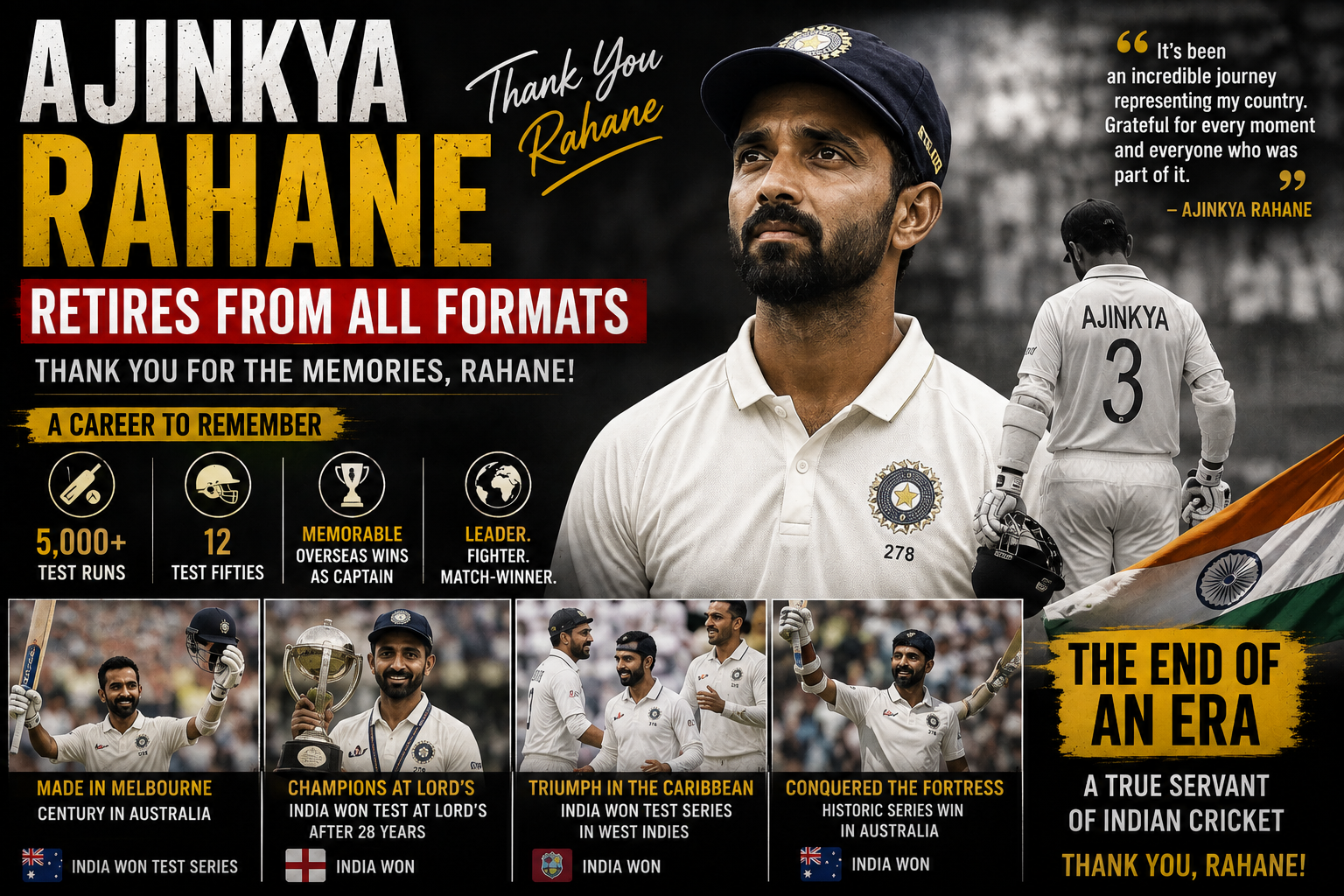
Ajinkya Rahane has called time on his cricket career, retiring from all formats. Renowned for his calm leadership and crucial contributions in overseas Tests, Rahane leaves behind a lasting legacy in Indian cricket

The Announcement
Ajinkya Rahane, 38, announced his retirement from all forms of cricket via a social media post on Thursday, ending an international career that spanned from 2011 to 2023. He last turned out in a competitive match during the 2026 IPL, where he captained Kolkata Knight Riders to 335 runs across 14 outings — but had not played international cricket since a Test in the West Indies in July 2023.
Career Numbers
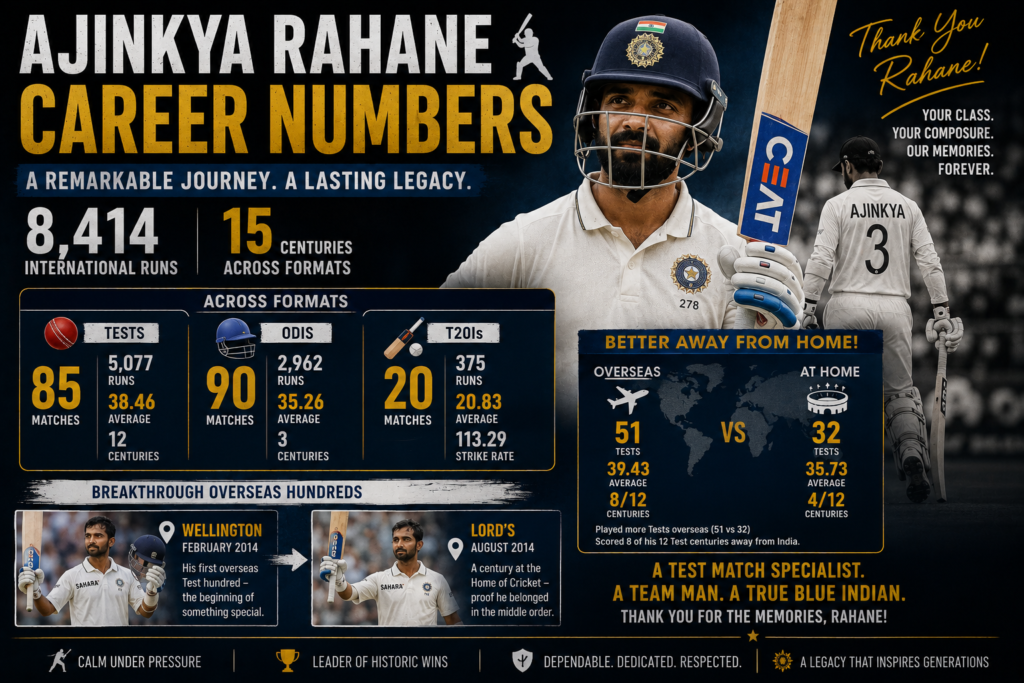
Rahane finishes with 8,414 international runs and 15 centuries across formats:
- Tests: 85 matches, 5,077 runs at an average of 38.46, with 12 centuries
- ODIs: 90 matches, 2,962 runs at 35.26, with 3 centuries
- T20Is: 20 matches, 375 runs at 20.83, with a strike rate of 113.29
Notably, he was better away from home than at home — he played more Tests overseas (51 vs. 32) and averaged higher on foreign soil (39.43 vs. 35.73), scoring 8 of his 12 Test centuries away from India. His breakthrough overseas hundred came in Wellington in February 2014, quickly followed by a century at Lord’s — proof he belonged in the middle order.
Signature Career Moment
The undisputed highlight: leading India to a historic 2-1 Test series win in Australia in the 2020-21 Border-Gavaskar Trophy — remarkable given India had been bowled out for just 36 runs in the series-opening Test in Adelaide. That series victory, achieved without several first-choice players due to injury and personal leave, cemented his reputation as one of Indian cricket’s most composed crisis leaders.
The Emotional Farewell
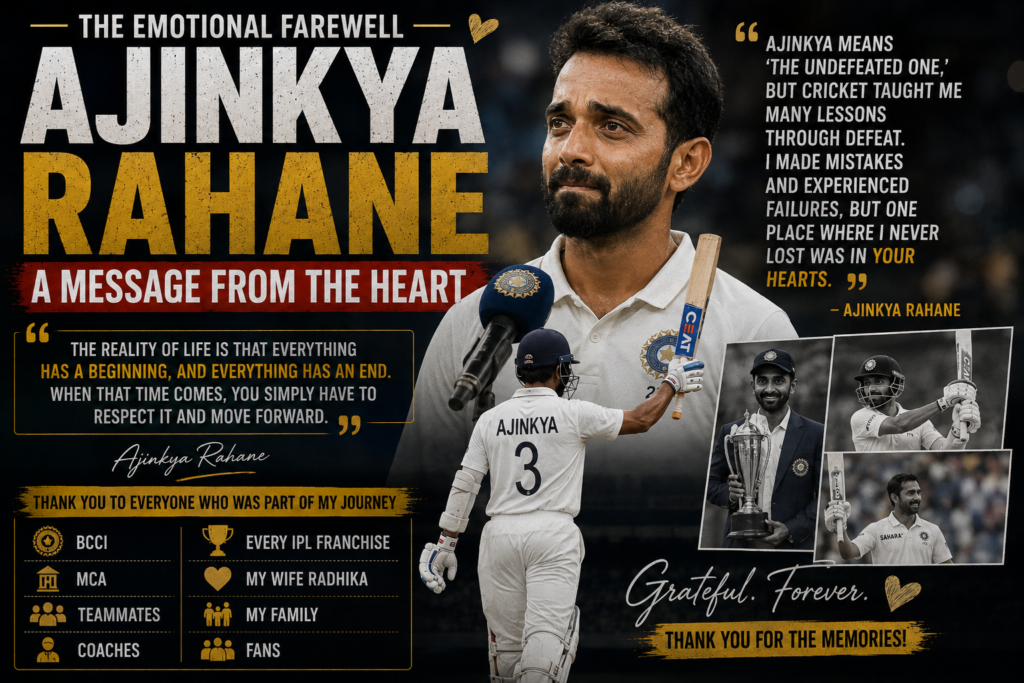
Rahane’s composure broke during his retirement message, as he thanked the BCCI, MCA, teammates, coaches, every IPL franchise, his wife Radhika, his family, and fans. His most quoted line played on his own name:
“Ajinkya means ‘the undefeated one,’ but cricket taught me many lessons through defeat. I made mistakes and experienced failures, but one place where I never lost was in your hearts.”
He also reflected philosophically on timing — both literal (his batting) and metaphorical (his career): “The reality of life is that everything has a beginning, and everything has an end. When that time comes, you simply have to respect it and move forward.”
What’s Next
His retirement leaves KKR needing a new captain after two underwhelming seasons under him (7th in 2026, 8th in 2025). It also closes the door on any potential recall — he’d already been dropped from India’s senior setup for tours like South Africa despite a strong WTC Final showing (89 and 46 against Australia) that briefly revived hopes of a comeback.
Why It’s Resonating
Rahane was never the flashiest name in Indian cricket, but he built a reputation for humility, composure, and being at his best in the toughest overseas conditions — which is why his retirement is landing as an emotional moment for fans rather than just a routine roster update.







Sports
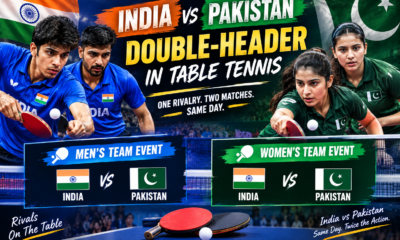
India vs Pakistan double-header in table tennis
India and Pakistan meet in both men’s and women’s table tennis team events on the same day.

Sports
India’s international cricket calendar heats up
India gear up for a major home white-ball series against the West Indies, beginning September 27 in Thiruvananthapuram.
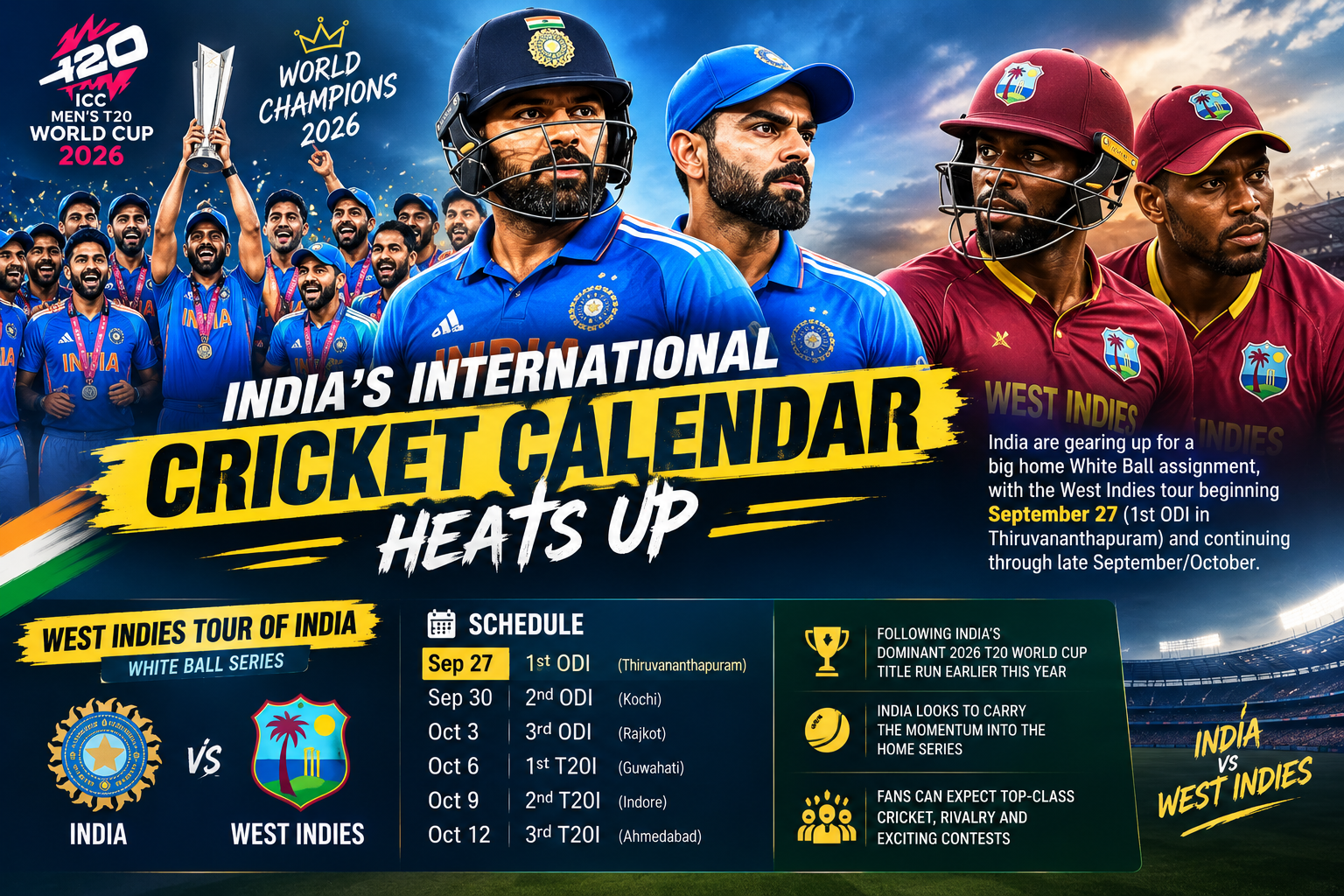
The full schedule (Sept 27 – Oct 17):
- ODIs: 1st – Sept 27, Thiruvananthapuram (Greenfield International Stadium); 2nd – Sept 30, Guwahati (Barsapara Cricket Stadium); 3rd – Oct 3, New Chandigarh
- T20Is: 1st – Oct 6, Lucknow; 2nd – Oct 9, Ranchi; 3rd – date TBD, Indore; 4th – Oct 14, Hyderabad; 5th – Oct 17, Bengaluru (marking M. Chinnaswamy Stadium’s return to hosting internationals since October 2024)
Captaincy split: Shubman Gill leads the ODI side while Shreyas Iyer captains the T20I team — a dual-captaincy setup, with Shai Hope leading the West Indies.
India’s ODI squad: Shubman Gill (C), Rohit Sharma, Virat Kohli, Ruturaj Gaikwad, KL Rahul (VC, WK), Dhruv Jurel (WK), Nitish Kumar Reddy, Ravindra Jadeja, Kuldeep Yadav, Prasidh Krishna, Gurnoor Brar, Mohammed Siraj, Auqib Nabi, Yashasvi Jaiswal, and Naman Dhir.
India’s T20I squad: Shreyas Iyer (C), Abhishek Sharma, Vaibhav Sooryavanshi, Ishan Kishan (WK), Sanju Samson (WK), Tilak Varma (VC), Shivam Dube, Kuldeep Yadav, Axar Patel, Washington Sundar, Ravi Bishnoi, Nitish Kumar Reddy, Arshdeep Singh, Prince Yadav, and Mayank Yadav.
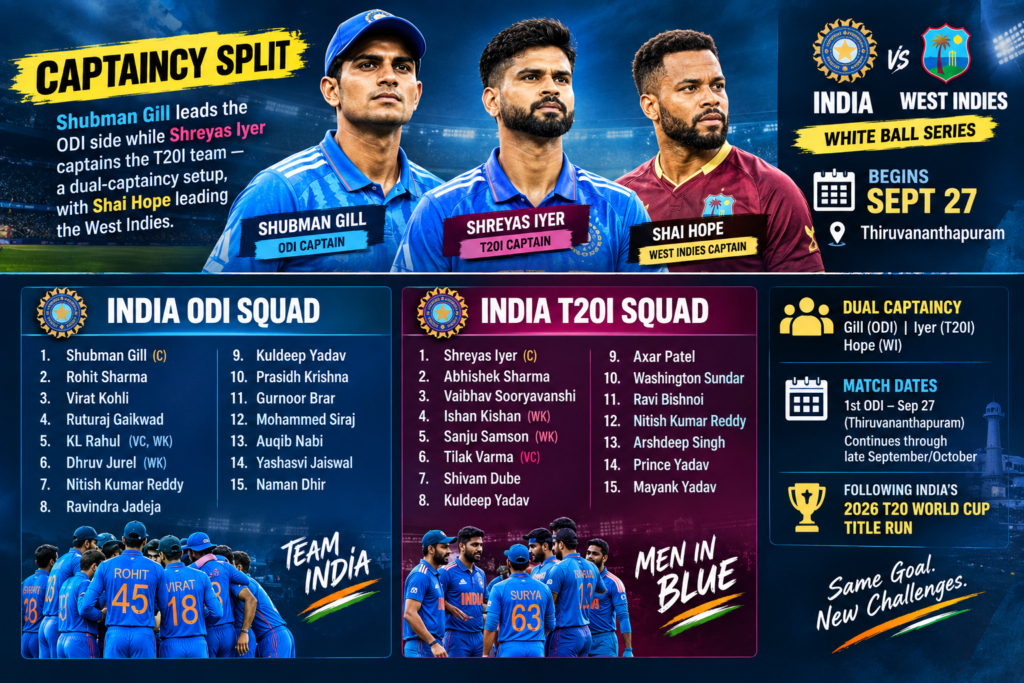
Why this series matters: This marks India’s return to 50-over cricket after a rough tour of England, where the team suffered a 3-0 ODI series defeat, on top of losing the T20I series against both Ireland and England. That dip in form came right after a high point earlier in the year — India had won the 2026 T20 World Cup, swept Afghanistan 3-0 in ODIs, and won a one-off Test against them. Ahead of squad selection, Rishabh Pant’s potential ODI comeback and Hardik Pandya’s fitness were reportedly major talking points for selectors, and the T20I squad was expected to largely mirror the Asian Games squad, while the ODI side had more loose ends given several key players’ absence for the Asian Games.
What’s next: After the West Indies series, India continue building toward the 2027 World Cup with a five-match ODI series in New Zealand starting November 4, and a home white-ball season that also includes Sri Lanka (Dec 13–27) and Zimbabwe (January), before a marquee five-Test home series against Australia from January 21 to March 7.
Sports
FIFA World Cup private equity controversy
FIFA’s reported private-equity plan for the World Cup is facing growing resistance, with European soccer associations threatening a boycott and a top FIFA adviser resigning in protest.
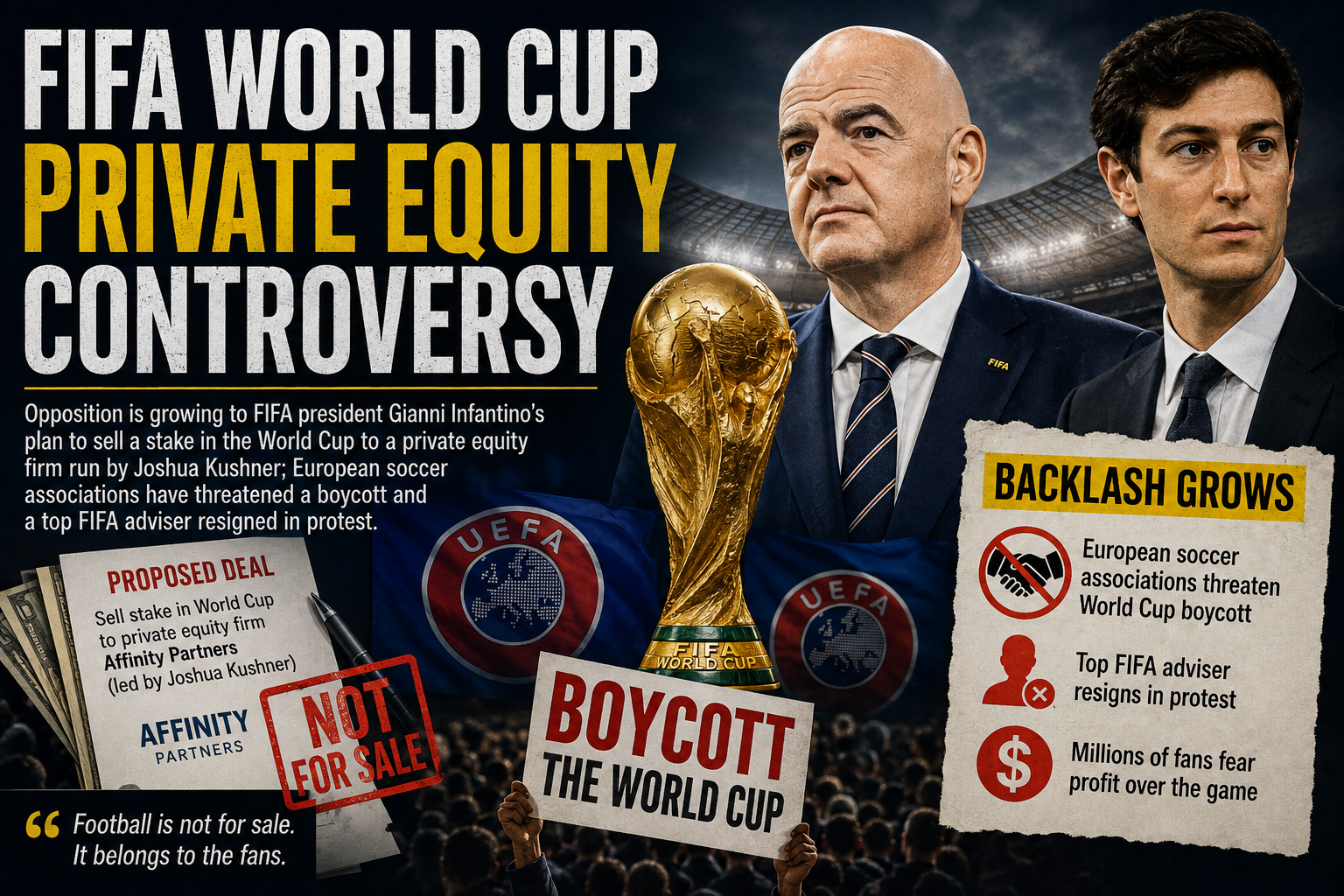
The Plan (announced Tuesday, July 28)
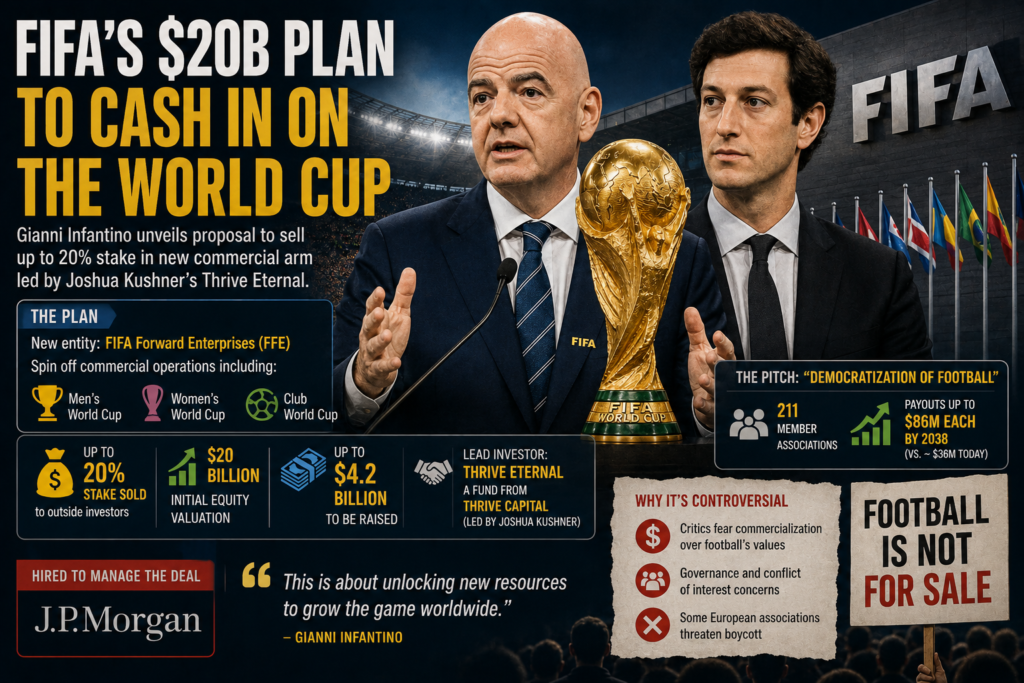
FIFA President Gianni Infantino unveiled a proposal to spin off FIFA’s commercial operations — including the men’s and women’s World Cups and Club World Cup — into a new subsidiary called FIFA Forward Enterprises (FFE). The plan would sell up to a 20% minority stake to outside investors, targeting an initial equity valuation of $20 billion and raising up to $4.2 billion. J.P. Morgan was hired to manage the deal.
The lead investor was set to be Thrive Eternal, a fund from Joshua Kushner’s Thrive Capital — Joshua being the brother of Jared Kushner, Trump’s son-in-law. Infantino framed it as “democratization of football,” promising FIFA’s 211 member associations dramatically higher payouts (up to $86 million each by 2038, versus roughly $36 million under the current structure).
Why It Blew Up Fast
Opposition was immediate and intense:
- UEFA (Europe’s 55 members, including World Cup holders Spain, plus Germany, France, England) voted to boycott all FIFA competitions — men’s and women’s World Cup included — for as long as the proposal remained alive, calling it “irresponsible and indefensible” and saying football’s future “cannot be dictated” by profit-seeking investors.
- CONCACAF (41 members, including 2026 co-hosts USA, Canada, Mexico) and the AFC (Asia) also formally rejected the plan.
- Two senior FIFA officials broke ranks internally — one resigned as a presidential adviser, another said staff had been “deceived” about the project.
- UK PM-level criticism: British PM Andy Burnham said Infantino was “the wrong man to lead” FIFA.
- US House Judiciary Democrats accused Infantino of running a “kickback hat trick,” tying it to his earlier FIFA Peace Prize award to Trump and a FIFA office lease inside Trump Tower.
The Political Subtext
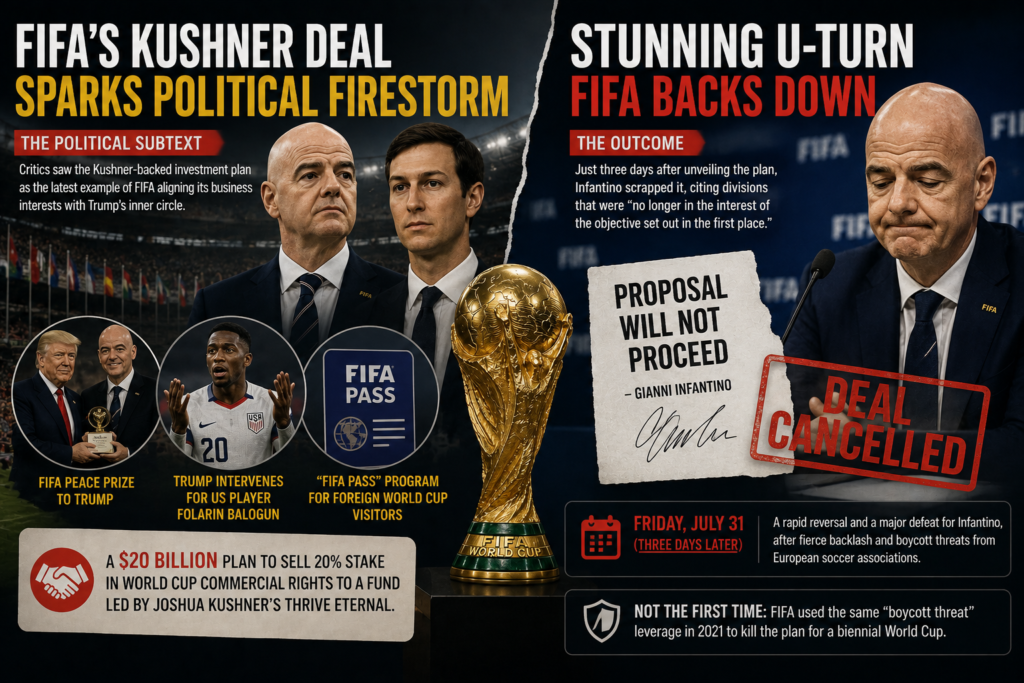
This landed on top of an already-scrutinized Infantino-Trump relationship: the FIFA Peace Prize given to Trump, Trump’s on-record intervention to get a red card suspension overturned for US player Folarin Balogun during the tournament, and the “FIFA Pass” program to help foreign World Cup visitors navigate immigration enforcement. Critics saw the Kushner-backed investment deal as the latest and most direct example of FIFA aligning its business interests with Trump’s inner circle.
The Outcome — FIFA Backed Down
Just three days later (Friday, July 31), Infantino scrapped the plan entirely: he said the “proposal will not proceed,” explaining that the project had created divisions that were “no longer in the interest of the objective set out in the first place.” It’s described as a stunning, rapid defeat — FIFA had used the same “boycott threat” leverage once before, in 2021, to kill a plan for a biennial World Cup.
Why It Matters Beyond Sports
This is a good segment to frame as a governance and money-in-sports story: it’s one of the clearest recent examples of member nations successfully checking a powerful global sports body’s leadership, and it ties into the broader “Trump-adjacent dealmaking” storyline that’s been recurring across sports, media, and business this year. It also raises fresh questions about how FIFA — sitting on record 2026 World Cup revenue near $12-15 billion — will fund its stated ambitions without private capital going forward.


Spain’s train crash and upcoming election. Spain is dealing with its second deadly train crash this year.

Hong Kong’s Tai Po fire fallout. Leader John Lee apologized

Serbia’s media shake-up. The head of public broadcaster RTS resigned after the student list won an election.

Generation Z Is Killing Fast Fashion in India — And Building Something Far More Beautiful in Its Place

AR Rahman reacts to “anti-national” row over Imtiaz Ali’s Main Vaapas Aaunga

According to Dior Couture, this taboo fashion accessory is back

-
 Entertainment14 hours ago
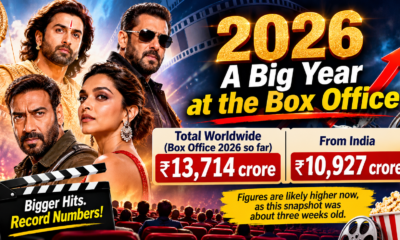
2026 is a big year at the box office
-
 Entertainment15 hours ago
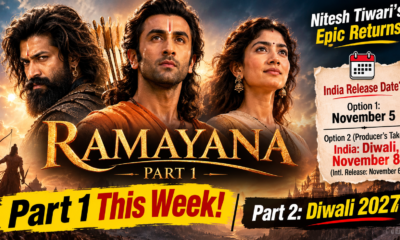
Ramayana Part 1 arrives this week.
-
 Entertainment15 hours ago
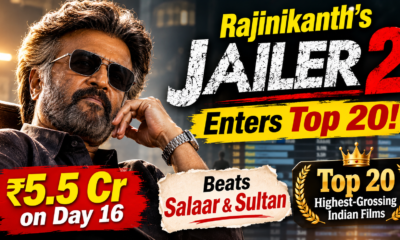
Rajinikanth’s Jailer 2 enters the top 20.
-
 Entertainment15 hours ago
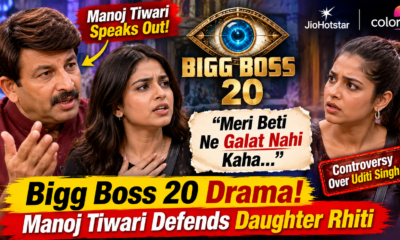
Bigg Boss 20 drama. Manoj Tiwari defended his daughter
-

 Entertainment14 hours ago
Other Diwali releases. Nayanthara’s Mookuthi Amman .