
Business
Migrant crisis strains Spain-Morocco relations
The deadly Ceuta border crisis is becoming more than a humanitarian emergency, putting pressure on Spain-Morocco relations and raising wider questions about EU trade, migration and security cooperation

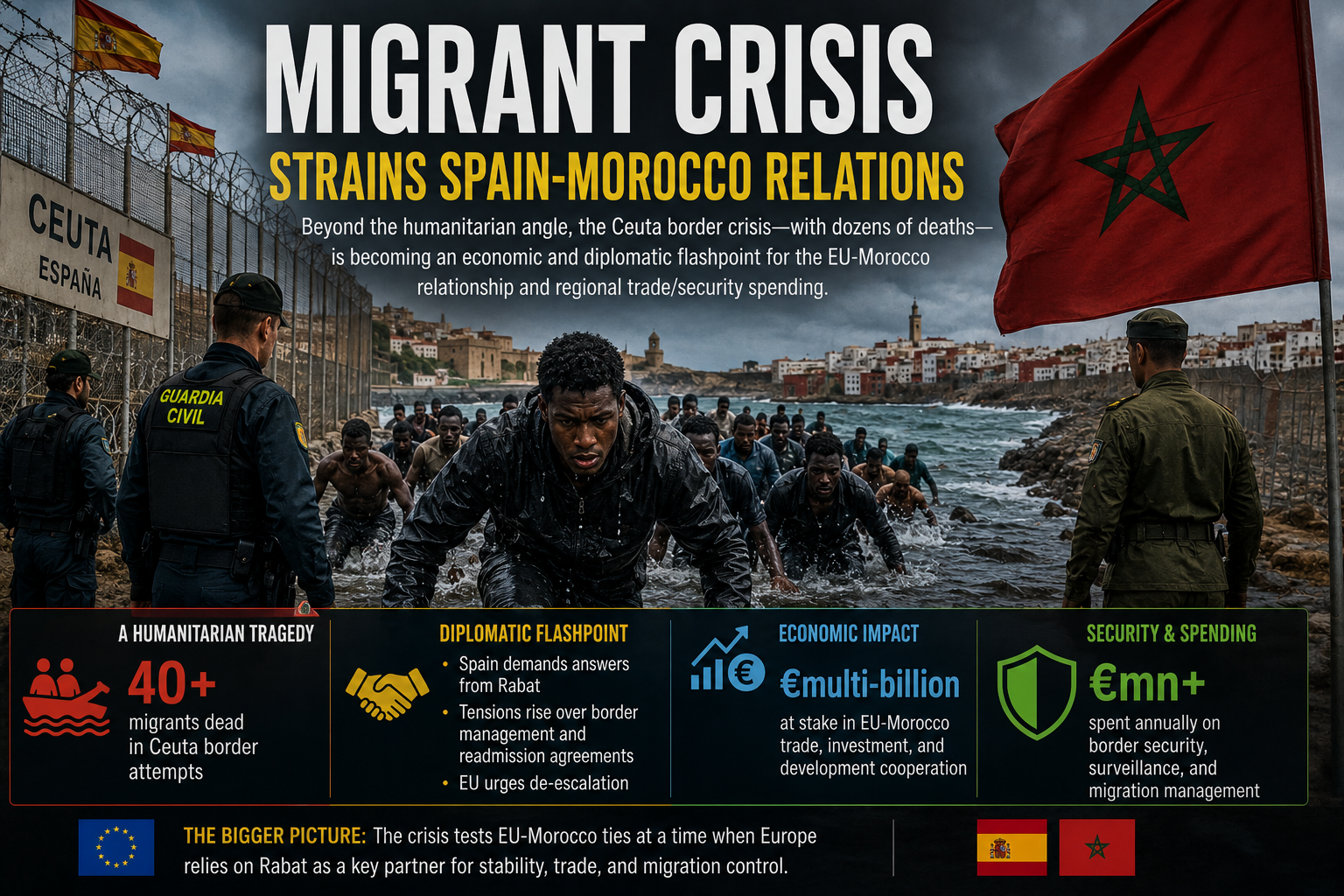
What Happened
Between July 30 and August 1, 2026, an estimated 50,000–70,000 migrants — mostly Moroccans — breached the border and crossed into Ceuta, Spain’s small North African enclave, either by land, by swimming, or by climbing the breakwater barrier. This was the largest single migrant surge into Ceuta in its history, dwarfing even the notable 2021 incident when about 8,000 people crossed. To put the scale in perspective: Ceuta’s entire population is only around 84,000 — so the crossing was equivalent to more than half the city’s population arriving in roughly 48 hours.
The Death Toll — Numbers Kept Climbing
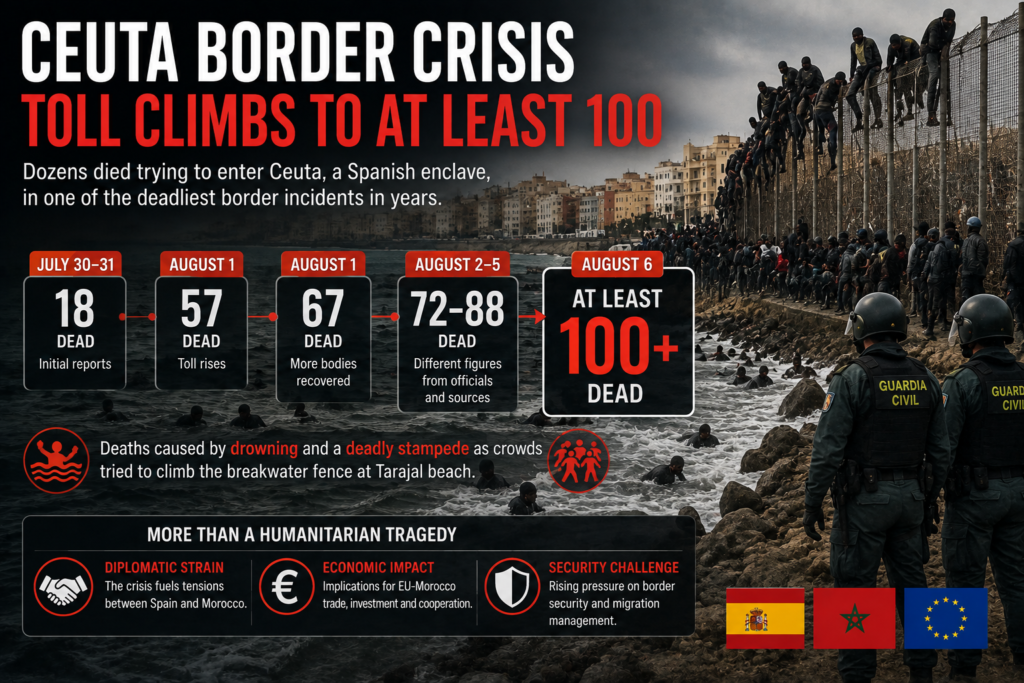
This was a genuinely chaotic, fast-moving story with the toll rising over several days as bodies were recovered:
- Initial reports: 18 dead (July 30–31)
- Then 57, then 67 (Aug 1)
- Then 72–88 depending on the source (Spanish government vs. Sky News vs. local officials)
- By August 6, Ceuta’s regional president told the European Parliament the toll had reached at least 100
Deaths came from drowning and from a stampede as crowds tried to climb over the breakwater fence at Tarajal beach. Some bodies were found later, washed up along the coastline.
Why It Happened — The Trigger
Spain’s Interior Ministry and officials pointed to a Spanish Supreme Court ruling issued earlier in July that said migrants who swim into Spanish territory could not be immediately deported unless they’d crossed a physical border barrier. Spain says criminal smuggling gangs spread rumors/misinformation about this ruling, encouraging a rush of crossings. Morocco rejected blame, arguing Spain should have anticipated the fallout from its own court decision.
There’s also a notable geopolitical theory circulating: some observers suggest Morocco may have facilitated or turned a blind eye to the surge as diplomatic pressure tied to broader tensions — Spain has been critical of Israel and the US over the Gaza/Iran conflict, while Morocco has taken a friendlier posture toward the US and Israel. Morocco has historically used migration flows as leverage in disputes with Spain, including over sovereignty claims to Ceuta and Melilla themselves (Morocco disputes Spanish control, though Spain has held Ceuta since 1580).
The Aftermath and Response
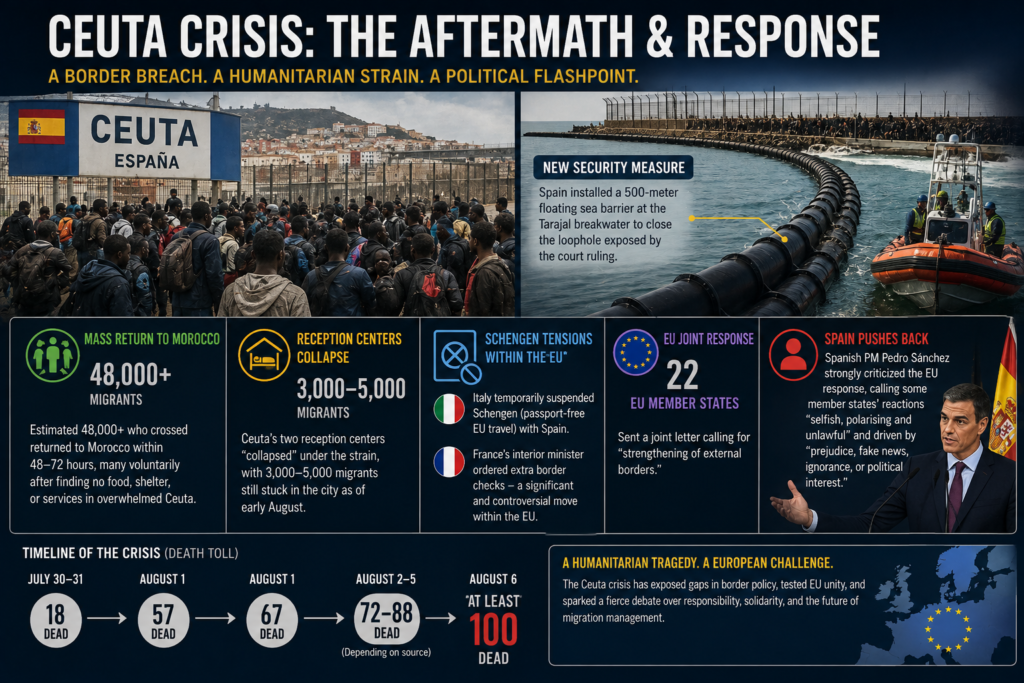
- Most who crossed (an estimated 48,000+) returned to Morocco within 48–72 hours, many voluntarily after finding no food, shelter, or services in an overwhelmed Ceuta.
- Spain installed a 500-meter floating sea barrier at the Tarajal breakwater to close the loophole exposed by the court ruling.
- Ceuta’s two reception centers “collapsed” under the strain, with 3,000–5,000 migrants still stuck in the city as of early August.
- Italy temporarily suspended Schengen (passport-free EU travel) with Spain, and France’s interior minister ordered extra border checks — a significant and controversial move within the EU.
- 22 EU member states sent a joint letter calling for “strengthening of external borders.”
- Spanish PM Pedro Sánchez strongly criticized the EU response, calling some member states’ reactions “selfish, polarising and unlawful” and driven by “prejudice, fake news, ignorance, or political interest” — pushing back hard against calls to suspend Spain from Schengen.
The Bigger Picture
Spain’s migration policy has actually leaned toward regularizing undocumented workers already in the country to support its economy — a contrast to the anti-migration, pro-deportation stance common elsewhere in the EU and the US under Trump. Despite the Ceuta drama, Spain has historically had fewer irregular arrivals than Italy or Greece. But Ceuta arrivals specifically spiked 164% in the first half of 2026 versus 2025 (2,582 vs. 978), even as Spain’s national arrival numbers actually fell.
The underlying driver, as with most Ceuta surges, is stark economic inequality just a few miles apart: Morocco’s GDP per capita was about $4,153 in 2024, compared with $26,774 in Ceuta.









Business
India: RBI policy, rupee and IT earnings
India’s markets face a crucial week as the RBI policy decision and TCS earnings approach, while rupee weakness and global pressures weigh on the Nifty.

Business
Pressure on US automakers. Reuters reports that GM, Ford and Stellantis could see their combined US market share dip to 36% for the quarter
GM, Ford and Stellantis could see their combined U.S. market share fall to around 36%, highlighting growing pressure on Detroit’s biggest automakers.

Detroit Three Slip to Record-Low US Market Share as Gas Prices Drive Buyers to Hybrids
GM, Ford and Stellantis are heading for their weakest US showing on record. Cox Automotive estimates their combined third-quarter market share at around 36%, an all-time low, while hybrid-heavy Asian brands including Toyota and Honda are expected to account for more than half of new vehicle sales.
The driver is fuel costs. The Iran war has pushed US gasoline to a national average of $4.43 a gallon in September, according to AAA, up from $3.20 a year earlier, and buyers are turning to hybrids and more efficient models.
Toyota is the clearest winner. Its electrified sales climbed 28.5% to 363,367 units, or 57.4% of its US sales, and its Corolla hybrid jumped nearly 36%. GM kept the top US sales spot, but its lead over Toyota shrank to 37,751 vehicles, and Cox has said Toyota could overtake GM in the coming years if the trend continues. GM’s quarterly sales fell 5.5% to 670,974 units. Honda posted a record hybrid quarter of more than 106,000 units, with sales up 9.3%. Stellantis sales were roughly flat at 324,277.

Ford is under particular pressure. Cox expects its sales to fall 8.8% through the first three quarters of the year, with its market share dropping nearly a full point to 12.5%. Cox also forecast that Hyundai Motor Group would outsell Ford for the first time, 511,421 vehicles to 504,172, though Ford argues that Hyundai and Kia are separate companies and that it outsold the two combined year to date.
Overall US sales for the quarter are estimated at about 4.1 million, down about 1% from a year earlier. The average new-vehicle transaction price rose 1.9% to $50,089 in August.
What to watch: Ford’s reported third-quarter sales, gasoline prices, and whether Detroit’s automakers shift more of their production toward hybrids.
Business
Chip-sector M&A. A chip supplier announced it is buying Synaptics for $5.7 billion in cash
Synaptics shares jumped 14% after a chip supplier announced a $5.7 billion all-cash deal to acquire the company.

onsemi Switches to $5.7 Billion All-Cash Deal for Synaptics After Rival Bid Surfaces
Shares of Synaptics jumped about 14% after chipmaker onsemi (ON Semiconductor) agreed to buy it in an all-cash deal valued at about $5.7 billion. The revised agreement, announced late Thursday, October 1, pays $123 per share in cash and replaces the all-stock deal the companies signed on June 25, which was valued at about $7 billion.
The change followed competing interest. A filing shows Synaptics had received an unsolicited, non-binding proposal from another strategic party, which likely drove the renegotiation. Synaptics’ board unanimously concluded that the amended deal remains in shareholders’ interests.
Shares of Synaptics opened more than 14% higher on Friday, moving close to the cash offer. The stock had closed at $106.15 the previous day. onsemi shares rose about 6% in premarket trading from a prior close of $80.08, with investors welcoming that the cash structure avoids issuing new shares that would have diluted existing holders.

Under the original agreement, Synaptics holders were to receive 1.350 onsemi shares for each share they own. The new deal will be funded with cash on hand and about $2.45 billion in committed debt financing from Morgan Stanley. onsemi expects the acquisition to add to its non-GAAP earnings per share immediately, and has identified $200 million of annual run-rate synergies.
The deal still needs approval from Synaptics shareholders and regulators, with completion expected by mid-2027. It came amid a broader rally in semiconductor stocks.


Spain’s train crash and upcoming election. Spain is dealing with its second deadly train crash this year.

Hong Kong’s Tai Po fire fallout. Leader John Lee apologized

Serbia’s media shake-up. The head of public broadcaster RTS resigned after the student list won an election.

Generation Z Is Killing Fast Fashion in India — And Building Something Far More Beautiful in Its Place

AR Rahman reacts to “anti-national” row over Imtiaz Ali’s Main Vaapas Aaunga

According to Dior Couture, this taboo fashion accessory is back

-

 Entertainment14 hours ago
2026 is a big year at the box office
-

 Entertainment15 hours ago
Ramayana Part 1 arrives this week.
-

 Entertainment15 hours ago
Rajinikanth’s Jailer 2 enters the top 20.
-

 Entertainment15 hours ago
Bigg Boss 20 drama. Manoj Tiwari defended his daughter
-

 Entertainment14 hours ago
Other Diwali releases. Nayanthara’s Mookuthi Amman .