
Entertainment
Resident Evil movie box office buzz
Sony’s upcoming Resident Evil reboot is building strong box office momentum, with early tracking suggesting a potential franchise-record domestic opening under director Zach Cregger.


The film itself
- Directed by Zach Cregger (of Barbarian and the Oscar-winning Weapons), co-written with Shay Hatten
- Stars Austin Abrams as Bryan, a medical courier caught in the Raccoon City outbreak, with Zach Cherry, Kali Reis, and Paul Walter Hauser
- $80 million budget, releasing September 18, 2026 via Sony/Columbia Pictures, with UAE theaters getting it a day early (Sept. 17)
- Notably, it’s shot for IMAX — the first new wide release with that distinction since Christopher Nolan’s The Odyssey
Why it’s a departure from past films
Cregger has said he isn’t adapting the games directly or using characters like Leon and Claire, feeling the games already tell those stories perfectly and that recreating them would do the material a disservice. Instead, he’s aiming to stay loyal to the game lore with new characters. The tracking numbers (and why they’re wild)
The projections have escalated fast over the past couple weeks:
- Early August: $30M–$40M opening projected
- Then revised to $40M–$50M
- Most recently (Sept. 2), driven by strong IMAX/premium-format presales: tracking as high as $60M–$80M domestically
Any of these figures would blow past the franchise’s existing domestic opening record of $26.65M, set by Resident Evil: Afterlife in 2010.

Why analysts think it’s happening
- Interest tracking (52%) reportedly surpassed where Nolan’s The Odyssey stood at the same point before release — and that film went on to open at $120.5M domestically.
- It’s riding Cregger’s post-Weapons momentum ($270M worldwide)
- Audience skew is currently strongest with men under 25, tracking ahead of first-choice interest for Weapons, Alien: Romulus, and 28 Years Later — though still behind Mortal Kombat II, which ultimately underperformed its own early hype ($38.5M vs. a projected $50M).







Entertainment
Kamal Haasan’s next project rumors
kamal Haasan is reportedly set to headline a gritty action film from the director of Veera Dheera Sooran, creating major buzz in Tamil cinema.

It’s now officially confirmed
Raaj Kamal Films International (Kamal Haasan’s own production banner) announced on Thursday (Sept 4) that his next film will be directed by SU Arun Kumar, known for the acclaimed Chithha (2023) and the Vikram-starrer Veera Dheera Sooran.
The announcement
- Revealed via a first-look photo with the caption “Here I come” (“Dho Vaaren”)
- Kamal is shown with salt-and-pepper hair, a thick moustache and full beard, holding a sickle — a deliberately rugged, rural look
- No title, plot, or full cast has been revealed yet

What kind of film it’ll be
- A gritty, grounded, no-frills action drama — reportedly a return to rural mass-actioner territory, drawing comparisons to his earlier films Virumaandi/Pathertaru
- Shot entirely in Madurai for an authentic, rooted feel
- Notably, the team is said to be avoiding CGI de-aging and skipping the usual song-and-dance sequences — leaning into realism
- A middle-aged actress is rumored to be cast as female lead/co-lead, though unconfirmed
- On-screen, Kamal is expected to sport a shorter hairstyle than the photoshoot look, despite the beard-and-moustache first look

Where this fits in his packed slate
This comes right after his role in Mani Ratnam’s Thug Life (2025), and he has several other major projects lined up:
- KHxRK — his long-awaited on-screen reunion with Rajinikanth, directed by Nelson Dilipkumar
- Kalki 2 (sequel to Kalki 2898 AD), alongside Prabhas and Amitabh Bachchan
- He was earlier attached to a project with directing duo Anbariv (tentatively titled KH237), but reports now suggest that may follow after the SU Arun Kumar film, with the shooting order between the two still unconfirmed
Entertainment
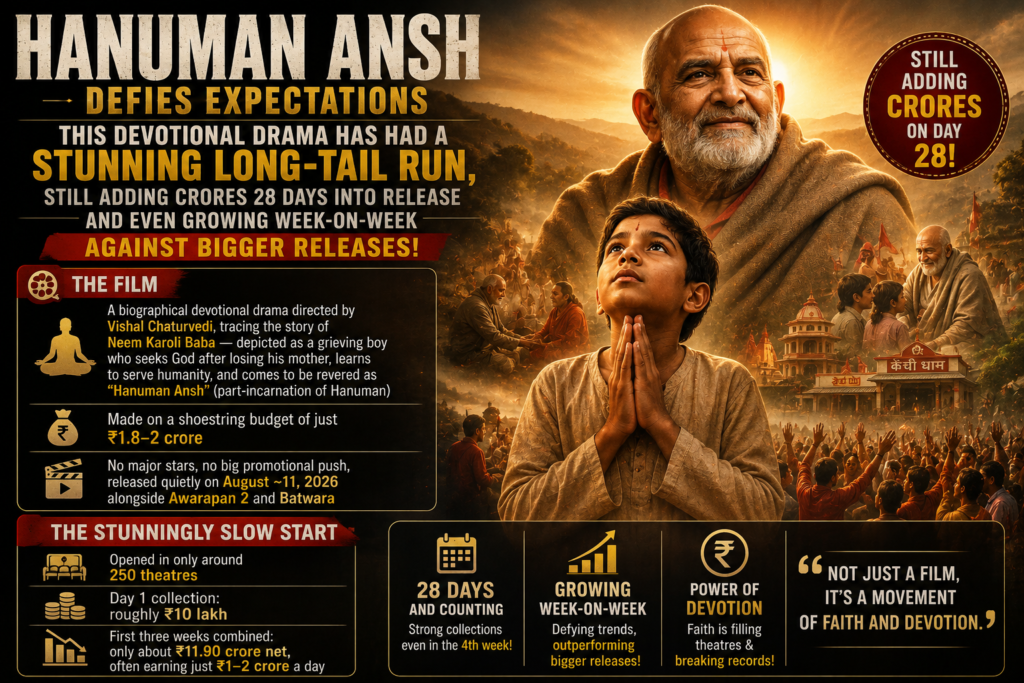
“Hanuman Ansh” defies expectations
Defying conventional box office trends, Hanuman Ansh is still earning strongly 28 days into its theatrical run and continues to grow against bigger releases.

This is genuinely one of the wildest box office stories of the year in India. Here’s the full picture on “Hanuman Ansh”:
The film
- A biographical devotional drama directed by Vishal Chaturvedi, tracing the story of Neem Karoli Baba — depicted as a grieving boy who seeks God after losing his mother, learns to serve humanity, and comes to be revered as “Hanuman Ansh” (part-incarnation of Hanuman)
- Made on a shoestring budget of just ₹1.8–2 crore
- No major stars, no big promotional push, released quietly on August ~11, 2026 alongside Awarapan 2 and another film called Batwara
The stunningly slow start
- Opened in only around 250 theatres
- Day 1 collection: roughly ₹10 lakh — a virtual non-starter
- First three weeks combined: only about ₹11.90 crore net, often earning just ₹1–2 crore a day
The turnaround — word of mouth ignites it
- In week 4, something shifted: collections climbed from ₹1.25 crore (Day 19) to ₹1.50 crore (Day 20), then kept accelerating
- On Day 24 (its fourth Sunday), it earned ₹12.75 crore in a single day — more than its entire first three weeks combined
- It started building genuine crossover appeal in Telugu states too, with sold-out shows reported in Hyderabad
- By Day 26, it had crossed ₹54 crore gross in India

The historic record
- With a final tally around ₹45.63 crore net on that tiny budget, it delivered an estimated 2,435% profit margin
- This officially made it the most profitable devotional film in Hindi cinema history, dethroning 1975’s Jai Santoshi Maa (which had a ~1,650% ROI) — a record that had stood for over 51 years (18,722 days)
- It was even outperforming Toxic — the ₹500–1000 crore blockbuster — on several shared box office days
Entertainment
Toxic” (Yash, Kiara Advani, Nayanthara) box office saga
Yash’s Toxic has crossed ₹285 crore worldwide despite mixed-to-negative reviews, though its daily box office collections are now seeing significant declines.

Here’s the deep dive on “Toxic” (2026) — one of the year’s most talked-about (and divisive) Bollywood/Kannada spectacles:
The film
- Full title: Toxic: A Fairy Tale for Grown-Ups, directed by National Award winner Geetu Mohandas
- Stars Yash (of KGF fame) alongside Kiara Advani, Nayanthara, Huma Qureshi, Tara Sutaria, and Rukmini Vasanth
- Budget of an estimated ₹500–1,000 crore, making it one of the most expensive Indian films ever made
- Released worldwide August 26, 2026, shot in Kannada and English
- Story: set in 1920s Portuguese-ruled Goa, following gangster Raya (Yash) — it’s billed as a “psychological thriller gangster film”

Critical reception — polarizing
Reviews were largely negative, criticizing the screenplay, pacing, and heavy reliance on substance abuse, sexual content, and violence, though critics praised Yash and Kiara’s performances. One review called it a “confused and dense film that mistakes pomposity for style,” pointing to overwrought symbolism (a death-by-grenade circus scene) and self-aware dialogue that tries to sound profound but comes across as hollow.
Pre-release buzz and controversy
- The teaser (released on Yash’s birthday) triggered heated online debate for its violence, with controversial director Ram Gopal Varma even comparing it favorably to Animal, calling it more “lethal and dangerous”
- The production faced a real-world legal issue: Karnataka’s Forest Department issued a notice over allegedly illegal tree-felling during the shoot, which the state’s Forest Minister called a “serious violation”
- Its UAE/Middle East release was delayed due to regional tensions — notably, it also cleared the way for Ranveer Singh’s Dhurandhar 2 to have a solo release there instead

Box office trajectory
Despite the reviews, it opened massively — crossing ₹200 crore in India within days — but has shown a steep decline since, dropping over 90% on some weekdays after its opening weekend. It currently sits at roughly ₹285 crore worldwide, a number that, given its enormous budget, has trade analysts debating whether it can be called a true financial success despite the huge topline numbers.


Kamal Haasan’s next project rumors

“Hanuman Ansh” defies expectations

Toxic” (Yash, Kiara Advani, Nayanthara) box office saga

Generation Z Is Killing Fast Fashion in India — And Building Something Far More Beautiful in Its Place

AR Rahman reacts to “anti-national” row over Imtiaz Ali’s Main Vaapas Aaunga

