
Tech
From Sarvam AI to 18,000 GPUs: Inside India’s ₹10,371 Crore Mission to Build Its Own Artificial Intelligence








Tech
Apple’s foldable “iPhone Ultra” and Chrome’s Manifest V2 extension cutoff
Apple’s rumored foldable iPhone Ultra impresses early testers, while Google Chrome ends support for legacy Manifest V2 extensions.

Apple’s Foldable “iPhone Ultra”
The Big Picture
After years of speculation, Apple has confirmed a September 9, 2026 “surprise and shine” event, and it’s now widely expected to include Apple’s first-ever foldable iPhone alongside the standard iPhone 18 lineup — though manufacturing hurdles could still push actual shipping into late 2026 or even 2027.
Design — the “Passport” Shape
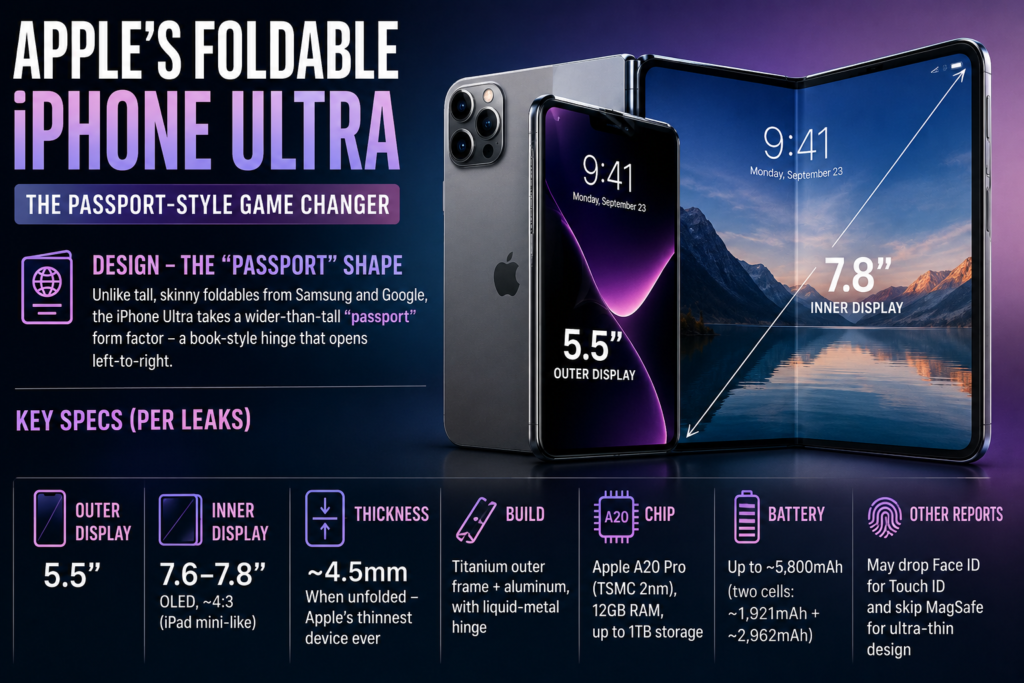
Unlike tall, skinny foldables from Samsung and Google, the iPhone Ultra takes a wider-than-tall “passport” form factor — a book-style hinge (like the Galaxy Z Fold or Pixel Fold) that opens left-to-right rather than top-to-bottom.
Key Specs (per leaks)
- Outer display: 5.5 inches
- Inner display: 7.6–7.8 inches, OLED, roughly 4:3 aspect ratio (iPad mini-like)
- Thickness: ~4.5mm when unfolded — potentially Apple’s thinnest device ever
- Build: Titanium outer frame + aluminum, using a liquid-metal hinge (inspired by Oppo’s “Zero-Feel Crease” tech)
- Chip: Apple A20 Pro on TSMC’s 2nm node, 12GB RAM, up to 1TB storage
- Battery: Up to ~5,800mAh (two cells, ~1,921mAh + ~2,962mAh combined)
- Reports suggest it may drop Face ID for Touch ID and skip MagSafe — practical trade-offs for the ultra-thin foldable design
The Headline Feature: No Crease
Apple has reportedly pursued a genuinely crease-free display “regardless of cost,” developing a new material property that makes the fold essentially invisible when open — a problem that has plagued nearly every foldable phone on the market to date, including Samsung’s.
Price and Competition
Most estimates put the starting price at $2,000 or more — the most expensive iPhone ever. It’ll go head-to-head with a rumored Samsung Galaxy Z Fold 8 Wide, which reportedly shares a similar 4:3 aspect ratio, suggesting Samsung is bracing for direct competition. Analysts see this as a potential turning point for foldables moving from a niche category toward the mainstream, given Apple’s market influence.
Chrome’s Manifest V2 Extension Cutoff
What Actually Happened on August 31
This is a bit less dramatic than headlines suggest: Google permanently deleted all remaining Manifest V2 (MV2) extension listings from the Chrome Web Store. But the real functional death happened over a year earlier — MV2 extensions stopped running in Chrome entirely back in July 2025 (Chrome 138). August 31 was really a “database cleanup,” removing dormant listings, reviews, install counts, and the ability to ever reinstall them — not a new disruption to anyone’s daily browsing.

What Changes for Users
- Any MV2 extension still installed on an old Chrome version (138 or earlier) can keep running, but can’t receive updates
- If you get a new device or reinstall Chrome, you can no longer reinstall those old extensions
- Most people affected already stopped noticing a year ago when the extensions quietly stopped functioning
Why It Matters — The Ad Blocker Angle
The most consumer-relevant fallout was the transition’s effect on ad blockers: because Manifest V3 removed the old blocking webRequest API (replaced with a more limited declarativeNetRequest system), the popular uBlock Origin was removed from the Chrome Web Store — Google now only offers the feature-limited uBlock Origin Lite, which lacks dynamic filtering and real-time logging. This has fueled a longstanding “Google is weakening ad blockers to protect ad revenue” criticism, even though Google frames MV3 as a security and privacy improvement.
Why This Took 4+ Years
Google began this transition back in 2021, closing the Chrome Web Store to new MV2 submissions in January 2022. The multi-year rollout was deliberately staged to give developers time to migrate, which is why the actual “end” already happened quietly in mid-2025, with August 31 just closing the book.
Workaround
Firefox remains the main mainstream browser still supporting MV2-style blocking extensions, so users wanting the older, more powerful ad-blocking tools have been migrating there.
Tech
Amazon expanding drone delivery to ~500 US cities
Amazon is expanding its drone delivery ambitions to nearly 500 U.S. cities, accelerating the use of AI and autonomous technology in logistics.

Why This Is a Genuinely Rare Story
This is one of the few truly bipartisan backlash issues in US politics right now. An Annenberg Public Policy Center poll found 61% of Americans oppose new data centers in their communities — including 69% of Democrats AND 54% of Republicans. Other polling backs this up: a Fox News poll found 70% oppose data centers being built in their area, and a Reuters/Ipsos poll found 59% would oppose one within 10 miles of their home.
Why People Are Angry — Three Main Threads
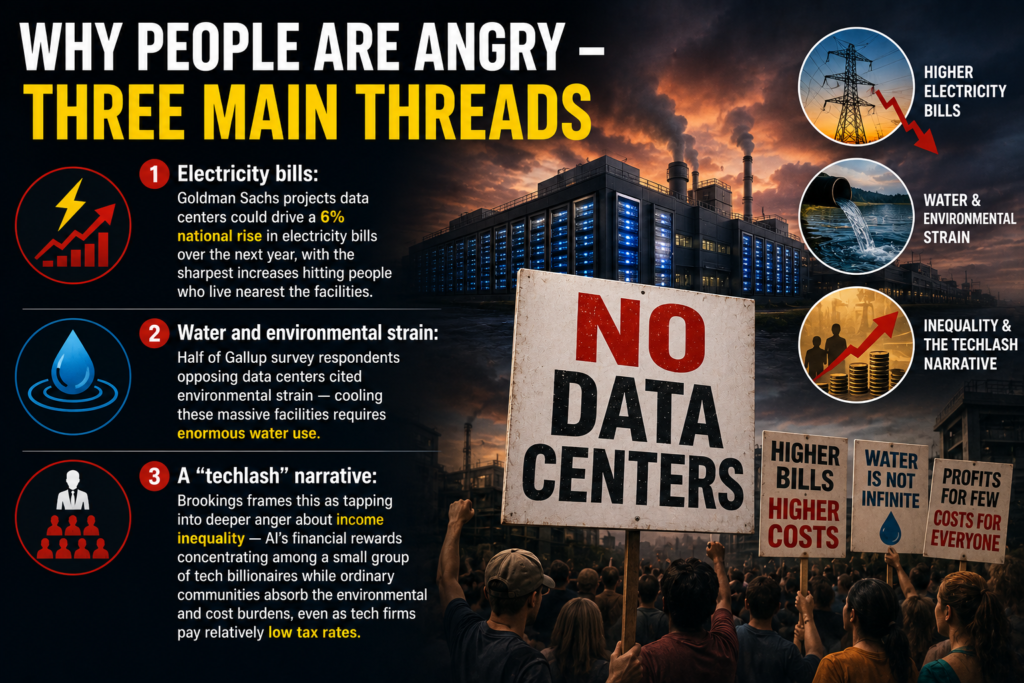
- Electricity bills: Goldman Sachs projects data centers could drive a 6% national rise in electricity bills over the next year, with the sharpest increases hitting people who live nearest the facilities.
- Water and environmental strain: Half of Gallup survey respondents opposing data centers cited environmental strain — cooling these massive facilities requires enormous water use.
- A “techlash” narrative: Brookings frames this as tapping into deeper anger about income inequality — AI’s financial rewards concentrating among a small group of tech billionaires while ordinary communities absorb the environmental and cost burdens, even as tech firms pay relatively low tax rates.
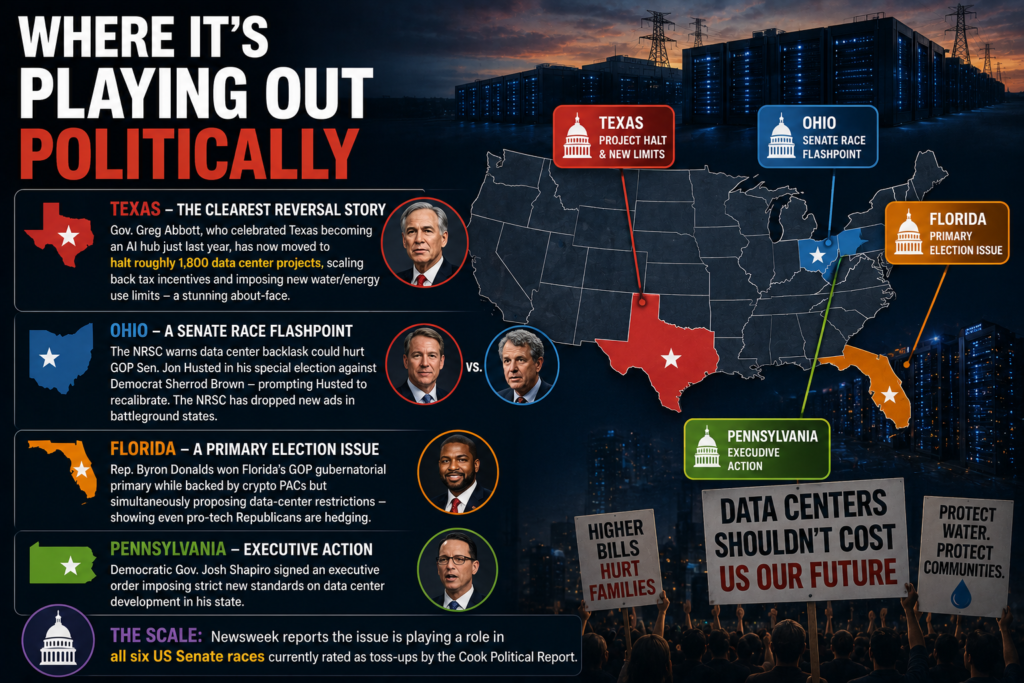
Where It’s Playing Out Politically
Texas — the clearest reversal story
Gov. Greg Abbott, who celebrated Texas becoming an AI hub just last year, has now moved to halt roughly 1,800 data center projects, scaling back tax incentives and imposing new water/energy use limits — a stunning about-face from a Republican governor running for reelection.
Ohio — a Senate race flashpoint
The National Republican Senatorial Committee has warned that data center backlash could hurt GOP Sen. Jon Husted in his special election against Democratic challenger Sherrod Brown — prompting Husted to recalibrate his messaging. The NRSC has dropped multiple new ads addressing the issue in battleground states.
Florida — a primary election issue
Rep. Byron Donalds won Florida’s Republican gubernatorial primary while backed by crypto PACs but simultaneously proposing data-center restrictions — showing how even pro-tech Republicans are hedging.
Pennsylvania — executive action
Democratic Gov. Josh Shapiro signed an executive order imposing strict new standards on data center development in his state.
The scale: Newsweek reports the issue is playing a role in all six US Senate races currently rated as toss-ups by the Cook Political Report.
The Culture-Jamming Angle
Beverage company Liquid Death released a satirical ad mocking data centers’ water usage timed to a major primary election day — a sign the backlash has moved from policy circles into pop-culture mockery.
Trump’s Response
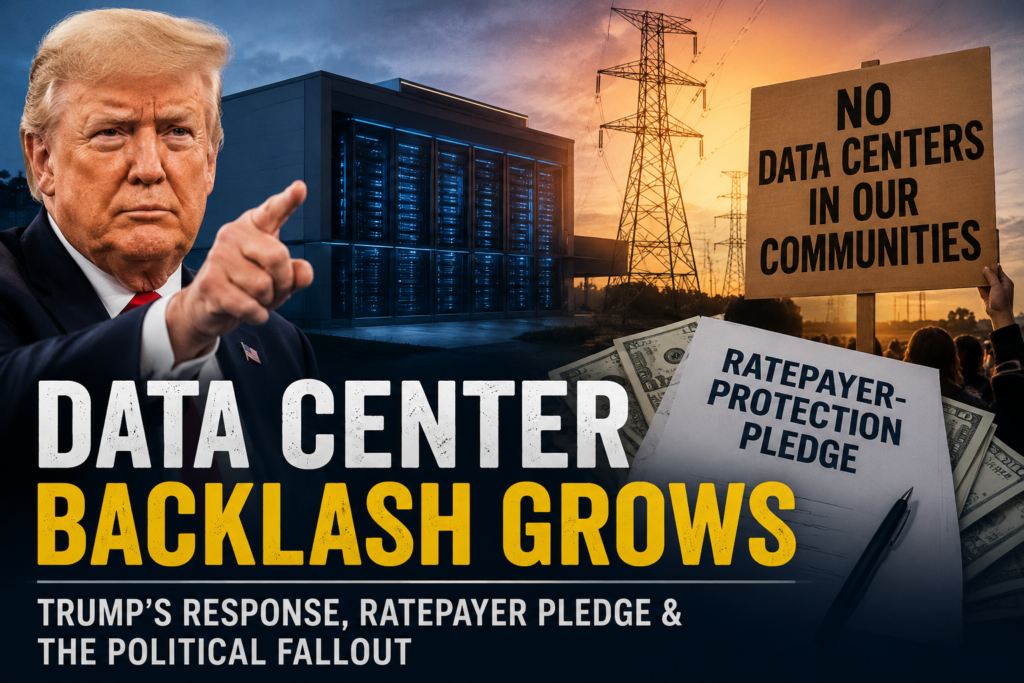
Trump has pushed back hard, posting on Truth Social that communities opposing data centers risk becoming “backwards and poor,” while insisting successful, “rich” communities should “let Data Reign.” He’s separately floated a “ratepayer-protection pledge“ requiring tech companies — not ordinary utility customers — to cover the power generation and grid upgrade costs their projects require.
The Political Fallout Angle
Axios reports this backlash caught the political establishment “flat-footed,” with Republican operatives privately frustrated that groups like the NRSC spent months fundraising from tech companies while under-resourcing candidates now facing attacks on the issue.
Historical Momentum
This didn’t come from nowhere — in 2025, Democrats flipped two Georgia Public Service Commission seats by 25+ points campaigning on rising utility costs, and Virginia Gov. Abigail Spanberger won partly on an affordability message tied to energy bills. In 2024, Warrenton, Virginia voters ousted their entire town council after it approved an Amazon data center.
Tech
Google’s $12.2 billion stake deal with Marvell
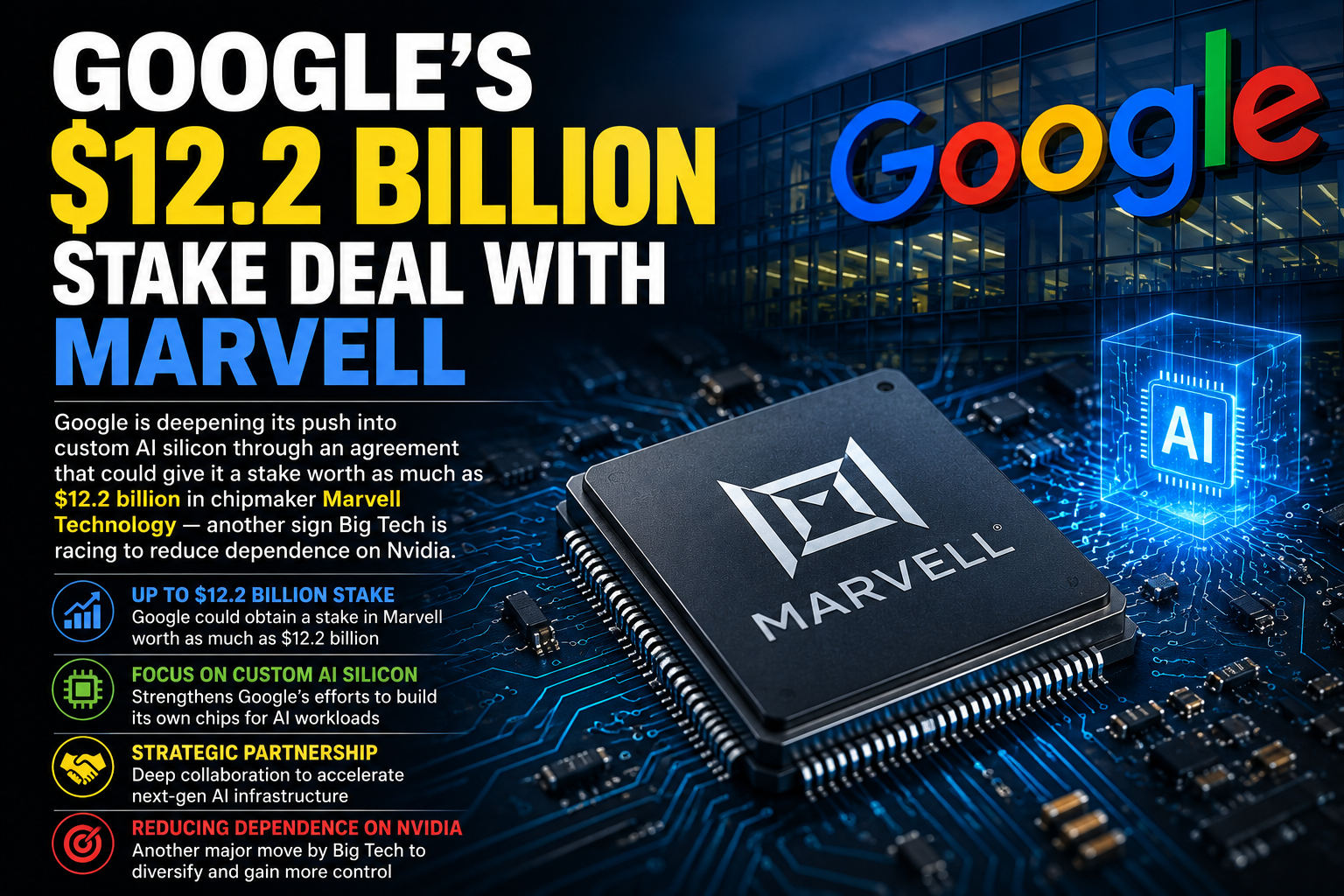
Google’s potential $12.2 billion stake in Marvell highlights Big Tech’s race to develop custom AI chips and reduce dependence on Nvidia.
The Basic Structure
On August 18–19, 2026, Marvell Technology issued Google a stock warrant — the right, not the obligation — to purchase up to 58,970,907 shares at $206.58 each, exercisable until August 18, 2033. If fully exercised, that stake would be worth roughly $12.2 billion and would make Google Marvell’s fifth-largest investor.
Importantly, this isn’t Google writing a check today — it’s an earned stake. Only about 1.4 million shares vest in the first year automatically; the rest unlock in 240 equal tranches, one tranche for every $500 million Google spends on Marvell’s custom chips, running from Marvell’s Q3 fiscal 2027 through fiscal 2033. In effect: Google’s ownership grows only as its actual chip purchases grow.
What the Deal Actually Covers
The underlying commercial agreement (signed July 29) covers chips built around Google’s Tensor Processing Unit (TPU) ecosystem — including AI inference accelerators, storage controllers, network interface controllers, memory interface controllers, and near-memory compute.
The Money at Stake
If Google hits every purchasing target, Marvell could collect roughly $120 billion in revenue from Google through fiscal 2033 — a massive validation of Marvell’s custom-chip (“XPU”) business.
Market Reaction
- Marvell shares jumped 8–14% (reports vary by exact timing) on the news
- Broadcom — Marvell’s larger rival and Google’s existing primary custom-chip partner — fell more than 5%, since this opens a second major supplier relationship for Google’s custom silicon
- Alphabet’s own stock was largely unmoved
Why This Matters: The Bigger Pattern
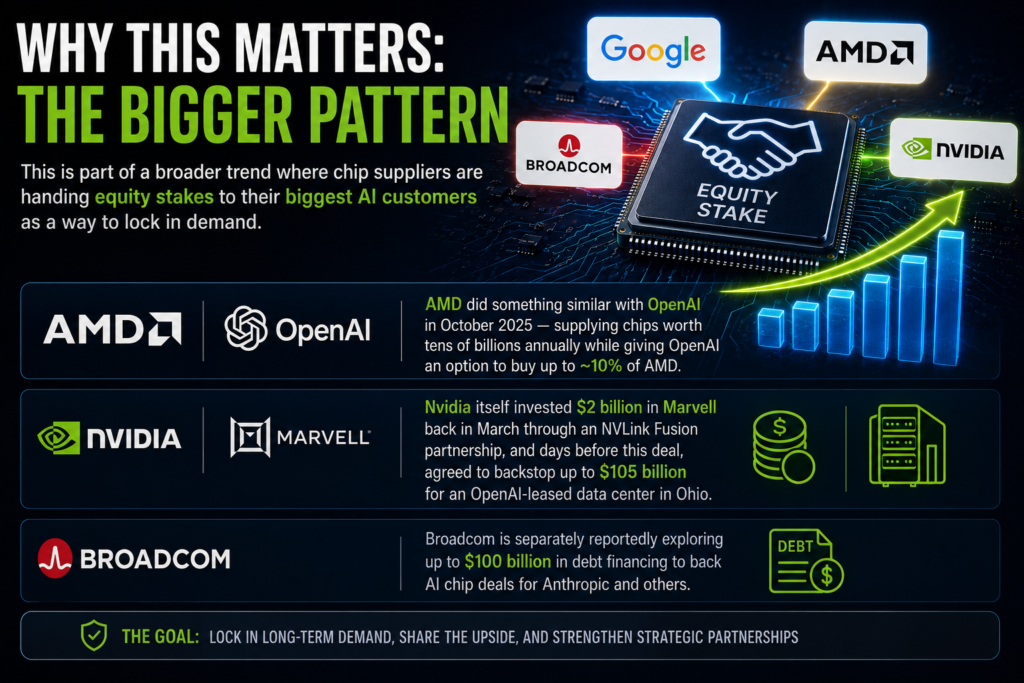
This is part of a broader trend where chip suppliers are handing equity stakes to their biggest AI customers as a way to lock in demand:
- AMD did something similar with OpenAI in October 2025 — supplying chips worth tens of billions annually while giving OpenAI an option to buy up to ~10% of AMD.
- Nvidia itself invested $2 billion in Marvell back in March through an NVLink Fusion partnership, and days before this deal, agreed to backstop up to $105 billion for an OpenAI-leased data center in Ohio.
- Broadcom is separately reportedly exploring up to $100 billion in debt financing to back AI chip deals for Anthropic and others.
Analysts frame this as companies hedging against AI chip supply constraints while also profiting from the very demand boom they’re helping create — turning customer relationships into ownership stakes.
The Skeptical Angle — Worth Including in Your Segment
Not everyone loves this trend:
- Investor Jeff Gundlach has warned that turning AI chips into a financial asset class “looks like a market top” — a bubble-warning worth a soundbite.
- Analysts are increasingly flagging “circular” arrangements in the AI chip market: Nvidia invests in a company, that company sells chips back to Nvidia’s biggest customers, who then buy more Nvidia chips — creating a web of interlocking, self-reinforcing deals that some worry inflate the appearance of demand.
- Morningstar’s William Kerwin offered a more measured take, calling it “a growing pie” for Google’s chip sourcing rather than Marvell displacing Broadcom outright.
Why It Matters for Google Specifically
This is Google diversifying its custom-silicon supply chain (Broadcom + now Marvell) as demand for TPUs surges — companies increasingly want cheaper alternatives to Nvidia’s GPUs, especially for inference (running trained models) rather than training. This connects directly to your earlier segment on OpenAI’s Jalapeño chip — both stories are about Big Tech racing to reduce Nvidia dependence through custom silicon.


Apple’s foldable “iPhone Ultra” and Chrome’s Manifest V2 extension cutoff

Amazon expanding drone delivery to ~500 US cities

Google’s $12.2 billion stake deal with Marvell

Generation Z Is Killing Fast Fashion in India — And Building Something Far More Beautiful in Its Place

AR Rahman reacts to “anti-national” row over Imtiaz Ali’s Main Vaapas Aaunga

