
Infastructure
Nigeria’s Recurring National Grid Collapses
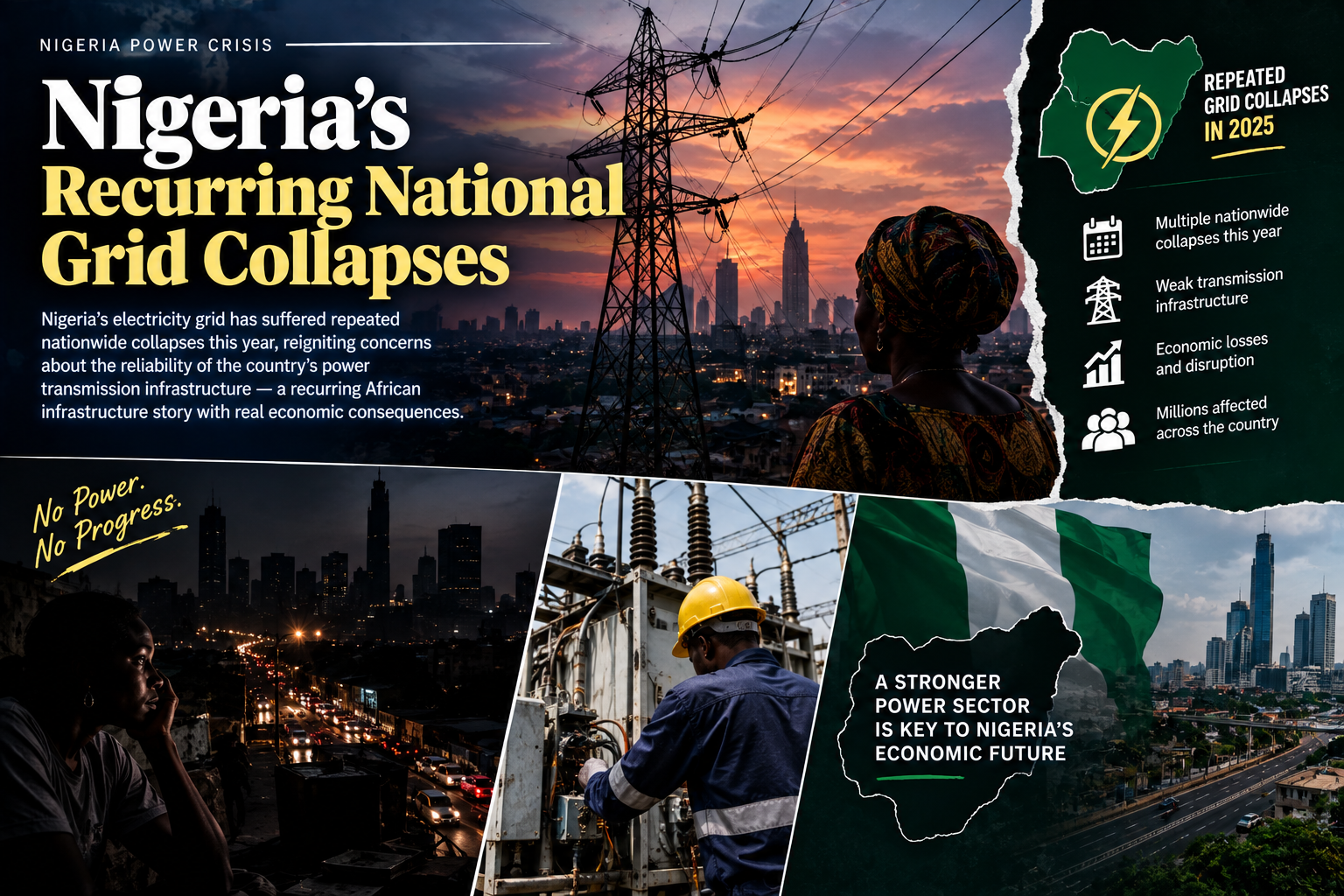
Nigeria’s repeated national grid collapses are raising fresh concerns about the reliability of the country’s electricity infrastructure and the economic cost of persistent power disruptions.

How Bad the Pattern Has Been
The scale of the problem is genuinely striking: the Transmission Company of Nigeria (TCN) recorded at least 16 major system failures between 2024 and 2025 alone. The January 2026 period was especially rough — the grid collapsed on December 29, 2025, again on January 23, 2026, and again just four days later on January 27, meaning Nigeria suffered two collapses within a single week and three within under a month. For context on the trend line: the grid collapsed almost monthly throughout 2024, improved somewhat in 2025 with only two major collapses recorded — making the early-2026 cluster a troubling reversal rather than a one-off.
What Actually Happens During a Collapse
These aren’t partial outages — they’re total system shutdowns. During the January 23 collapse, real-time generation data showed power output falling to 0.00 megawatts nationwide, with every major power plant on the grid — Afam, Alaoji, Egbin, Geregu, Jebba, Kainji, Odukpani, and Okpai — simultaneously showing zero output. Total power allocated to the country’s electricity distribution companies (DisCos) dropped to just 65MW, far below national demand, plunging large parts of the country into darkness in the middle of the day.
Why It Keeps Happening — The Technical Explanation
A grid collapse in Nigeria isn’t usually one single cause — it’s typically a cascading combination of:
- Generation loss (a large power plant suddenly trips offline)
- Transmission faults (a major line fault isolates part of the network)
- Frequency instability/deviation (the system can’t stay synchronized)
- Gas supply constraints (many plants depend on gas that isn’t reliably delivered)
- Inadequate spinning reserve (not enough backup capacity to absorb shocks)
- Protection system miscoordination (automated safety systems that are supposed to isolate problems instead worsening them)
One specific documented cause: a January 2026 incident was traced to a voltage disturbance originating from the Gombe Transmission Substation by the Nigerian Independent System Operator (NISO).
Who’s to Blame — A Contested Question
The federal government has specifically pointed to electricity distribution companies (DisCos) being unable to take the power that’s generated, effectively creating a bottleneck. But independent industry experts push back on that framing, pointing instead to poor coordination of automated protection systems and insufficient capital investment in the transmission network as the real underlying culprits — meaning there’s a genuine dispute between government officials and outside experts about where responsibility actually lies.

The Political Dimension
Nigeria’s Minister of Power, Adebayo Adelabu, has repeatedly promised 2026 would bring “reliable, accessible and sustainable electricity” — but critics, including Nigerian commentary outlets, argue no tangible improvement has materialized, with some suggesting Adelabu is more focused on his reported 2027 governorship ambitions in Oyo State than on fixing the power sector. In one especially embarrassing moment, a January grid collapse happened at almost the exact same time senior government officials were in Lagos signing a N501 billion bond deal specifically meant to settle legacy debt owed to power generation companies (Gencos) — undercutting the government’s own messaging in real time.
The Real Economic Cost
This isn’t just an inconvenience story — it has measurable economic consequences:
- The Lagos Chamber of Commerce and Industry (LCCI) has warned Nigeria could see “tens of grid collapses” in 2026 under a business-as-usual scenario without urgent structural reform.
- Repeated failures have reportedly contributed to companies exiting the country entirely, unable to operate reliably.
- A newer, notable angle: Nigeria’s growing population of remote workers and digital freelancers — increasingly important to the economy — are directly hit by unannounced outages, leading to missed deadlines, lost foreign-exchange earnings, and serious bottlenecks for anyone trying to participate in the global digital job market from Africa’s largest economy.
A Sign of Possible Progress — State-Level Reform
There’s a genuinely more hopeful thread buried in this story: President Tinubu signed the Electricity Act in June 2023, which — for the first time since the colonial-era Lighting Electricity Act — gave individual Nigerian states legal authority to generate, transmit, and distribute their own electricity rather than relying solely on the national grid. UNDP Nigeria noted that energy sector revenues nearly doubled in 2025, partly crediting these state-level reforms — a sharp contrast to the national grid’s continued struggles, and a possible sign that decentralization (smaller, localized regional grids) could be part of the long-term fix experts are increasingly calling for.







Infastructure
India’s Port and Logistics ExpansionWestern Carriers has secured a 15-year contract
Western Carriers’ 15-year Kolkata cargo-terminal contract highlights India’s broader expansion of port and logistics infrastructure.

The deal: Western Carriers (India) Limited (WCIL) has secured a 15-year development-and-operation contract for a General Cargo Terminal (GCT) at the GCD Yard of the Kolkata Dock System, awarded by the Syama Prasad Mookerjee Port Authority (SMPA).
It’s already live: This isn’t just a signed contract — the terminal was formally inaugurated on September 11, 2026, so it’s operational now, not a future project.
Why it matters strategically: This is WCIL’s first operational base on India’s east coast, marking its debut into port infrastructure and a shift beyond its traditional asset-light 4PL (fourth-party logistics) model. It complements the company’s existing 42-acre Multimodal Cargo Terminal at Devaliya, Gujarat — giving it a presence on both coasts along the East–West freight corridor.

Scale and connectivity: Initial civil infrastructure investment is modest at roughly ₹13.68 crore. The terminal handles dry bulk, break-bulk, and all container categories (20-ft, 40-ft, specialized), and connects to the Eastern Railway network via the Sealdah and Budge Budge sections, plus Kolkata’s road and inland-waterway links. Phase I equipment and manpower deployment is complete; Phase II (throughput and efficiency upgrades) is expected within 90 days of launch.
Company context: WCIL’s Q1 FY27 numbers show the broader momentum — consolidated operating revenue of ₹465 crore (up 11.8% YoY) and container volumes up nearly 15% YoY to 58,261 TEUs.
Infastructure
China’s Shipbuilding and Port Infrastructure Boom
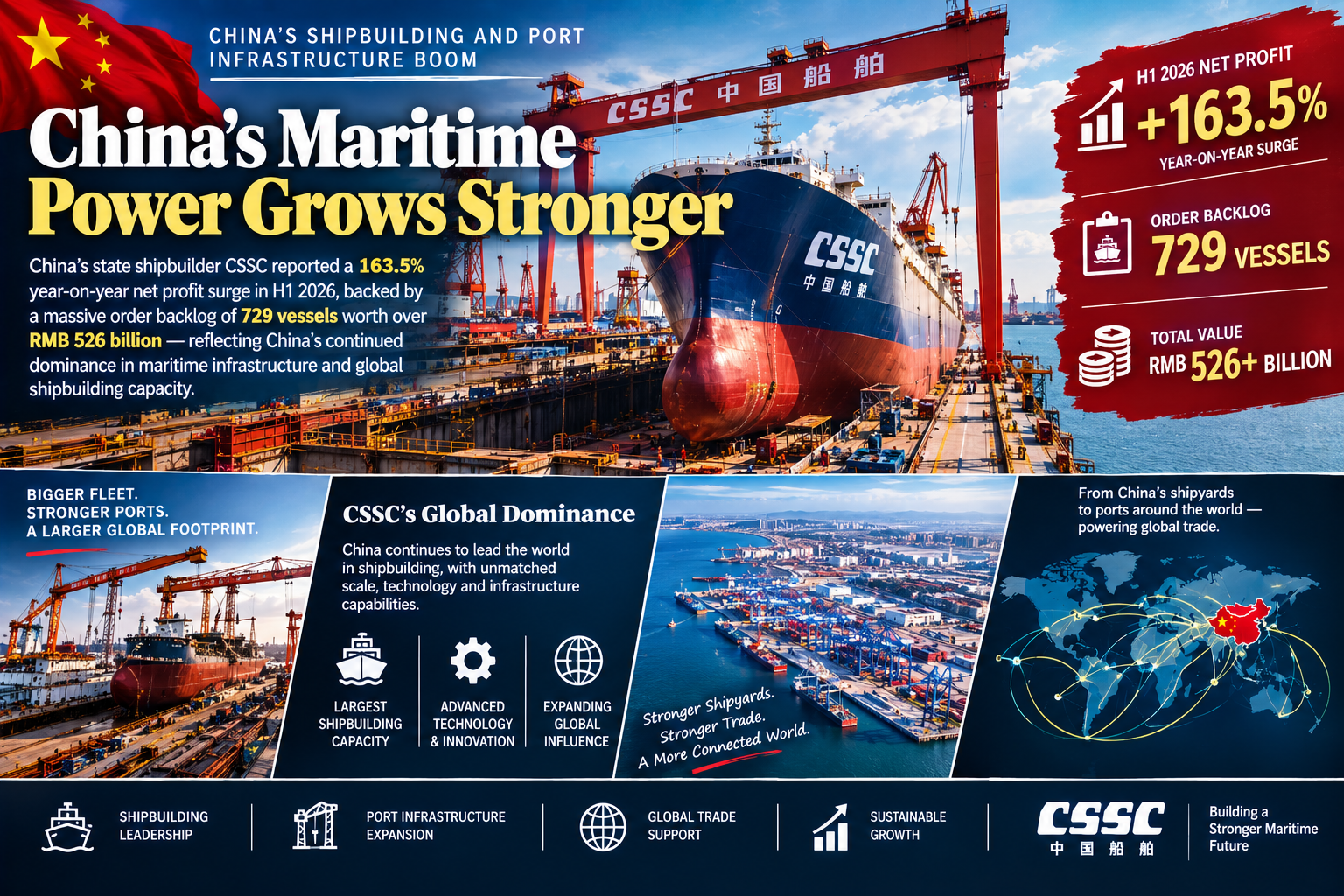
: CSSC’s 163.5% profit surge and 729-vessel backlog underscore the scale of China’s shipbuilding industry and its growing maritime infrastructure footprint.
The numbers
For the six months ending June 30, 2026, CSSC posted operating revenue of RMB91.53 billion (about $13.28 billion), up 26% year-on-year, with net profit soaring 163.5% to RMB9.95 billion — a genuine profitability breakthrough rather than just a revenue bump.
What drove it
The company attributes the jump mainly to increased deliveries of high-end civil vessels, a higher proportion of premium ship types, and rising average vessel prices. On deliveries specifically, CSSC completed 102 vessels in H1 2026, covering 9.56 million dwt — 60.71% of its full-year target and a 27.5% year-on-year increase. It also picked up meaningful repair revenue: 397 ship repair projects generating RMB 3.069 billion.

The order backlog
Your figure is accurate too. As of end-June 2026, CSSC had 729 undelivered civil and offshore vessels on hand, totaling 93.89 million dwt and RMB 526.27 billion in contractual value. New orders in H1 alone were strong: 177 civil and offshore vessels worth RMB119.39 billion, with ordered deadweight tonnage up 128.82% year-on-year and order value up 93.06%.
By vessel type, the backlog skews toward oil tankers (30% of order volume by ship count), container ships (20%), bulk carriers (15%), and LNG/gas carriers (10%).
Context: this sits on top of a September 2025 mega-merger — CSSC absorbed China Shipbuilding Industry Corporation (CSIC) — which is why 2026 numbers look so outsized versus 2025; a lot of the growth reflects consolidation, not just organic demand. Worth flagging if this goes into a blog post, so the “163.5%” doesn’t read as pure market-driven growth without that caveat.
Infastructure
Spain’s Industrial Reinvention — Chemical Plant to $1.1 Billion Data Center
A former chemical plant in Spain is being reinvented as a $1.1 billion AI data center, showcasing industrial land reuse and water-free liquid cooling.

The Announcement
Submer Group — a Barcelona-headquartered, full-stack AI infrastructure company — announced on Saturday, July 11, 2026 that it will invest more than €1 billion (approximately $1.14 billion) to build a next-generation, sustainable AI data center on the site of the former Ercros chemical plant in Flix, a town in the Ribera d’Ebre county of Tarragona province, Catalonia. The reveal happened at a high-profile event attended by Salvador Illa, President of the Government of Catalonia, and Miquel Sàmper, Catalonia’s Minister of Business and Labor.
The Site’s Backstory
The location carries real symbolic weight. The Ercros chemical factory — once a defining symbol of the region’s industrial identity — ceased operations in January 2023, following a long industrial decline in the Ribera d’Ebre region. Since closure, Ercros has run only a solar farm on the site. Notably, the plant itself was acquired earlier this year by the Portuguese group Bondalti, adding another layer to its ownership history right before this transformation.
Technical Scope
- The facility will occupy roughly 13,000 square meters
- It will have an installed electrical capacity of 85 to 90 megawatts
- Construction is planned in two phases
- It will use advanced liquid cooling technology that requires zero water during operations — a meaningful sustainability detail, since traditional data center cooling is often a heavy water consumer, a growing point of local controversy around AI infrastructure projects worldwide
- Renders show a layout of four data halls arranged around a central building
- The project is targeted to be operational by the end of 2027
The Companies Behind It
- Submer Group, the parent company, was originally focused purely on immersion cooling technology for data centers, and has been actively diversifying — it launched an AI cloud platform called InferX last year, and created Rubix Data Centers in June 2026 specifically as its new AI data center development-and-operation arm.
- Rubix will both build and operate the facility using a “develop-and-operate” model — meaning rather than building and walking away, it will run the site long-term for a third-party tenant under agreed service levels. Rubix claims access to roughly 8GW of power across vacant sites spanning the Americas, EMEA, and APAC regions, suggesting Flix is one piece of a much larger global expansion strategy.
The Human and Economic Impact
- Once fully operational, the project is expected to generate 150 highly skilled permanent jobs, spanning operations and maintenance, critical facilities engineering, facilities management, security, site services, and operator support.
- This is explicitly framed as economic renewal for a region that’s faced real industrial decline — Ribera d’Ebre losing a major chemical employer in 2023 and gaining a much larger AI infrastructure investment in its place is a genuinely compelling “old industry to new industry” transition story.
Quotes Worth Using
- Submer CEO Patrick Smets tied the choice of location directly to symbolism: “The Flix site has notable industrial heritage, and it is where our vision for AI infrastructure can start to take shape… As demand accelerates, we will expand across the full stack, from land and power to cloud and edge, and we are building where it creates the most lasting value.”
- Rubix CEO John Eland emphasized long-term commitment, pushing back against any “build and leave” narrative: “It’s not simply about developing the project and leaving. Our commitment to Flix is long-term… [we are] not simply passing through Flix.”

The Policy Framework Behind It
This isn’t a one-off private deal — it’s explicitly part of Catalonia’s Reindustrialization Framework/, a set of formal government “round tables” and task forces specifically designed to help former industrial sites transition into new productive uses, with direct support from the Government of Catalonia’s Department of Business and Labor. This makes it a useful case study for how European regions are proactively trying to convert legacy industrial land into AI-era infrastructure rather than leaving it derelict.
One Caveat Worth Flagging
Industry coverage notes that site preparation on a former chemical works inherently brings remediation and ground-condition risk that hasn’t yet been publicly quantified — a reasonable due-diligence question for a project moving fast on a former industrial/chemical site.
Why This Story Works for Your Channel
This has a clean, visual “before and after” narrative (chemical plant → cutting-edge AI campus), ties directly into the massive global AI infrastructure investment story (the $31.6 trillion PwC forecast from your earlier list), and offers a genuinely different angle than the US-centric AI infrastructure stories — showing how Europe, and specifically Spain, is positioning itself in the global AI infrastructure race.


Spain’s train crash and upcoming election. Spain is dealing with its second deadly train crash this year.

Hong Kong’s Tai Po fire fallout. Leader John Lee apologized

Serbia’s media shake-up. The head of public broadcaster RTS resigned after the student list won an election.

Generation Z Is Killing Fast Fashion in India — And Building Something Far More Beautiful in Its Place

AR Rahman reacts to “anti-national” row over Imtiaz Ali’s Main Vaapas Aaunga

According to Dior Couture, this taboo fashion accessory is back

-

 Entertainment14 hours ago
2026 is a big year at the box office
-

 Entertainment14 hours ago
Ramayana Part 1 arrives this week.
-

 Entertainment14 hours ago
Rajinikanth’s Jailer 2 enters the top 20.
-

 Entertainment14 hours ago
Bigg Boss 20 drama. Manoj Tiwari defended his daughter
-

 Entertainment14 hours ago
Other Diwali releases. Nayanthara’s Mookuthi Amman .